 I grabbed this at the Whole Foods Co-op in Duluth to go with my slice of bacon and dried tomato pizza. That's real Wisconsin honey! Not that Wisconsin honey is any different than any other honey, but they make a point of it. And you better like honey if you get this pop. It was the dominant flavor with my first sip. I looked in the bottom of the bottle and could see something syrupy swimming around there. I assume that was more honey, so I gave it a gentle whirl to mix it up. Not too fizzy, so no problems there. The honey definitely subdued the tartness of the cherries, which is fine I guess. But there wasn't much room left for the vanilla. A little less honey and a little more creaminess would have made this a better soda. But pretty decent, if you like honey.

Thursday, May 28, 2015
Honey Cherry Vanilla
I grabbed this at the Whole Foods Co-op in Duluth to go with my slice of bacon and dried tomato pizza. That's real Wisconsin honey! Not that Wisconsin honey is any different than any other honey, but they make a point of it. And you better like honey if you get this pop. It was the dominant flavor with my first sip. I looked in the bottom of the bottle and could see something syrupy swimming around there. I assume that was more honey, so I gave it a gentle whirl to mix it up. Not too fizzy, so no problems there. The honey definitely subdued the tartness of the cherries, which is fine I guess. But there wasn't much room left for the vanilla. A little less honey and a little more creaminess would have made this a better soda. But pretty decent, if you like honey.


Thursday, May 21, 2015
Out of the philosophical trilemma
I stumbled across this little gem the other day. It expresses a misconception, that rational thought is not
rational. This is common across every level of Christianity and other
religions that I know, from the most fundamentalist to pagans and
nature worshipers. I’ve seen it expressed by the highly educated,
like the editor of the religion page for Washington Post. C.S. Lewis
had a popular version in his time. This particular web page has a
fundamentalist bent, but the graphic is laid out nicely and gives me
something to build from.
This trilemma, 3 choices that all fail
on some level, has been around since the Greek Skeptics. There is no
ultimate solution, but a path can be built out of it. That
path discussed here is the same, regardless of what belief system you
start with.
The idea was first proposed by Agrippa
in the 1st century. Although famous, religion continued to
be tied into daily life with its clear rules and rituals, no
dilemmas. Then Descartes sat down and tried to think his way out of
the problem of not knowing where thoughts come from. Like the option
on the far left of the chart, he theorized that maybe we don’t
exist as we think we do, but our thoughts are being controlled by an
evil demon. For Descartes, this was just a thought experiment. For
some that is a real possibility, but it’s one I won’t pursue
here.
Descartes determined that even if he
was under such control, he still had the awareness that he was
separate from that demon. That he existed. But Descartes still
couldn’t solve the basic questions of knowing what is true or what
is right. He decided that since he could conceive of perfection then
perfection must exist, and that must be the God of the Bible. This
was a bare assertion and dumps him back into the trilemma, and we’ll
leave him there.
On the other side of the chart, we have
the answer of divine revelation. Although different terms may be
used, this is still widely used as a solution to the problem of a
basis for knowledge. It is regularly invoked by elected officials at
the highest levels of public office in modern democratic countries.
In the WaPo editorial I mentioned, the woman explained how she grew up religious, then became an atheist, then thought about the difference and thinks either is a faith decision. She says she read a bunch of books with good reasons for religion, but doesn't share much of those reasons..
I admit it's a problem. We weren’t there in the beginning, so we don't know how we got here.
We came into consciousness in a world
that was already over 4 billion years old. If you count the earliest
proto-humans as having some kind of awareness, it took a few million
years for us to figure out where we are in the universe. We’re
still working on what that means. I don’t have an answer to that,
but I have some thoughts on how to get there.
Digging into the trilemma, if you
haven’t already, we are faced with three choices, circular
reasoning, infinite regress, or making some bare assertions. The last
one is expressed in a variety of ways i.e; axiomatic, self-evident
argument, bedrock assumptions and others.
Circular reasoning is the
easiest to spot, and to dismiss. The article that gave me the graphic
does a horrible characterization of atheism, saying it assumes god
doesn’t exist in its effort to prove god doesn’t exist. This
wouldn’t be so bad if so many didn’t make the circular claim for
god. There is even a verse for it, “All
Scripture is God-breathed and
is useful for teaching, for reproof, for correction, and for training
in righteousness .” That's in
the Bible, proving the Bible is the word of God. This usually gets
confused during a discussion with some version of the Aristotelian
solution to infinite regress.
Infinite regress is also easy to
understand if you’ve ever played the “why” game with a 5 year
old. They keep asking “why” until you run out of answers.
Aristotle solved the problem by saying there must be some uncaused
cause at the beginning. Descartes did something similar. A more
sophisticated form is Anselm’s Ontological Argument. Spinoza also
requires some sort of prime mover, although his is more of a
pantheistic creation. Contemporary “spiritual but not religious”
have some concept of how consciousness existed before the physical
universe. All of these lend credence and intellectual rigor to the
possibility of a real supernatural being of some kind. They all fail,
but I'll leave those long arguments for another time.
Formal logic can deconstruct and find
the flaws with these arguments. But those discussions are not
satisfying for the average person on the street. Finding flaws with
an argument does not mean the conclusion is wrong either. Worse, we
still don’t know where our thoughts come from exactly, how we
developed morals, when life began, or where the universe came from.
The Big Bang seemed like a solution for a few decades, but we don’t
even have the language to describe what that was. How do you say when
time began? Beginnings imply time. They imply something existing to
create creation. We have a mathematical language for it, but very few
understand it and even those who do, don’t agree. We still have
questions.
Bare assertions may be the
easiest to identify. There is no reason given for them, circular or
otherwise. They only have value when they are such a bedrock of an
assumption that no one argues. Of course there are always a few out
there who will argue anything. Some examples:
- All complex things come from simpler things.
- With regards to morality, pain hurts, I assume you experience it the same as me.
- Consistent rules of nature that we figure out today were the same in the past and will be the same in the future.
Problems with the given solution
Our friend in the article suggests the
trilemma is false, that by leaving out the possibility of God, it
presents an unsolvable problem that actually has a solution. But his
solution falls back into the trilemma. “Personally verifiable” is
a bare assertion. Something that is true for you may not be true for
someone else. I can only verify things that we can share and
demonstrate. Your thoughts and feelings are true, but I have no way
to know if you are lying about them or not. Or maybe you are not
lying in the sense that you are misrepresenting your thoughts, maybe
you are convinced of your own truth, but if I don't know how you
arrived at it, I don't know if it is true or not.
“Whoever seeks Him finds Him” is
circular. This is shown when people don’t “find Him”. They are
told to go back to the scripture, and to repeat the rituals, because
if they didn’t “find Him” then they must have done the seeking
wrong. I actually have more respect for someone who states that they
are in the “Assume God therefore God” box. They are being honest
with their thoughts and reasoning and letting me know where they
stand rather than attempting to apply logic and failing and then not
accepting their failure.
There are also worse ways to do this.
Attempting to apply Quantum Physics to escape our cause and affect
universe for example. These states of matter that we have recently
discovered, where the same particle exists in two places at the same
time or things just appear and disappear, can only be maintained for
fractions of seconds. They have only led to new theories, not to new
principles that we can apply. We can’t apply these new data to
psychology or spirituality. If you do, it is pure speculation. Not
that there’s anything wrong with speculation.
Speculation is also something I respect. As long as you say you are speculating. It is the beginning
of science. If we didn't look up with awe and wonder, we wouldn't
have started asking questions in the first place. Sometimes science
does not give us satisfactory answers and we can look to our dreams,
our stories filled with allegory. Mythology opens our minds and leads us
to new thoughts. Just call it what it is.
Building our way out of the trilemma
If you read the linked article, you'll see his chart copied below, showing four foundations of irrational thought and his one claimed rational process. My chart builds it's way out of two of those foundations and shows where the others fail.
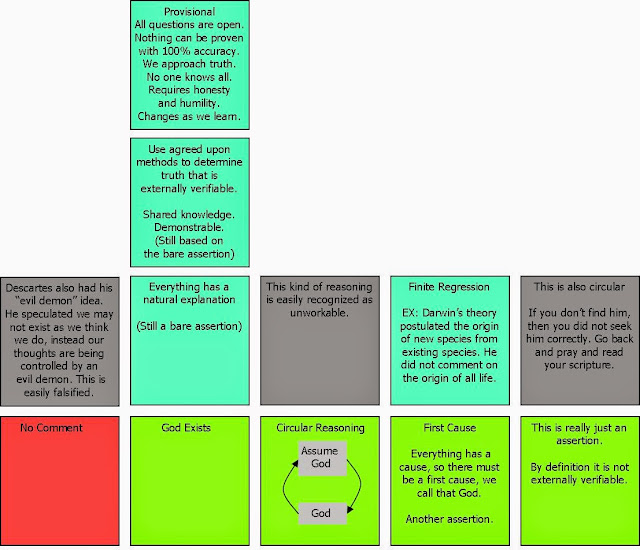
If you read the linked article, you'll see his chart copied below, showing four foundations of irrational thought and his one claimed rational process. My chart builds it's way out of two of those foundations and shows where the others fail.


There’s one box in this chart that
shouldn’t be a box. It's called “infinite” so it's
representation in the chart should go on infinitely. We can't do
that, but even if we could make a box that contained all human
knowledge it would still go on for, well, quite a few pages. We may
not be able to ever answer every question “why”, but we can
answer a lot of them. We've done that by choosing a starting point
and building on it.
Darwin did this when he theorized about
where species come from. His theory was incomplete, and he freely
admitted it. He had evidence for differentiation within a few
specific species and speculated on how that could explain where all
of life came from. DNA was not discovered until after he was dead.
How life came from non-life is still an open question. But having an
open question does not destroy Darwin's answers.
This is the box where most people live.
The box where there are no philosophical problems. There are answers
that allow us to have lives, get to work, raise our children, see a
movie now and then, enjoy a decent cup of coffee and hopefully enjoy
old age. If you go to church, you may not be sure what the sermon is
about every week, but it's close enough and the community offers you
something, so no need to question it. There's nothing terribly wrong
with living in this box. We accomplished quite a bit without knowing
that we are a lonely planet on the edge of one of many galaxies. It's
only a problem when people start defending the boundaries of their
box and hurting others in the process.
Naturalism
But even a finite regression needs
something to base itself on. This is where we finally get to the base
assertion that religion has such a problem with; There is no
supernatural. It's not proven. It's an assertion. When teachers in
Catholic universities in the 13th century started
considering it, they shut the schools down. They did re-open them,
but with the agreement that the Church would decide about the
supernatural. If they said it was a miracle, the philosophers were
not to question that.
Methodological
Some say this was suppression of
science. Others say this was a clear boundary that allowed science to
begin to define itself outside the walls of religion. There's no
doubt that science began to take off after that and has not slowed
down. The rules and guidelines are continually questioned and
refined. There is no one place to go for a list of those rules. Like
scientific knowledge itself, each generation builds upon the work of
the previous. There are no authorities. The authority is the
accumulation of evidence and logical reasoning that interprets that
evidence. New evidence is accepted and new interpretations are made
all the time.
Provisory
The difference between religion's base
assertion that the supernatural exists and science's base assertion
that only the natural exist, is that science, by its own rule, allows
its base assertion to be questioned. The difference is, you can
question it without pulling the rug out from under it. So far,
questioning scientific facts has only led to new facts. We look back
in time when we look in a telescope and we don't see anything but the
natural physical universe. If we ever see evidence of something else,
we'll have to accept it, but provisionally, we'll stick with the
original premise.
Tuesday, May 19, 2015
Joia soda

Tuesday, May 12, 2015
NT Wright, another disappointmnet
I was recently given a recommendation
to look into N.T. (Tom) Wright in this exchange on a Patheo's
blogger's comment section. Rebecca Florence Miller is currently my
favorite Christian blogger, and she's very responsive to her readers,
so I wanted to take it seriously.

Rebecca,
you make a comment in passing, "neo-Platonic treatment of the
physical as “lower” and the spiritual as “higher” ".
I've heard this in many forms, but still can't see this as something
neo-Platonism introduced into Christianity. It sure looks like it
was there all along. Any references you could recommend? I know
there are non-Platonic passages in the Bible, but that doesn't mean
dualism came from Greece and Christianity is strictly about earthly
renewal. I need more cultural context to make that case.

Honestly,
I would recommend reading N.T. Wright's Surprised by Hope. It deals
with the argument for this far better than I could.
For
me personally, I think the incarnation is one of the best arguments
for the earthy kingdom of God. God comes DOWN to us in physical,
corporeal form rather than asking to rise UP to God in spirit form.
The physical is hallowed because God created it. When God created
it, it was called "good" and that is still true, though
it is broken by sin. In the resurrection, we see Jesus being the
"firstfruits" of the resurrection work God plans to bring
about for all of creation. In the final book of the Bible, we see
the new heavens and new earth coming DOWN to earth. Again the
physical creation is hallowed.
It's
easy to draw out a proof text and try to make it say that the
physical is bad in and of itself. But that ignores the larger
narrative of Scripture and especially the centrality of the
incarnation.
The exchange continues for a bit, and I interacted with another commenter, but it wasn't productive. It's not
the first I've heard of this "Plato screwed up Christianity"
thing either. Tony Jones gave me a longer but similar response in his"Questions that Haunt" series. You can see that in the preview of the published version in book form on amazon.
I've heard of N.T. Wright. He is
referenced often by progressive Christians. But I don't feel like
reading another book that I'm almost certain will disappoint me. So,
I went to Google University to find out what I could. I found out he supports the defense of marriage, which is the nice way of saying he is against homosexual marriage. Somehow it interferes with the
marriage of Christ and the Church or something. Really don't care.
Strike one.
I found an hour long interview that touches on his latest book. It also includes a classic straw man argument against atheism, saying atheists view the physical world as inanimate and something to be exploited. Strike two. It ends with an
open question. He is asked what he would like to highlight, what
question wasn't asked in the interview that he would like to bring
up. He says, Jesus. It's all about Jesus. We just need to keep
learning about Jesus. We'll never completely understand him, but he's
been important for 2,000 years, therefore he is important, Jesus.
Okay, well, strike three.
Read on if you can. He has been called
the successor to C.S. Lewis. I don't see how he has improved on that, and C.S. Lewis has been soundly refuted. If this is as good as it
gets, progressive Christianity is in big trouble.
The interview begins with an
introduction to Wright's book about "The Good News" which
seems to be about acknowledging that Jesus is doing something and
will continue. Exactly what that is, is not made clear. He discusses
how Octavian proclaimed he had brought peace to the world, but of
course he had done it through killing off his enemies. The wars in
the Old Testament or people burning in Revelations is not brought at
any point in this interview.
Wright denigrates how Christianity has
devolved into the idea of scripture just being "good advice".
Whether that be instructions on how to get to heaven or more
practical knowledge about what you should do or believe at any given
moment. To him, the Bible also gets you to consider what changes to
the world happened when Jesus arrived, the coming of the Kingdom.
Ideas that came up much later, like Purgatory are really not relevant
to him. He calls these ideas a "corrupted" version of what
the Bible teaches. Typical progressive stuff, begin by putting down
old time religion without mentioning any names.
They discuss how Paul himself noted
that the gospels are "foolishness" to some. That would have
been even easier to see at the time when you consider how crucifixion
was viewed. To say that was the messiah would seem ludicrous. The
expectation of God stepping in solving all the problems of the Jews
was not realized.
Even today, the resurrection is
dismissed and people want to listen only to the ethical teachings of
Jesus. Wright notes that Jesus speaks to the wicked things that come
out of our hearts. The cure that he offers is his own sacrifice, not
a psychology or method that can overcome that wickedness. He admits
this is "cryptic", but states that it is clear that what
Jesus is bringing is the Kingdom. It is also clear that we need the
resurrection to be victorious over the "dark forces". All
the teachings, no matter how good, can't do that. At this point,
Wright says this is a difficult to get your mind around, "our
whole thought patterns are not designed to do that, but Matthew,
Mark, Luke and John are doing exactly that". In other words,
don't think for yourself, just read the Bible. Throughout the
interview, he continues to say the message is not a recipe, but he
leaves it a mystery as to what the message actually is.
In keeping with every major theologian
for the last couple hundred years, he blames Western individualism
for the problem of people watering down the language of the Bible and
dismissing the transformation of creation that Jesus brought. He
brings in Platonism at this point
too, saying Plato brought us this idea that the world we see is one
of shadows and corruption and the answer to that is to find
another world outside of that and figure out the keys to getting
there. In the same breath, he makes sure that we don't think he is
becoming a materialist. In the Biblical view, or I would say his view
of the Bible, heaven and earth overlap and interlock.
I agree with his thoughts on not being
a Platonist, but he offers nothing here to explain how this was
strictly a Greek idea and that it somehow infected the Jewish
tradition around the time Christianity was forming. Surely just the
idea of God as lawgiver is an example of something better "up
there" and nothing but sinners down here. If he explains this
better in a book somewhere, please provide a reference.
He covers pantheists too, and makes a
bit of a truce with them. He recognizes that there are Christians who
act more like pantheists, reveling in the beauty of creation. Wright
says, God will do his thing and we should support that. God has begun
the work of radical renewal with Jesus, after already having given us
the responsibility for the earth in Genesis. This is somehow better
than doing good things because you feel called by the beauty and
grace of nature itself.
At minute 32, he addresses the myth of
progress. I happen to agree with that. Progress has not been a steady
stream of great ideas, each better than the last. But he slides over
into moral progress and points out that sexual norms were loosened in
the 1960's and then "people were given carte blanche to abuse
children and cover it up". That is so unbelievably slimey. Child
abuse was not invented in 1972. The reason we know more about it now
is that we have made it harder to cover it up. It get's harder to
keep going at this point, but stay with me if you have the stomach.
He goes on to blame "The Western
Enlightenment" for prejudice. He makes no case for it, he just
says it. He describes the natural human response to seeing people who
don't look like us, for example Muslim terrorists killing other
Muslims, and says we feel something, but mostly we feel disconnected
from them since we don't see them as part of our community. God's
community of course is the whole world and that's how we should see
them. He doesn't mention anything about "chosen ones" or
"tribes of Israel" or Jesus being transformed into a
handsome blue eyed man that would have been completely out of place
in 1st century Palestine.
The next few minutes are a rambling
dance through history about God doing new things just when needed and
people corrupting the ideas of great theologians like Aquinas. He
never describes good or bad or acknowledges that Aquinas' works were
banned in his lifetime, he just says God is good and people are
sometimes bad.
He also makes one of those points that
baffles me about progressive Christians. He remembers being taught
that The Reformation was a "great light" where God allowed
the Bible to come forward and everyone would understand what was
really in it. But as he later found out through his studies, opening
up the question of what IS right led to wars among themselves. He
recognizes, and realizes people today recognize, that is NOT the way
to discover which interpretation is right. He also recognizes that
recent history doesn't show that we've advanced much beyond that. He
recognizes these are serious issues to be wrestled with, but offers
nothing in the way of how to do that. Other than, Jesus.
This is immediately followed by a
criticism of modern atheism. In it, he denigrates the very tools and
methods which have been created to discuss our differences and learn
how we can live together. He brings up pantheism again, saying that
results from eliminating Gods. People still notice forces of nature
that they can't explain. He somehow relates this to Nazism, again
ignoring 2,000 years of antisemitism.
He compares God's creation to the
naturalist view, saying God gave us the world as a gift and for us to
be stewards, but God is still in charge, and the naturalist view is
one of exploitation. I suppose every Christian throughout history who
took God's commands to use the world as they needed was just wrong.
Wright even relates worship to stewardship, saying we are here to
articulate the joy of creation through our speech and our rituals.
This, according to Wright results in a much better relationship with
the world than one where you think of the world as "miscellaneous,
inanimate stuff that we can do what we like with". He says this
understanding of the order of things is "remarkably exciting"
and leads to us being "humble of our role within it."
This is why I don't see progressive
Christianity as progressive at all. What we have discovered by
starting with a premise that we won't rely on a supernatural
explanation, is that we are far more integrated into this world than
we ever knew. We discovered the universe was billions of times bigger
than we thought and not too long after that, we found that our very
chemistry was part of the early stars that formed a long time ago.
We don't need an invisible hierarchy
telling us we need to take care of this world, we have found that our
very existence depends on us doing that. If that is not something to
celebrate and at the same time make you humble, I don't know what is.
At best, we can thank religion for an intuitive recognition of our
connection to the universe and for finding a way to mythologize that
intuition and encourage each generation to internalize it. But we now
understand where those feelings come from and we can strip away the
false parts of the belief system that are no longer functional and in fact
harmful.
Next is ethics. He talks about baptism,
sin, dying to sin and the resurrection and belief therein, taking up
your cross, etc. I don't see any point in discussing it. The
interviewer however makes an interesting comparison. He compares
Plato's Republic, where reaching "the good city" is
difficult, it is only dimly available to us, to how Jesus starts off
the Sermon the Mount with "You are the light of the world."
He and Wright think this is awesome, and who wouldn't? That is the
appeal of religion. It would be a great message, if it were true.
Someone is telling you how cool you are and how important you are.
Then they tell you to give away all your stuff. I always wondered who
actually ended up with all that stuff. The Bible doesn't mention it,
but now we have accountants who can tell you.
At 53 minutes they start talking about
philosophy. He summarizes the central questions that all philosophers
are asking and have asked, what is there, how do we know things, and
how do we behave. This is the triangle of physics, logic and ethics.
He wraps them up beautifully, if you want to act ethically "and
you are thinking clearly (logic) you should be able to see human
behavior ought to be consonant with the way things are (physics)".
He then relates this to Paul, but says Paul doesn't spell it out, but
he is seeing the new way to behave, brought on by Christ, read
Chapter 14 of Paul and the Faithfulness of God if you want
more on that. He just overlays these claims of Paul and says they are
central to the triangle. But, he says, this is not a different world,
they overlap, because Jesus was here, new creation, something,
something.
Wright offers a way out of
fundamentalism, or he at least points to a flaw in it, that it looks
for a new set of rules to live by, a way out of this world, but he
offers no tools for what to do once you get away from fundamentalism.
He drops you off in the new New Jerusalem, then turns the van around
and goes looking for some new disciples. "Just don't sin",
he yells as he drives off.
Logic and reason promise you nothing,
in fact, to use them properly, you have to accept that they may lead
you to discover that they don't work. The premise of naturalism is a
premise, and it must be allowed to question it, or it's not a
premise, it's a belief. They regularly lead you to conclusions that
contradict earlier conclusions that were arrived at by logic and
reason. This is not a bug, it's a feature. It is not a flaw of logic,
it is the result of building on each new discovery and each new
result of each new experiment arrived at using new data. Jesus just
keeps leading you back to Jesus and the promise of a shining city on
the hill. But it is never anymore than that, a promise.
The final question is the kicker. It
makes it clear that everything I interpret from everything else he
says is accurate. You have to wonder if you are getting the full
picture in a one hour interview. But the interviewer allows Wright to
pick his own topic and fill in whatever he wants. His choice, Jesus.
Keep studying the gospels and learn about Jesus. Because we still
don't understand him and can't. Intellectually or personally, you
need to get back to Jesus. "Ultimately it all comes back to
Jesus."
Wednesday, May 6, 2015
Shouldn’t we just let them die?
 |
| @starvingAfrican |
I hear this phrased in more benign terms from some of the
nicest people I know. And, if you’re being completely objective, the question
of whether or not we should work to sustain a population of 7 billion and
growing is a valid question, worth considering. But if you decide that it’s
better for fewer people to be alive so that more of the living can have a
higher quality of life, you have put a rather heavy burden on yourself. You
have to choose who dies.
It’s been said that all great men are also bad men. If you
look at all of the presidents of the United States
It’s a little more benign to look at a population that is
struggling, perhaps starving and instead of asking if we should kill them, ask
how much help should we give them? Parents have to make that kind of decision
with their own children all the time. How long do you allow them to live in
your basement? Maybe a better analogy is our neighbors or friends. Do we keep
letting them borrow our tools and giving them cups of sugar, or do we start
dropping hints about their lifestyle choices?
If you just arrived here by spaceship and looked at the
situation, you might see a hopeless situation in sub-Saharan Africa
and wonder why any effort is being put into it. I could say those are not very
compassionate creatures in the spaceship, but that would be only focusing on
the compassion for the starving children in Africa .
Maybe those aliens are feeling compassion for the countries who can grow plenty
of food, but still need to consider how to take care of their own.
Now we’re into a classic moral dilemma of the choice of
killing one person or five. Most people want to find a way out of having to
make that decision.

The answer is easier than you might think. We didn’t just
arrive here on a spaceship. We have well documented history of how we ended up
with 2 billion people living on a few dollars a day.
One graphic example is Haiti Western
Hemisphere full of prosperous nations and fertile land, they are
impoverished and hungry. Even on their little island, things get better just by
crossing the border into the Dominican
Republic
 |
| Haiti border with Dominican Republic |
Their problems are the result of a decision made early on
when America
By
providing aid to Haiti
 |
| www.acumen.org |
If you only take that spaceship view and ask why should we
help them when they are doing nothing for us, again, look at history. Look at
how we stripped resources from Haiti
and Africa not to mention exploiting their
labor. Europeans did not build the U.S.
 |
| www.heifer.org |
We’re getting better at all of this. The Heifer project
doesn’t give away food, it makes a loan of living animals or farming supplies
with the expectation that will be paid back. And it usually is. Building
infrastructure doesn’t need to be done for free. It may seem strange to profit
from an impoverished population, but you’re wearing clothes and using
technology that does just that. It can be done in a way that grows their
economy and leads to sustainability instead of destroying whole environments.
Acumen and Oxfam have been doing this for a long time.
The original question then looms up again, but in different a
way. If we grow the economy in these
starved areas, won’t they just have more babies? Historically, the answer
to that is no. When people see a society that will care for them in old age,
they don’t have a bunch of children in the hopes a few of them will live and be
able to support them later. That’s the kind of decisions humans made for
hundreds and thousands of years. It’s why you are here, but we have better ways
of surviving now. When there is a middle class, when people can see a bright
future for their children, they have less of them. The phenomenon of well off
people having large families is very recent, and I hope it is isolated.

This has happened consistently for hundred of years, since we
have been transitioning from an agrarian society to an industrialized one and
hopefully now into a sustainable one. This is not a dream. It is not a fantasy.
It’s already being done in small ways. We don’t have to choose between our own
survival and the survival of millions of starving babies. Our actual choice is
between ignoring our neighbors or getting to know them and how what we do
affects them.
Sunday, April 26, 2015
Taste of the BWCA
 I found this one at TJ's Country Store in Mahtowa, MN, where the wurst is best. Seriously, they make a huge range of bratwursts and jerkies and they have locally made cheeses. If you don't know what the Boundary Waters are, google it. Boundary Waters Canoe Area Wilderness is the full name and pretty much describes it. The only problem here is, you shouldn't take glass with you when you go there. Camp responsibly, take only pictures and leave only footprints, but when you get back to civilization, have one of these to refresh. It is not too syrupy but sweet enough to replenish the sugars you burned while portaging your canoe 100 rods. Even if you're not a creme soda lover, you might want to try this one. The flavor is not overpowering and leaves no after taste.
Wednesday, April 22, 2015
It's on you
This answer to an audience question
from Tony Jones presents a huge dilemma to Christians. He is saying
the political statements of the past that were justified by religion,
but have since been determined to be wrong, must be addressed by
Christians today. In my opinion, that they aren’t addressed
accounts for many of the reasons people say they don’t go to church
today.
It can’t be avoided. If you say Tony
is wrong, you’re making a political statement yourself. The
question (not shown in the video) was about how to address the
centuries of anti-Semitism. If you say it was wrong, you’re saying
great theologians throughout history, including possibly John the
Apostle, were wrong, which leads to the question of what else they
were wrong about. If you say it was right, then you are anti-Semitic.
If you try to ignore the dilemma, it won’t go away.
When I have asked people questions
about slavery or hell directly I have received a spectrum of answers,
from being given books that describe the reasoning of the people in
those times to blatant lies about what the Bible actually says. When
I speak of those responses in general to others, I’m told I’m
going to the wrong church, and that if I went to their favorite
church, I’d get the right response. This is the run around on a
grand scale.
To keep chasing the rabbit down this
hole, I have to show up on Sunday to some new church, show I’m
sincere, put money in the basket, get a meeting with the pastor, take
an Adult Sunday School class, read the material, ask a specific
question, and get one of those responses from the spectrum I
mentioned above. If I ask enough of those questions, and continue to
express dissatisfaction with the answers, I’m told that maybe
religion is not right for me. Actually, in most cases I’ve figured
that out for myself. Rarely do I need to be asked to leave.
What Tony is saying is, it’s time
religion put that burden of asking questions on itself. He addresses
specifically people who write about religion, I’m saying all
churches and all religious people should be doing this. I should be
able to walk into a church or have an open discussion with any
religious person and ask a straightforward question about their stand
on homosexuality, treatment of women, relationship with Jews and
Muslims, slavery, smiting, or genocide, and I should get a
straightforward answer. They don’t need to know every Bible verse,
but if I show them one that disagrees with their views, they should
agree it’s wrong, or the burden is on them to explain it.
Some people, when confronted with
verses like these will tell you some abhorrent behavior is okay if
God says so. Take the one about beating your slaves, some people have
told me that they think slavery should be legal. More often people
say something more generic about believing in the Word and not being
open to argument about it. I don’t respect their logic or their
conclusion, but I respect them for being clear and firm about their
stand. I respect them more than the person who tries to make excuses
for God’s behavior or starts out making a logical argument but then
switches to a faith statement when their logic fails.
I could make an extensive list, but try
a few for yourself. Think about what your view of morality is, how
the world should work, then look at these Bible passages.
Exodus 21:20
20 If
a man strikes his male or female servant with a stick and he or she
dies as a direct result, the master must be punished. 21
But if the servant survives a day or two, the
master is not to be punished because the servant is his property.
There is a beautiful passage in 1
Kings, chapter 19. You've probably heard it, the one about the still
small voice of God. But the standard lectionary ends at verse 15,
because at that point, God instructs Isaiah to build an army. In the
pages that follow, those armies follow what God tells them to do
here:
15 The
Lord replied to him, “Go! Return to Damascus, and when you get
there, anoint Hazael as king over Aram, 16
anoint Nimshi’s son Jehu as king over Israel, and
anoint Shaphat’s son Elisha from Abel-meholah as a prophet to
replace you. 17
Whoever escapes from Hazael’s sword Jehu will
execute, and whoever escapes from Jehu’s sword Elisha will put to
death. 18
Nevertheless, I’ve reserved 7,000 in Israel who
have neither bowed their knees to Baal nor kissed him.”
This is from a parable in Matthew 3.
You tell me what's going on here:
11 “I baptize you with[b] water for repentance. But after me comes one who is more powerful than I, whose sandals I am not worthy to carry. He will baptize you with[c] the Holy Spirit and fire. 12 His winnowing fork is in his hand, and he will clear his threshing floor, gathering his wheat into the barn and burning up the chaff with unquenchable fire.”
Or this one. What the?
2 Kings 6:29
So we boiled my son, and did eat him: and I said to her on the next day, Give your son, that we may eat him: and she has hid her son.
Or this one. What the?
2 Kings 6:29
So we boiled my son, and did eat him: and I said to her on the next day, Give your son, that we may eat him: and she has hid her son.
Subscribe to:
Posts (Atom)