Showing posts with label Lectionary. Show all posts

Sunday, April 10, 2022

 The Worst passage in the Bible. Another expanded sermon helper.

Easter Sunday, Year C

I link to an article titled “The Worst passage in the Bible” this week. It’s the Corinthians passage, actually scheduled for Tuesday.  It’s not one of those articles that goes on about evil Christians who want to see people burning in hell. It’s not that kind of bad. It’s bad because it is not seen as bad by perfectly kind and loving people. What’s bad about it is that it sets up a wall between Christianity and anything good that doesn’t validate or might even contradict it. It renders useless any discussion about where we come from or something like morality comes from. As it states a few times, such talk is “foolish”. 

There are other difficulties in leaving or challenging religion, like in-group loyalty, or in more insular environments there are people who will come after you if you try. If this bit of bad logic only existed in Christianity then I think we would have overcome it a few hundred years ago, if not sooner. But like many things in religions, it was not invented by just one of them, it’s something more ingrained in human nature. 

That makes the way out of this bad reasoning a lot harder than people think. Those who are not involved in organized religion think they have the right reasoning, but often they are doing the same thing from the point of view of whatever worldview they have chosen. The problem is explained in the link within the Lectionary helper but I’ll skip to the positive answer first, rather than focusing on that negative. 

Religion can and does contain helpful practices and teachings. It is becoming more popular for mainstream churches to say they “don’t own the franchise” on faith. They are willing to partner with other faiths and with secular organizations to accomplish the goals they believe are in line with their faith. They will also use logic like this passage to explain why they still think it’s important to pick one set of beliefs, one denomination, and stick to it. And this logic prevents any curiosity about where else their ethical teachings might come from or why it is that there is so much cross-over with those other faiths.

The answer to that, I believe, is natural facts. That is, when choosing to put someone’s eye out, turn the other cheek, have an abortion, or enter war with another nation, everyone always relies on facts that can be derived from observing nature. Some experimentation may be needed, and in all cases, certainty is impossible, but deriving our views from our environment is part of being a conscious social creature. We figured out how to get along over millions of years of evolution and what we learned was passed on, with many errors along the way. 

We have some sense of being good. I’m going to have to wave a hand here and acknowledge there are bad people, but it is rare to find someone who can articulate that they know they are bad and that they don’t care. I’m not talking about having too many sweets or not flossing kind of bad, that’s covered in the “many errors” part of how we have passed along these ideas of right and wrong.

I also acknowledge that we can see bad behavior rewarded. Nature itself does not enforce morality. We can’t claim that killing is moral because predator animals do it. We can observe that and see that those creatures are still leading brutal lives, lives that don’t lead to cures for diseases or vacations by the sea. 

That good person that we think we are, is constantly challenged. Our choice of grocery store includes how our food sources and packaging affect people around the world. It can’t be avoided. Even doing nothing, when there is so much need in the world, is a moral choice. We can’t save the world, and sometimes that is a source of stress. Prayer does not always make that go away. 

Even if you believe in God and love your church, you bring some reasoning to it. When challenged to question your beliefs you will start with facts. You might say something about the value of human life. At some point, you will run out of reasons why, and you will rely on some cosmic origin for those values. These are patches for those errors in our understanding of the world. A less charitable anti-theist might call them “crutches”. In any case, they are a way to bridge what we are able to discern with our rational minds with the place we’d like to be, our aspirations for what we envision. 

I see the same phenomenon in Wiccans, or pagans, of some off-the-grid self-made philosophers. Even an average person on the street of an industrialized nation will admit there is work to do. You may have heard the words that capitalism or democracy are “the worst systems, except for all the others”. We are beings that look to the future, reflecting on the past, with barely a plan. 

It’s interesting that this passage comes on Easter Sunday, a day that attempts to reconcile the world to the Old Testament, and to deal with the death of Jesus on Good Friday. After a few hundred years of Jews trying to understand these letters and gospels, the dominant theology said that death had been conquered. I think that was an interpretation of people who had lost their own history. I think Easter is about accepting death and moving forward, not about finding a way around it or conquering it. 


Sunday, May 12, 2019

Atheism for Religious and/or Spiritual 9

Previous                            First                     

Before I go on, I promised back in the 2nd of this series that I’d talk about the problems of the early Catholic Church. I hope I have spent enough time discussing the Enlightenment era and the flaws in Western philosophy in general. But there are good reasons why I still choose them over Christianity. There are a few things that started gnawing at me about Christianity and the more I looked into them, the more I realized they were foundational problems that could not be solved. That is, they weren’t just cracks in the foundation of Christianity; they were demonstrations that there is no foundation.

The first is the consensus on the existence of Jesus. That’s it really. That is, the entire extent of the scholarly consensus on Jesus is that he existed, and maybe that he was crucified. The dates of his life are disputed, his name is in dispute, everything he said is debatable, let alone what he meant, his family life, if he was a spirit or a man who was inhabited by spirit or if he was born God. All of these questions are played out in the scriptures and some of them have led to wars and schisms (John 14). Holy wars are not cool as they used to be. Claims about what someone did in the past are expected to come with data that can be confirmed and facts that are agreed upon by a number of experts. Part of the statement of the consensus on Jesus is that we can’t recreate any of these details from the documents we have, not the four gospels or with the help of the apocryphal documents.

They spent centuries trying to work back to some original theme and what they discovered was there isn’t one. Instead, we get Peter arguing with Paul (Acts 10), Thomas painted as an unbeliever who repents (John 20), and a fourth gospel that is out of sync with the other three. This was expected and normal at the time the scriptures were written. Authors added to and reworked the stories to bring their new insights to them. But now we have modern history which is expected to be accurate and to let us know when something is uncertain. This leads to a confusing mixing of these two different genres. A historical fact like “Jesus existed” is used to claim that everything written using the name “Jesus” is also historically true. It may be true that Jesus died at the hands of the Romans but that says nothing about how that death washed away sins or the details of how he rose or who found him or who saw him later. The truth of one historical fact has very little effect on the truth of most of what is found in the New Testament.

This leads to the second thing, the order of the New Testament. If that collection of books was simply reordered to the order in which they were written, I think we would all have a very different view of the meaning they are attempting to convey. The first book in the New Testament, Matthew, begins with a birth narrative, connecting Jesus back to King David. That makes sense if you are attempting to tell a story that you think is real. But many believe the story of the virgin birth was concocted later to sell people of that time on the idea of Jesus being God. Gods of that time were born of virgins, so Jesus should be too, so you need a story.

If you want to follow how the stories began and were copied and embellished, start with the Book of Mark. It was written first. It has no birth story. It doesn’t have a resurrection story either. Maybe I should say it didn’t have a resurrection story. Many Bibles have footnotes telling you that the last verses of Mark were added on later, to harmonize it with the other gospels. Matthew and then Luke were written after Mark, sometimes copying, sometimes changing stories slightly, sometimes adding a new story. The gospel of John was written decades later.

To further correct the chronological order, all of the works of Paul need to be shuffled to the beginning. All of them were written and its author died before the first gospel was even heard of. Acts talks about Paul, but it was most likely written by the same author as the Book of Luke. Making sense of the different stories and contradictions is hard enough, but if you were to be presented first with a story of a man who only met Jesus in a vision and mentioned virtually nothing of a family or any earthly travels, it would be disconcerting indeed to then find out about Kings hearing of a virgin birth, to read of encounters with priests, of a man having meals, and telling parables. Was Paul unaware of all of this? For me, it’s led me to consider that this is a legend that developed, not a history that was poorly documented.

This project of ordering the books chronologically is complicated by the difficulty of assigning dates to the writings. That is an inexact science, and the authors sometimes attempted to mask who they were and when they were writing. The complete reordering might begin with the “undisputed Paulines”, Romans, 1 and 2 Corinthians, Galatians, Philippians, 1 Thessalonians, and Philemon. These would be followed by Mark, Matthew, Luke/Acts then John. The job would get more difficult after that as we would need to sort out the psuedepigrpaha (like 2 Thessalonians), the works that were falsely attributed to Paul or other figures of the time. These were either assigned authorship in error by people who didn’t know any better, or deliberately claimed to be an author other than the actual one as a way to legitimize the message.

This is not just a New Testament problem either. Deuteronomy is the fifth book in the Old Testament, but is now known to have been written much later. Maybe most significant is the story of Eve tempting Adam with the apple. Besides simple facts like no apple appearing in the Bible, the story itself might not be a creation story. It may have been written earlier but it was given its place in the Bible by the people who assembled it, not some original author attempting to write a coherent narrative. It’s a folk tale, probably not intended to be an account of the first man and woman. So the entire reason for Jesus, to save us from the sin that got us kicked out of the Garden of Eden, is a mistake of some scholars in the centuries around the Fall of Rome who received a text and did not question its authorship or authenticity. They were told Moses wrote it and that was good enough for them.

With all of these competing narratives and a lack of scholarship, we arrive in 381 AD at the third thing. In that year, soon after Theodosius became emperor of Rome, he declared that he knew the correct version of all of this. Rather than honor other ancient traditions and allow for freedom of expression of a plurality of religions, it was time to get everyone under one system. To do that would require enforcement of these Catholic ideas using his military power and in many cases, the burning of anything and anyone who didn’t agree. This included not just pagan or Jewish places of worship, but Christian churches that didn’t preach the correct doctrine.

The page Theodosius gets at Catholic.com calls him a “just and mighty emperor” and puts it this way,

“In January, 381, the prefect had orders to close all Arian chapels in the city and to expel those who served them. The same severe measures were ordered throughout Theodosius’s dominion, not only against Arians, but also in the case of Manichaeans and all other heretics.”

It tries to soften exactly what these “severe measures” were but that’s why you shouldn’t get history from only one source, and especially from a source that is biased. By the way, “Arians” here have nothing to do with Nazis. The big problem with them was they were not Trinitarians. They said Jesus was subordinate to God, not part of him. My problem is no one can explain what the Trinity is. Instead of discussing it that though, Theodosius just said he was bored with all the talk and started killing people.

This wasn’t just an establishment of a strong military rule or just a wedding of religion with government it was a closing of minds that had been developing philosophies of democracy and science for centuries. In his book, Confessions, from around 397 AD Augustine wrote, “There is another form of temptation, even more fraught with danger. This is the disease of curiosity. It is this which drives us to try and discover the secrets of nature, those secrets which are beyond our understanding, which can avail us nothing and which man should not wish to learn.” Granted I’m taking this out of context in this short piece. He was confessing his thoughts as a young man and how they led him away from a more pious life. However, from archaeology we can see that technology stopped advancing around this time and we see less works of literature over the next few hundred years. I’m not blaming the Fall of Rome on Christians, but they didn’t prevent it and didn’t even seem troubled by it.

You should check all of my facts here and draw your own conclusions. Nothing I said here necessarily cancels out everything the Church has ever done. It shouldn’t change your relationship to your favorite parable or the community you consider your spiritual home. For me, it led to questions and it was the reaction to those questions from church leaders that eventually led to my lack of a belief in the divinity of Jesus and ultimately anything supernatural.

Saturday, December 15, 2018

Atheism for the Religious and/or Spiritual 4

It might seem like this would be a good time to summarize the previous entries and start to converge toward a philosophy that I believe in or that is expressed in some sort of non-believer terms. That’s not where I’m headed. Atheism is not a philosophy. There is no atheist creed. At its simplest, it means a lack of belief. People love to complicate it and add qualifiers like “strong” or “hard”*. Some like to say that agnosticism is the only correct choice. Those are all points worth considering, but also not where I’m headed.

Previous                    First                       Next

Where I’m headed is better expressed by someone like Karl Popper. If you don’t know who that it is, you will be surprised to find out how much of how you see the world today was shaped by him or at least expressed by him. He wrote “The Open Society and Its Enemies” as the world was embroiled in its Second World War, a time when it was uncertain if decent democratic societies would survive. He wanted to preserve as much of the accumulated wisdom of our cultures as he could. He got it so right that his ideas are pretty much taken for granted so it just doesn’t seem necessary to quote him.

One thing you might hear Popper’s named attached to is the scientific concept of “falsifiability”. For something to be considered scientifically true, you must be able to state it in a way that you could create an experiment and prove it false. If repeated experiments provide data demonstrating evidence in support of the facts, then it’s a pretty good chance it is true. There are plenty of philosophical discussions about this, and it is being questioned more and more lately, but it has been a guiding principle of science since 1963.

Popper also wrote on government, ethics, and much more, including this statement about the Golden Rule,

“The emancipation of the individual was indeed the great spiritual revolution which had led to the breakdown of tribalism and to the rise of democracy.” 

He says this in a discussion about Plato and how he attacked individualism. Plato was an advocate for a caste system. But I don’t think we need a complete history of Western thought to get the point about loving our neighbors. As Popper says,

“This individualism, united with the altruism, has become the basis of our western civilization. It is the central doctrine of Christianity (‘love your neighbor’, say the Scriptures, not ‘love your tribe’); and it is the core of all ethical doctrines which have grown from our civilization and stimulated it.”

He goes on to say how even Kant, who believed morality is derived from reason, not the divine, said, ‘always recognize that human individuals are ends, and do not use them as mere means to your ends’.  Nor is this limited to Western culture. I would go so far as to say there are no cultures that survived or have left behind any kind of legacy that did not have some version of this idea in their core guiding principles.

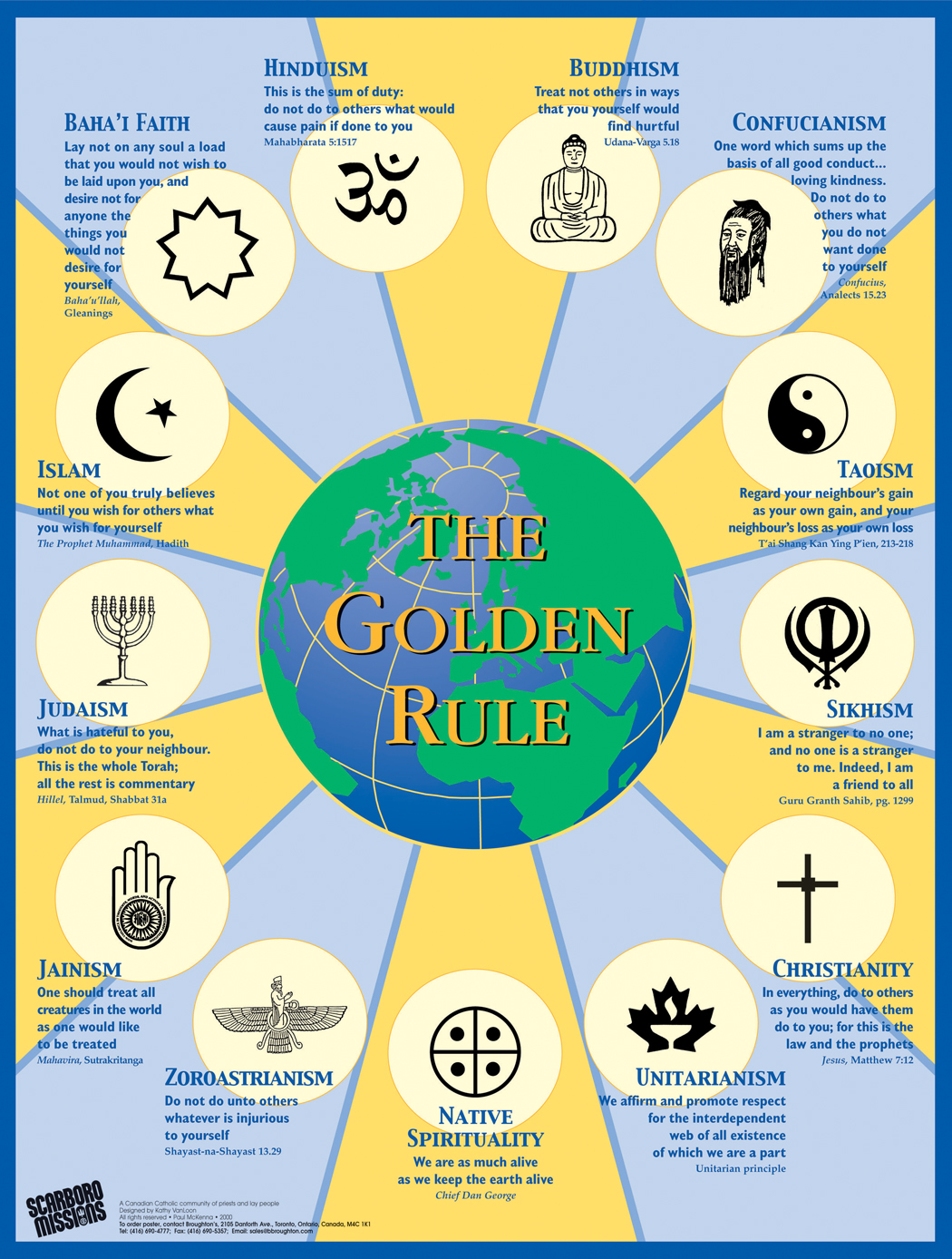
I have found endless versions of this rule, sometimes referred to as the Platinum rule or Universal Rule. You can find slightly grainy pictures like this one (because they want you to actually buy the nice clear one) depicting some of those guiding principles of other cultures.

Image result for golden rule poster

You could spend hours discussing which one is better or which fits you better. Whatever you do don’t start fighting about it or you have completely missed the point.

To avoid that kind of fight about Popper’s quote, I need to go back to it because it contains a few key words that were adequate to what he was saying at the time, but now that we have rebuilt Europe, taken down the Berlin Wall, found our way to a world beyond two super powers bent on destroying each other and entered a world where empires can fall without the inevitable grab for power involving death and destruction on a massive scale, we need to develop a new language that acknowledges how all of our cultures share common bonds.

One of those words is “spiritual”. This word gets bandied about quite often in phrases like “spiritual but not religious”. I let people use whatever terms they want to define themselves, then, if I’m interested, I ask them to describe what they mean. So I don’t need to come to a consensus on what this word means. For my purposes here, and I think adequately for Karl Popper, spiritual things are not material things. They are the hard to measure things like feelings, the value of health over wealth, and knowledge as an end itself instead of a means to something else.

In the quote, Popper is putting the “tribe”, the ones who defend a bordered territory, a set of traditions and ties of birth and history up against an idea of listening to as many voices as possible and synthesizing and harmonizing them for the good of all. Democracy in this quote is not just majority rule or an ideology tied to an economic policy and a particular constitution, it is the ideal of maximum inclusivity and plurality. At least that’s how I see it. That he says “rise of democracy” indicates to me that he still saw much work to be done.

I’ve already addressed that the idea of individual over tribe is not solely a Western idea, but Popper also makes the claim that it is the central doctrine of Christianity. This is a Western-centric statement. It even ignores the very Eastern roots of Christianity. It’s something we have to deal with when evaluating any wisdom coming out of thinkers in the mid 20th century and even more so from those before that. Popper knew his ancient philosophers. I don’t know how well he knew religions. Regardless, I’m not going to devalue him or his sentiment because he choose this particular symbol of neighborly love to express it.

The Old Testament and the New as well as commentaries surrounding them have versions of their greatest prophets being asked how to summarize their teachings. They all say something like loving God and loving your neighbor. Trouble is we also have a wide variety of scholars who spend their days trying to understand words that have been translated through a few languages and through many cultures. Even today, the word neighbor can mean the person next door, or an adjoining country. In Biblical times, it may have meant only Jews or only certain Jews. By the time the gospel of Luke was written, it appears it was starting to mean more than just that. Later letters though, like 1 John, appear to be returning to more tribal thoughts.

The rise of democracy and broadening sense of morality include the idea that we care about a wider and wider circle of people and places. If we agree on that, then it doesn’t matter so much that Christianity has it as a core tenant. It’s great, don’t get me wrong, it means they are on board with the arc of human history, but it doesn’t say anything special about that particular part of history. I suspect if I was alive in Popper’s time, I could have easily been happy knowing I was a Christian and that my traditions included loving those around me in the way I would hope to be loved. I’m glad I’m alive now in a time when I know that sentiment has a much wider reach and is derived from a wider base. I know it’s something even my enemies have some sense of.


Mark on the Golden Rule and its link to Old Testament
Luke and the Golden Rule and it’s alternatives
Leviticus early version of the Golden Rule, Matthew too, what is a neighbor
1 John


* Strong atheism involves the denial of all, or at least one god in particular. Usually it’s saying they know gods do not or cannot exist. “Hard” or “Explicit” atheism also state gods don’t exist with some degree of certainty.

Monday, October 29, 2018

Atheism for the Religious and/or Spiritual


I have been working through the 3 year Lectionary cycle of the Christian Bible. People ask me why, given that I don’t believe in the Christian God. It’s not a simple answer. It lies somewhere in the people and ideas I discovered along the way. They don’t fit neatly in a box.

"Mystery generates wonder, and wonder generates awe. The gasp can terrify or the gasp can emancipate. As I allow myself to experience cosmic and quantum Mystery, I join the saints and the visionaries in their experience of what they called the Divine,..."
Goodenough, Ursula. The Sacred Depths of Nature. 

The God Box

In William R. Herzog II’s book Jesus, Justice and the Reign of God, he summarizes Robert Funk’s and Robert Miller’s work, Finding the Historical Jesus: Rules of Evidence, saying, “The Gospel writers ‘invent narrative context’, provide interpretive overlays, soften hard sayings, ‘attribute their own sayings to Jesus’ and translate Jesus’ words into ‘Christian’ language.” This was acceptable and expected of writers at the time. Anything you wrote was expected to be your perspective on it, not unbiased reporting of what someone else said.  This is especially true in the genre of storytelling. The teller adds their unique voice.

For Herzog, this doesn’t diminish what the Gospel writers were doing. He wants to understand what they were thinking by understanding how they developed their narratives. He isn’t attempting to make a case for or against the existence of a man named Jesus, although occasionally in his books he will make a comment about words having come from such a man. His main goal though is to determine what the words were attempting to teach.

Thomas Sheehan, in his lectures on the Historical Jesus (available on iTunes University), puts this search in a slightly differently light. He says the Old Testament legends are “read into” Paul. Paul’s writings came before the writing of the gospels, despite their order as they appear in the Bible. Paul's words are then “read into” the gospels. Looked at this way, you see their influence and how the story of a man became the story of a god. How the Kingdom of God Became Christianity

He begins his lecture series by saying you might be challenged to rethink Jesus. It’s not his intention, but it is a possible consequence of the study. He uses the name Yeshua ben Josef, because he is starting the history at a different point than the New Testament. He, as well Herzog and most scholars agree that the Gospels alone do not provide a consistent picture of a historical figure. Yeshua, or whomever it was that inspired the Gospels, cannot be accessed through the lens of the Jesus that has been handed down through the centuries.

Much of the effort to reconstruct how this was handed down to us was conducted by well meaning and devout Christians and Jews. This deconstruction and reconstruction has not thwarted the efforts to maintain the relationship between the God of the Bible and humankind. Some young people, called to ministry, don’t survive the education they receive at seminary. Once they learn how the Bible was assembled and the church came to be, the magic is gone. This could explain why those details are not heard from the pulpit. Religious education for the congregations might be offered on a Wednesday evening, but those are not well attended. Perhaps people just aren’t interested and would rather keep the mystery just as it is.

Some can bridge the gap between the literary and the historical. Eugene Peterson, who created The Message Bible, offers us a way to approach this academic exercise of attempting to understand what these ancient authors were trying to tell us. In his interview with Krista Tippet on NPR’s On Being, he talks of metaphor. “A metaphor is really a remarkable kind of formation because it both means what it says and what it doesn’t say. Those two things come together, and it creates an imagination which is active. You’re not trying to figure things out; you’re trying to enter into what’s there.” As a metaphor for metaphor, he refers to the hoop one uses for embroidery. The fabric is us, loose and unfinished, so it is stretched by the hoop then you can work with it, create the needlepoint art. He offers people poetry like the Psalms or sometimes Dickens and says, “just let your mind stretch around it, and see what happens.”

It’s important to note that you don’t leave the fabric in the hoop. At some point you move to a different part of the piece and hopefully you actually finish it and put it to good use. Peterson also said “People ask, ‘How do you mature a spiritual life?’” And he responds that you should eliminate the word “spiritual.” “It’s your life that’s being matured. It’s not part of your life.” The idea is not to get lost in these words, but to move with them and bring them into your life.

For others, the investigation into what’s factually true as opposed to what’s factually false but holds some metaphorical meaning that can be understood leads to a path that can no longer be called religious. Ryan Bell, a pastor who became increasingly liberal in his teaching until he was told he could no longer keep his position as a pastor, took this investigation about as far as it can go. As he put it, he kept learning new ideas, like the forgeries and mistranslations in the Bible or the science and psychology of LGBTQIA+ people and the limitations of inclusiveness that he found in his traditions, even in the words of Jesus. He applied the gospels to teachings of peace and justice and found he sometimes had to skip parts when preaching about them. He kept trying to fit all of this into his “God box”. He knew the ideas were right and he felt Christian teachings should include them, but what he had been taught did not always comport to what he was learning. The God box had to expand with each new thing. One day he realized the box was as big as all of his understanding of the world, and he no longer needed the box.

You might land anywhere along this spectrum. I make no claims here. The overwhelming number of people throughout history who say they have found inspiration in the Bible is not an argument I care to take on publicly. I can only report what I found and hope to engage a few people and listen to their perspectives. My own investigations have taken me through many books on philosophy and history and how they fit in with The Enlightenment and The Dark Ages and that elusive first century. I have almost as many questions as I did when I started. I don’t need to repeat that history, but I’ll connect a few dots, hopefully correctly.

More importantly, I hope to expand your definition of “atheist”, just as pastors and lay people I have met over the last few decades have expanded my definition of “theist”. I’m not sure if this quote is attributed to anyone in particular, but I think it came from Buddhism, “There are as many religions as there are people.” You don’t need to join the church to enjoy a hymn and you don’t need to leave it to be inspired by the exploration of the stars.

So with no particular goal in mind, I’ll start the conversation with a Psalm. You may find “stretching” yourself around a Psalm is perfectly comfortable and is a place you want to return to again and again. If you’re like me, you may it find it hard to see what all the fuss is about. Psalms are frequently drenched in allegory. With “saving horns” and “Cherubs” and “bulls of Bashan” and words that defy translation I wonder what they are talking about. Are they just pleas for mercy and justice, or something more? But sometimes, as in Psalm 40, I can feel the poetic tension pulling toward something we aspire to while knowing we will inevitably fall back. Year A, Week 2

Next in the series

Friday, August 3, 2018

Jesus didn't say that

A response to a response, from the Counter Apologist.

http://counterapologist.blogspot.com/2018/08/atheism-is-preferable-to-christianity.html

There are few ways to go with this. CA’s original statements stands well on its. Also, in any current form of religions I know, there is no preferable universalism that I know of. My problem with Randal is, he doesn’t go far enough with interpreting hell out of Christianity. I think that can be done, although it strips Christianity down to its Jewish roots, even into some type of Reformed Judaism, so it probably is not a popular route. My problem with the Counter Apologist is the use of assuming beliefs by the gospel writers when it’s convenient while claiming we don’t know what they meant most of the time. I think this hinders the very reforms we want to see in religion.

Starting with the reforms; I don’t think it’s a stretch to say the arc of the Biblical narrative is that history has a goal, that there is some inherent reason for our existence, and it’s something good, and we need to discover our part in making it happen. This is the MLK thesis on justice and even if you take the atheist view of meaning created by the individual, it is compatible with a goal oriented form of utilitarianism as a theory for morality. To have this discussion across cultures, we need to be reasonable and accept that neither modern philosophers nor the Bible have a clear sense of what “justice” and “good” are. Modern philosophy accepts that, practically as a premise. The Bible has its moments, like Job arguing with God, but for the most part modern day practitioners of Abrahamic religion believe a supernatural force is the source of “good” and don’t care if they can’t prove it with scripture.

The above point is somewhat proven in the way Randal backtracks on his own religion when confronted with a rather straightforward problem like eternal or long lasting punishment. So let’s look at how CA supports the argument.

If atheists want to make the point that the Christian version of hell is wrong, I don’t think they need to stray deep into what the Bible says hell is. The Bible is not clear on that, that’s clear. Atheists don’t need to quote Jesus to prove Jesus was saying something. This degrades their own arguments since they begin with the understanding that the gospels are a poor reflection of any actual Jesus. This is the consensus of scholars, including religious scholars, but it seems to get forgotten when atheists start looking for proof texts. We are always quoting unknown authors and worse we might be quoting many authors in the course of just one passage.

For example, “torments” and “flame” in Luke 16 might be an allegory of justice for the rich man who neglected to care for the poor man at his gate. The thrust of the parable up to that point is about upending the power structure, and rewarding goodness for goodness sake instead of rewarding the powerful just because they do their rituals. This passage looks like a Greek version of hell getting tacked on to an earlier tale. Whether that was for better marketing of the book or because that belief was creeping into Jewish culture is debatable and barely relevant to a debate on the reality of hell.

What I think is important here is to recognize the opening Randal gives us. Christian scholars are quick to say things like Hellenism had crept into and corrupted Judaism at the time the gospels were being written, but they are slow to say exactly how. Christian scholars probably won’t lead those discussions because they suspect or fear they will result in less believers. This is exactly why atheists should be pushing in that direction.  Two passages from Revelation were included in CA’s list. Maybe Randal is open to eliminating Revelations from the canon. It has been debated since it was first proposed and is not in some Bibles. If it is an inaccurate depiction of hell that is incompatible with 1st century teaching, then let’s settle that and then move on to the next misinterpretation, redaction or mistranslation.

This might sound daunting, but I don’t think every line of scripture will need to be addressed before Christian culture begins to change. This approach to the Bible has been happening for a long time and has altered many denominations and led to reforms like women and gays being accepted. Atheists would do well to understand it.


Sunday, February 12, 2017

Why Milepost100?

I've been focusing less on creating new Milepost100 sermon helpers and instead adding to my background knowledge. One big source for that has been Richard Carrier's recent work, “On the Historicity of Jesus”. In this peer reviewed scholarly book, he applies modern tools to the questions surrounding Jesus and discusses how two approaches to the New Testament have failed; the religious apologist, who attempts to find the meaning that has been handed down by the theologians for centuries, and the historian who looks for some historical truth behind the text.

“Modern apologists respond with implausible ad-hoc harmonizations, while historians attempt to isolate the historical truth behind the conflicting accounts. This method has been found invalid. If the gospels are myth, both efforts are futile. Both assume the author is recording a collection of historical facts reported to them. If instead they are intending to construct myths about Jesus, we don't expect historicity, they aren't trying to distinguish fact from fiction, so the text does not give it to us. External evidence helps, and we can't use this approach to disprove historicity, but it does limit our ability to determine historicity. Instead our focus would be to extract the mytho-symbolic meaning and intent.” 

To answer that question, it is more important to look at the background information, the history of what was happening while the scripture was being written, and what earlier scripture they would have had available to them at the time. This is the opposite of how Christianity is presented to us now, beginning with the birth of Christ and following through to later letters written about him as if he existed. It is presented that way, but in actuality, those letters were written first, by someone who never claimed to have met a living Jesus. The accounts of his actions in life, came much later by different authors.

To begin before that, at the beginning, with Genesis and one family, is to ignore all the other creation stories that were being written at the time. It ignores that there were very few who could write at all. There were no fact checkers, no media watch dogs. If you wanted to write a counter narrative to someone else's myth, you wrote another myth, using the same characters, but added a new element that expressed your values and your desired outcome.

Any phrases inserted on an ad-hoc basis that claim the writing is true are there to attach the value message to the story. These were not notes to future readers in future millenia, these were devices for the illiterate, telling them to simply remember the name of John and don't be like those who are like Thomas. The listener then could express their values through that simple formula and had no need to remember a chain of logical arguments or even a list of what the values are. If anyone asked, they could refer them back to the story.

Biblical writing has special challenges because we have so many translations, so many copies and so many differences across those copies. The slight changes made back when copies were done by hand could have been mistakes, or they could have been purposeful redactions to steer the political message in a new direction. We know that this type of changing of the narrative happened in modern times and have no reason to believe it didn't happen back then.

It doesn't help that Romans were attempting near genocide of the Jews just as the gospels were being written in the late 1st century, or as the Romans would have said, “repressing a rebellion”. They lost track of who the authors actually were and they had far fewer tools than we do now for determining truth from fiction in the writings they were left with in the early 2nd century. We can't be certain what later emperors were thinking, but just as myth writers are more concerned with message over facts, the 3rd and 4th century co-opting of the message of this tiny Jewish sect  certainly helped both the emperors and the Catholics.

The rest is history, and history that we can become increasingly more confident about as we get closer to the present. We also get better at interpreting earlier history. We find more artifacts and we determine by the lack of evidence, that some things are highly improbable. We are also very far removed from any conquering Roman emperors who might not want us asking pesky questions.

So I will leave the medieval history to the historians. I may mention it occasionally, but only to point out how a particular verse led to a later belief. I may also mention an early church father who was just as sceptical as I am about the truth of a particular passage. Primarily, I want to put myself into the mind of peasants under extremely difficult living conditions, hearing a message of hope for their people.

Milepost 100. The sermon helper that doesn't tell you what to think.

Sunday, September 18, 2016

Milepost100

I have reached the 6 month milestone for my sermon helper, and, with the help of some good coffee, I've come once around the lectionary cycle. I hope to set a little faster pace over the next 6 months so I can relax and enjoy the summer next year as I complete the project.

Update: I've decided the Sept 2017 deadline was too aggressive, but I will keep months ahead of the Lectionary as I am now.

Here are a couple "best ofs" if you aren't following the calendar.

Central Christian themes, and an alternative view 
Responds to the slam on philosophers, and offers a beautiful interpretation of the the symbolism of “bread” from William Herzog
Shows how the Old Testament just can’t be reconciled to the New.
Where I try to fix the fundamentalist interpretation
Loaves and Fishes as Community building
The Whistleblower, aka Parable of the Talents
More Matthew 25

Sunday, May 8, 2016

Milepost 100 comments

If you arrived here via the Milepost100.com page on sermon help, and want to leave a comment, please feel free. Depending on demand, I'll open additional threads. Use the "Lectionary" keyword on the right side to find related posts.

Sunday, April 10, 2016

Milepost 100 is up and running

If you have any comments on the sermon helper at Milepost 100, feel free to leave them here. I'm online often.

I had planned to start the site on June 12, but writing has been going well and web development turned out pretty good. Then I started working back to get closer to the current date and I wrote the May 22nd entry. It seemed like a good place to start, both in where it comes in the liturgy and the opportunity to talk about where this journey began for me.

If you don't like that one, please read a couple more. I tried to mix my commentary so almost anyone will find something that appeals to them if they read more than one or two entries.

I have some "rules of engagement" from earlier blog posts, but I'm going to hold off linking to those just yet. See how it goes.


Wednesday, March 30, 2016

Samplings

I'm still plugging away on the lectionary. Here's some samples from the dozen or so I have not yet published:

Proper 16

I think the 21st century speaker can repeat these themes of community building without the language of worship or “delighting in the Lord” or stopping to explain who the ancestor Jacob is. Our rituals can involve more direct symbolism of where our attentions should turn. Whether those attentions turn on a certain day at a certain time, is not always that important. And there doesn't need to be lot of promises about springs of water or our needs being satisfied. It doesn't hurt to talk about how investing in your community has a tangible return, but the work itself should be its own reward. You may not see a direct payoff to serving up a free meal, but someone in that line will undoubtedly go on to contribute in a way that benefits others. That's how it's supposed to work.

************************
The book of Jeremiah may have actually been written by Jeremiah, a prophet in the time of King Josiah. As we get further along in the Bible we know more about the people discussed. Jeremiah probably also wrote Deuteronomy. This "second law" of Deuteronomy was intended to fix the problems of Israel being exiled by the Babylonians. Here he's proclaiming his authority by saying God literally put words in his mouth. And he gets to destroy and overthrow. This is why we have secular governments and democracy now.

  Proper 14, on the Hosea text 

For Old Testament help, I frequently turn to John C. Holbert. http://www.patheos.com/Progressive-Christian/The-Only-God-John-Holbert-07-22-2013. This week, he lays it out pretty clearly. After discussing the odd behaviors of other prophets, he says, “…, but the use of a woman of the evening for an object lesson is quite something else. For those of us who are feminists—and I hope all you readers consider yourselves feminists, too—it is deeply offensive to use a woman as a metaphor for human idolatry. Such literary effects do nothing but demean women and hold men up for the crude and misogynist beasts that they too often are.”

*******************************

Rather than try to understand the mind of a 1st century Palestinian who couldn't have heard of the word “science” since it hadn't been invented yet, I'll just make an observation. While Protestants and Catholics were killing each other for the right to worship differently, while thousands of new denominations were being created because new information about the Bible was coming to light and as people began to understand how the brain worked and that mental illness was not demon possession, we were also discovering that we are a small planet on the edge of a vast galaxy with galactic neighbors and all that took billions of years to come into being. We are gaining this knowledge so fast, the language is not keeping up. We are going to have to come up with a new word for “universe”. It's supposed to mean all that exists, but we are finding there is something before time and outside the boundaries of everything we know.

Proper 11

Amos then tells us what the punishment is going to be. Besides the terrible acts of nature, God will stop speaking to us. If we continue to act this way, this is what will be passed on to our children. If we teach them to be profitable business owners and managers, but don't teach them that the economy is built by people doing work then earning wages then buying the goods from those very businesses, then those businesses will fail. The lessons of how to create a prosperous country through a healthy working class will be lost. The ideas of educating your populous and providing a healthy environment will be ridiculed. This is what was happening when the Kingdom of Israel was crumbling. It has happened throughout history.


Sunday, March 20, 2016

Palm Sunday, 2019

This one won't come around for three years, but I really wanted to get it out there. At best, I'm an Easter and Christmas Christian, so I went to church today. It was also a chance to catch up with a couple old friends.

Link to this week's text
Explanation of this series

Isaiah 50:4-9a, Luke 19:28-40
Palm Sunday, Last Sunday of Lent

The most important influence in my theological life has been Roger Lynn. I heard his Easter message in 1993 and it turned my head around on the meaning of the New Testament. In a way, that sermon was just doing what Paul did. He turned the cross, a symbol of torture and oppression, into a symbol of love and forgiveness and community. Roger also brought that message into the modern world and breathed new life into it. In 2016, I visited him in a small church where he is semi-retired and his message was just as powerful. He used the Luke passage from the liturgy of the Palms, and the Isaiah and Philipians passages from the liturgy of the passion.

He started by pointing out something that is easy to do, to see these stories as our memories of the stories handed down to us from Sunday School or TV specials. In those, Palm Sunday is a big parade and celebration and everyone is singing “Hosanna in the highest” as the King arrives. But we read the words in the Bible and it doesn't sound so ostentatious.

This story has palm fronds, and as far as I know, the history of why they were used is sketchy. It also has a donkey, not a great stallion. This symbolizes the opposite of self-aggrandizement. Instead of setting up shop and having others bring people to see his miracles, Jesus sends his disciples out to heal. He's saying we just need to open ourselves up to what we all already know. We don't need a big stick to prove we are powerful.

If we look into the historical context, we know that the people who would have been part of the community that is depicted in this story would have been people with no opportunities, no security about where their next meal was coming from. The people who owned the vineyards were not providing jobs, they were using the banking systems to confiscate more land from those who could barely make it to selling the next bushel. The people in this story are not middle class folks going to an Easter parade, they are protesters, staging a demonstration.

The other thing the TV shows depict is a world where no one has thought of these ideas of working together to build a just and peaceful world. However, in the Isaiah passage for today, we hear about turning the other cheek. The message of the New Testament is not unique in history. This is why it says if people were silenced, the stones themselves would talk. The message is that this is the nature of things.

Roger and I parted company a bit at this point. He differentiated people from stones and eventually led to the conclusion that we “need more Jesus”. That may not mean anything to you, but remember we are looking in to what it means to have stones sing Hosanna. If that can have meaning, then “more Jesus” can too.

We came from minerals and we return to dust, but that is not an end. We are not just our component parts. We are born of love and survive because we are loved. We endure the pain of child birth and the risk of raising children because we don't see ourselves as simply existing. We know there were many who came before us who made this a better place and we want to build on that foundation.

We want this even if we see the reality of pain all around us and see more people bent on destruction than working on creation. Even the feeling of loneliness tells us that we desire others, and from that feeling we infer that others desire us. If all of the beautiful poetry and music that speaks of friendship and togetherness were destroyed, we would still know this. If we were prisoners being beaten to work all day and barely given enough to eat or time to rest, we would still know this. We know that people who have endured such suffering did not give up hope. Some did, but not all.

Children do not intuitively know to hate people with different color skin or different abilities or different clothes or according to how much stuff they own. That has to be taught. Love on the other hand, comes completely naturally.

If you only look at the biology and theories of how we evolved into animals that have the ability to reflect on the past and consider the future, you miss part of the story, whether it is this Biblical story or the story from science. Even if you accept the theory that we are completely lacking free-will, that everything we do is a product of some chemical reaction, that does not lead to the conclusion that you should stop thinking and stop planning. Those chemical reactions are giving you the desires that call you to a brighter future. If you once thought there was some bearded man in the sky out there doing the calling, but now you think not, that doesn't change that the call is still coming in.

If you are someone who looks at all the facts, calculates the risks, and determines it is unlikely you will succeed, but then goes ahead and does it anyway, you have an evolutionary advantage over the one who is stopped by those calculations. Some people call overcoming the odds a miracle. If you understand probability, it's just overcoming the odds, but I kinda like giving it that another name.

According to probabilities, you don't really overcome the odds, it's just that some people make it and some don't. But if we knew exactly why some do and some don't, we wouldn't need probabilities, we would have certainty. Certainty is a good thing to have when you are thinking about jumping off from a high place. When you are a poor person speaking up against a powerful empire, expecting to be heard, we call that crazy, but fortunately, a few keep doing it. If you are living in a free society, where you can speak your mind with minimal consequences, it is because someone did that.

Philippians 2:5-11

In the Philipians passage, Roger said there is a feeling of it being a hymn, and it might have been, but was then incorporated into this letter. He said the Greeks had a sense of words forming from the essence of what was being said like the bouillon of a soup. I'll leave it up to you to look into that.

The feeling of it is included in the above. It draws on the symbolism we all know. That symbolism draws on Old Testament ideas of the messiah and from classic mythologies of dying and rising gods. I think this passage differentiates itself from those simple “corn gods”, the ones who arrived in spring, helped the crops grow, then died in the fall as a symbol of decay to be later reborn again. This is a son of a god that does not exploit his equality with his father god. A humble god who wants the poor to be fed and women to be recognized, who wants to see an end to war.

By the end of the passage, we've switched to him being exalted and bending our knees and confessing his glory, but I wonder how well that translation has held up. I wonder if we have lost the sense of the bouillon those words were simmered in. Certainly, in America, it seems we pay more heed to the one whose name is above every name and have forgotten that part about being a humble servant. People go to church to get to heaven, not to hear about the example set by the one who came from there. Well, some do, fortunately not all.

Monday, March 14, 2016

21st Century speaking


I have two months "in the can", from June 12 to August 21. I'm not stopping to put them all up just yet, just offering these teasers for now. I do take requests. 


Luke 13:10-17

The symbols in the Luke verses have a little more meaning than many of the verses in recent readings. Jesus calls this woman to him. But he's teaching in a synagogue, that's male territory. The inclusion of women in the early movement may be a significant factor in why Christianity has survived. When men began fighting the Romans in the uprising of 70 AD, an exclusively male movement would have suffered. No doubt the women also contributed to the more compassionate nature of the movement. (See Richard Carrier's chapter in John Loftus' collection, "The Christian Delusion")

He also challenges the law. The details of exactly which laws were the right ones (the ones Jesus came to fulfill Matt 5:17) and which were wrong is not laid out in any detail. You only get clues like this, that healing someone is more important than watering your donkey. It doesn't seem that difficult of a choice. This story carries more weight if we understand how these additional laws, supported by the elites played a role in maintaining their status (as we saw in Luke 11 back in week 12).

You also might want to compare this to the similar story in Mark 2 and 3. Mark is the earliest written gospel that we have, and this similar story comes earlier in that gospel. It sets the tone in Mark. It's important to Luke, but Luke is addressing the growth of the movement into the upper classes.

Today, we are dealing with questions of moral law like family values. Some Christians say things like; staying in a marriage is the only right thing to do. This is sometimes followed so strictly that a single mother is shunned and her children are not given the support they need. This is done regardless of the circumstances of how she came to be a single mother. Hopefully, a thousand years from now, everyone will have difficulty understanding why someone would say that, just like we have trouble understanding why the Pharisees acted as they did.

Jeremiah 1:4-10

The book of Jeremiah may have actually been written by Jeremiah, a prophet in the time of King Josiah. As we get further along in the Bible we know more about the people discussed. Jeremiah probably also wrote Deuteronomy. This "second law" of Deuteronomy was intended to fix the problems of Israel being exiled by the Babylonians. Here he's proclaiming his authority by saying God literally put words in his mouth. And he gets to destroy and overthrow. This is why we have secular governments and democracy now.

As an aside, I live where there are lot of billboards about abortion. One of them uses this “Before I formed you in the womb I knew you” partial verse. I'm pretty sure this is Jeremiah making this claim about himself and what God said to him, not every egg that has ever been fertilized or in this case, every soul that existed before it was even conceived. If I were to say that God speaks to me because he spoke to Saul, I'm pretty sure the people who made that billboard would have a problem with that. It's convenient to say that God can know us individually in that way, but inconvenient when someone says they have a relationship to God that doesn't fit their narrative.

Isaiah 58:9b-14

Often, an easy way to increase your understanding of the lectionary passage is to simply read the whole chapter that contains it. Verse 6 tells says the yoke is the yoke of the oppressed. In the included verse 9, it is also about not arguing with one another about what to do next. The other verses expand on the ideas of sharing bread with the hungry and bringing homeless into your home. Acts like performing a fast are said to be meaningless if these actions are not also taken.

However there is also mention of honoring the Sabbath, so ritual acts are not to be eliminated. This author, as many in the Bible do, sees the two things, ritual and working for the community as integrated, almost one and the same. As we've been seeing lately in Luke and some of the Old Testament passages, this theme of doing more than merely appearing to be godly is repeated throughout the Bible. The reminders to actually do some kind of work usually are often mixed with reminders to pray or to remember God. Here, the Sabbath is not just the day to stop working, it's the day to refrain from pursuing your own interests. It is not some arbitrary rule designed to oppress you, or to focus on something imaginary, it's a reminder of how to build a community, through peace, with justice.

I think the 21st century speaker can repeat these themes of community building without the language of worship or “delighting in the Lord” or stopping to explain who the ancestor Jacob is. Our rituals can involve more direct symbolism of where our attentions should turn. Whether those attentions turn on a certain day at a certain time, is not always that important. And there doesn't need to be lot of promises about springs of water or our needs being satisfied. It doesn't hurt to talk about how investing in your community has a tangible return, but the work itself should be its own reward. You may not see a direct payoff to serving up a free meal, but someone in that line will undoubtedly go on to contribute in a way that benefits others. That's how it's supposed to work.


Tuesday, March 8, 2016

Pray

If you are trying to follow the lectionary series in order, I just skipped a few weeks. I will have a website up in the next couple months that follows the schedule.

Hosea


For Old Testament help, I frequently turn to John C. Holbert. This week, he lays it out pretty clearly. After discussing the odd behaviors of other prophets, he says, “…, but the use of a woman of the evening for an object lesson is quite something else. For those of us who are feminists—and I hope all you readers consider yourselves feminists, too—it is deeply offensive to use a woman as a metaphor for human idolatry. Such literary effects do nothing but demean women and hold men up for the crude and misogynist beasts that they too often are.”

So, yes, this is saying what you think it is on the first read. We don't get any details about just what they did wrong here, but God is obviously fed up with it. Depending on where you want to go with your sermon, you may need to do some more research into the context.

The names obviously have some symbolic meaning, so I'll cover those quickly. “Jezreel” is “God Sows”, in this case it will the bad kind of sowing. “Lo-ruhamah” is “not pitied”, that's followed by God's words about not pitying Israel. “Lo-ammi” is “not my people”. God is going back on his promise that Israel is his chosen people. It does get better, but scholars speculate that the verses about having pity on the house of Judah and how things are going to turn around, were added later, much in the way modern preachers would like to turn this whole passage around and make it something it's not.

Psalm

The Psalm goes perfectly with the Hosea passage. It accepts the idea that God can be vengeful and angry if he wants. It's saying its our job to let him know we are here for him and that we are certain he has a plan that we can all trust.

Colossians

I'm spending extra time on the parable this week, so I'm going to focus on only one aspect of the New Testament reading.

2:8 See to it that no one takes you captive through philosophy and empty deceit, according to human tradition, according to the elemental spirits of the universe, and not according to Christ.

Putting “philosophy” and “empty deceit” next to each other like that implies philosophy is deceitful. Bill O'Reilly now says Christianity IS a philosophy, so I guess he sees it different. Neither Bill nor the Bible discuss the details of this. Greek philosophy would have been known, certainly in the 1st century, although we can't know how well versed in it the authors of the Bible were. There is no direct philosophical debate in the Bible. Here it is described as “according to human tradition”, so they are acknowledging that there is a distinction between Biblical teachings and some sort of secular school of thought. It also says, “elemental spirits of the universe”.

Rather than try to understand the mind of a 1st century Palestinian who couldn't have heard of the word “science” since it hadn't been invented yet, I'll just make an observation. While Protestants and Catholics were killing each other for the right to worship differently, while thousands of new denominations were being created because new information about the Bible was coming to light and as people began to understand how the brain worked and that mental illness was not demon possession, we were also discovering that we are a small planet on the edge of a vast galaxy with galactic neighbors and all that took billions of years to come into being. We are gaining this knowledge so fast, the language is not keeping up. We are going to have to come up with a new word for “universe”. It's supposed to mean all that exists, but we are finding there is something before time and outside the boundaries of everything we know.

These discoveries, that the very fabric of our being was cooked in the first stars then blown apart only to come back together to form more stars and planets and atmospheres and creatures that could then reflect on all of this and ponder the mystery of it and experiment against that universe to discover why it is here and why we are here, none of this is covered in any part of the Bible or in any theology. We have discovered where we came from and evolution gave us a theory of how we came to care about each other. We found out that we were not put here as stewards of someone's creation with some unknown purpose, instead we are completely interconnected to that creation. We are part of its cycles on a biological level and if you get down to the smallest physical level, we are exchanging particles with everything around us. It is difficult to even find the boundaries.

These are profound discoveries that have altered the relationship of human beings to the planet, but religion refuses to integrate them. A few tepid attempts are made and they usually involve getting the science wrong. The Pope closed the universities in 1277 because he was afraid of anyone attempting to reach God using reason. If they had succeeded, why would we need a Pope, and if they failed, people would have to choose between thinking for themselves or not. He had to reopen the schools, but the world had already begun to move on.

There are references in this passage to pagan worship and other warnings to stay away from other religions. One of the few phrases I find agreeable is the one about not getting “puffed up”. That's wrong even if you happen to be technically correct. But I can't salvage much else from this passage. If someone has found a way to integrate all of our modern knowledge into their services, I would love to hear about it.

Luke

This passage starts with the Lord's Prayer, then tells us the parable of the Friend at Midnight, then tells us more about prayer. A basic reading might just see it as a suggestion to pray often. I will spend a little extra time on this parable because it is included in William R. Herzog III's Parables as Subversive Speech. This is a rare book that covers many modern interpretations and offers conclusions based on all data available to the modern reader. It considers the parables in light of Paulo Freire's work, The Pedagogy of the Oppressed. It covers 9 parables, and is an invaluable tool for anyone serious about Bible study. Thankfully, it also accessible to the non-scholar.

Herzog spends 11 pages on this passage, going into great detail on the Greek word anaideian, which appears in verse 8 as “persistence” or possibly “importunity” in some translations. Translators have had trouble determining if this applies to the neighbor being awakened, or the friend at the door. Applied the wrong way, it can appear that Jesus is portraying God as the neighbor, who is reluctant to bother with the petitioner at his door. This could be a parable about being persistent with your prayers, something Luke definitely advocates.

To unravel this, Herzog spends almost a page just on how the community that Jesus is preaching to would handle its bread making; small loaves or large, community oven or not, everyone baking on Monday or a system of rotation. If this is not interesting to you, serious Bible study may not be your thing. If you want to have “our daily bread” mean anything other than a vague analogy to eating, these are important details.

Herzog doesn't just jump around wildly speculating, he sights theological, archaeological and textual evidence and how they support the different interpretations they have published. Without this information, we would be left trying to apply this story to our own experience. Would you even answer the door at midnight, even if it was a friend? Do you expect friends to make appointments? This is a family with children, is the friend being inconsiderate? Almost every word needs to be carefully considered to get the correct interpretation.

Herzog considers one theologian that he, and many others, think got it wrong. Herzog only gives us the name Levison, who says anaideian should be applied to the sleeping neighbor. If it doesn't it would lead to the view that prayer is nothing more than badgering God into submission. Levison needed to translate the word to “strengthen” to make this work. Herzog calls this “theological slight of hand”.

Preachers often do this, but rarely will they tell you they are doing it. Your only clue will be if you have not heard it before. If you haven't, you can check with your favorite source or a more familiar preacher, but even then, you are limiting your sources. This is the problem with theology, there is nowhere you can go to get a consensus answer. There is no code book like there is for electricians. It's not a science where some things are still speculation and others are well established theories based on empirical evidence, and data that has been verified as factual after repeated experimentation. This citing of many sources and discussing them is what makes a work like Herzog's so valuable.

To help us understand the irony in this parable, Herzog spends a few pages on the idea of “The Moral Economy of the Peasant”. They had to deal with the reality of a subsistence lifestyle, where they felt that any gain of their own was done at the expense of their neighbors. They felt powerless to deal with the ways they were being exploited, so they looked for how those means resulted in something left over for them. It is hard to understand for anyone living in a society where much is provided. They knew there was an elite status that they could never obtain, but they expected those elites to draw a moral line at limiting their exploitation in a way that left them with their subsistence living.

In this system, reciprocity was a norm. You helped others when they needed it and they understood the obligation to reciprocate. Also important, as was discussed two weeks ago earlier in this same chapter, there was a tradition of itinerant preaching. This tradition of receiving a traveler is included in the Holiness Code of Leviticus. This is not simple utilitarianism. It is friendships developed to alleviate the increasing pressures of those elite patrons. This act of giving mere sustenance, bread, is a participation in the hospitality of Abraham. As Herzog says, “every time they place their meager resources at the disposal of the village, they participate in some small way in the continual redistribution of wealth for the sake of protecting and caring for the vulnerable, as envisioned in the Torah.”

I've left out a lot of the details, but Herzog concludes that the parable is breaking a boundary. Modern readers can recognize this, but they have a very different set of boundaries. Boundaries were set by the Torah in 1st century Palestine, but the elites had rewritten those boundaries with an oral Torah. They used that to continue to pursue their acquisitive greed at the expense of peasants and rural poor and still be Torah-clean. To them, extending hospitality to a stranger was shameless, using the “importunity” interpretation of that difficult Greek word. They were fools.


The parable delivers the punchline in verse 8 with irony. Jesus turns that judgment into an affirmation of village hospitality. By doing so, they created a messianic banquet, making a mockery of the lavish banquets of the elite that were done to promote themselves, not the community. This was a system of justice by the impure that those practicing the purity laws couldn't comprehend. The villagers didn't cave in to the desire to hoard and accumulate. This ordinary action of sharing bread was no small matter.