Showing posts with label getting along. Show all posts

Saturday, December 20, 2025

Listening Across the Divide

 I have changed my tune. I used to say "Facts don't change people." It's one of those poorly developed slogans, like, "defund the police." The change I want to see takes at least a paragraph to start to develop the idea. Facts are of course important. I could simply add, "alone", as the second word. It takes a little more skill and practice to get to the "how" of presenting facts. When I try to have these conversations, I get plenty of counter examples, sometimes data (anecdotal or otherwise), and my favorite, "they will never change." That last one is conversation ending, but it doesn't have to be "the end."

This post will be updated as I find examples of people using their listening skills to build relationships and finding that the person they disagree with has something valuable to say. The stands on the issues might not change, although sometimes they do. The perceptions that the people have of each other change in most of these. They also find that even though their ideas remain more or less intact, they can work together toward a common goal. 

In 2017, a journalist from the very liberal Seattle Oregon loaded up a bus of people like herself and went to a small town that had voted the opposite of her own. It went better than expected. 

MeltingMountains

One I haven't examined in too much detail yet

Americans Reconnect: Talking Across the Political Divide | MPR News

Jonathan Rausch is gay and Jewish and has presented his work to groups like "Faith in Family". They listened

Cross Purposes and https://www.abebooks.com/9780805076332/Gay-Marriage-Why-Good-Gays-0805076336/plp

Stand Together Stories


Tuesday, May 5, 2020

You're Right

You’re right. Of course you are right. Everyone wants to be right. If you are doing something or saying something that you know is wrong that’s antisocial personality disorder.  You are only wrong for as long as it takes to correct yourself, then everything is right again. You are right, but you are not always right. If you think you are always right, then you would be arrogant and obnoxious. Being right includes admitting that you might be wrong. Right?

If you want to check if you’re right, surround yourself with people who are willing to tell you when you are wrong. This is what you do when you seek an education. They could be wrong too but you can’t both be right if you disagree. Knowing what’s true is a different conversation. If everyone around you is agreeing with you and telling you that you are right, you might be surrounded by people with antisocial personality disorder or at least people who want something from you. It’s good to have friends who support you no matter what but real friends will let you know if you are wrong when it matters.


Truth

Just a few quick notes on this topic. I might refine it later.

Knowing what is true turns out to be kind of complicated. You can avoid all the philosophy and just remember the last time you stubbed your toe or hit your head. It doesn’t get much more real than that.

Otherwise you have to start with definitions, and they won’t answer “why” and they will leave us with more questions. That’s the human experience. First, truth is that which comports with reality. Great start huh? Reality is that which we can demonstrate is true. That’s circular. I did warn you. Truth is demonstrated by collecting empirical evidence. That is done using our senses, and extending our senses with instruments, and extrapolating from those results with reason and logic. All of this can fail at any point along the way.

We can’t be certain about anything. Not even what I just said. We still say things like “settled science” or “that’s a fact”, but technically, we are always speaking of probabilities. A “proof” is something you do in mathematics. You define rules about numbers and prove that equations will always have certain results. You can’t do that with people, or history, or psychology, or pretty much any animal behavior.

However, not being able to prove anything is different than not being able to know anything with a high probability of being accurate. People didn’t know about the shape of the earth at one time, and they were way off on the shape of the universe. But their being wrong then says very little about how accurate we think we are now. Truth may always be elusive, but we know how much evidence we have, how well we have checked it, and how consistently our experiments have verified it.

We use evidence and reason naturally every time we take a step or hear something new. We may not use formulas or check every fact, but there is nothing we can use to reason away reason. As soon as you try to explain whatever else might replace it, you are using reason to do it. The best we have to extend our knowledge and our experiences, is each other. Together, we’ve done some pretty amazing things.

All models are wrong, some are useful - George Box

Tuesday, March 24, 2020

Corona Blog

So, I’m a blogger, so I guess I should do this. It’s about change, about lots of changes through history and what that means to us now. I might seem a bit annoyed. If you want to get a teenager to read this, preferably one who doesn’t want to, they might get the proper tone of voice for it.

Everybody is talking about change. Of course we will change. Hasn’t every President run on that platform for the last 50 years? Make America Whatever or Hopey Changey, I don’t care. Throw the bums out. That’s a desire for change. But there is always tension, against the fear. Too much rapid change to greater rights for more people and a move toward socialism resulted in populism, on the left and the right. I have watched the constant battle between the dawning of the Age of Aquarius and the good old traditions since I was born in 1960. Look at what’s happened in the last 100 years since the 1918 flu pandemic. That’s in your parents’ or grandparents’ lifetime if you are older, so hopefully you talked to them. If you are younger, hopefully you know someone in the next generation up. They might have an old recording or at least some pictures.

They went through:
Nuclear weapons
Invention of vaccines
1918 flu
World War I (1914 to 1918)

Despite the pace of change having increased in the recent centuries, we haven’t developed new ways to cope with it. I don’t have much to suggest for that, but for me, getting some perspective on how much has happened, how far we have come in a short time, and how it has always been the people pushing leaders to change. That has helped me understand it.

My Public Education history spent too much on the days before the Revolution in this country, that’s my opinion. I always wanted to get to the World Wars and why those happened.

It was a major change in how the world worked. Before then, we were a world of royal families. Generals road on horses with colorful uniforms and battles lasted for a few days. With the arms buildup of the late 19th century, a result of the industrial revolution, these in-bred idiots who had no idea how to live in a time of electronic communication and world travel, put a match to the powder keg they built. To defend against heavy artillery, they created trench warfare, to breakthrough that they invented tanks, and on and on.

If you don’t want to have a love for history, don’t click here. Dan Carlin has a great ability to tell the story and provide the facts. His “Blueprint for Armaggedon” series is the story of WWI. 

Going back through the 19th century further you had:
The Industrial Revolution, steam engines, mechanics, oil. Horses were no longer the best source of power, but we still use the term “horsepower”.
Darwin published the Origin of Species in 1859.
Michael Faraday, who died in 1867, advanced our understanding of electromagnetism. That’s kind of important to whatever device you are reading this on.

Pause for a moment on this guy. He discovered the mysterious energy floating around that we could use to move things and to communicate across miles. Click to see David Tong giving a lecture in the same hall where Faraday gave his. Tong is talking about the newly understood forces of quantum physics, that we now understand are the fundamental forces behind all things. He’s giving that lecture in the same hall, with the same desk, that Faraday did. It’s like we just figured out stone tools yesterday, and now we all have scalpels in our medicine cabinets. 

While Faraday was alive, we were finally throwing off the last myths about race and changing laws so we could no longer justify slavery. There are still slaves in the world, I know, but most people know that’s wrong now. What will be commonly thought of as wrong by end of your lifetime?

Change takes a little longer in the centuries before that, but let me connect just a few more things. Once the empires that grew out of ancient history started bumping into each other and “discovering” each other, we started accumulating our knowledge, sharing it actually, but not always in a nice way. You might have heard of Thomas Aquinas, who tried to reconcile the Catholic religion with Greek philosophy. He had a little help from the Muslims by the way. Not too long after that, we had Protestant kingdoms, so there was a lot of fighting with the Catholics.

At the end of all that fighting, after the Thirty Years War, 1648, a treaty was signed called the Peace at Westphalia. It took away powers from the Pope and created a new type of nation. That’s what you live in, a Westphalian nation-state. Sure, your way of life is rooted in a Judeo-Christian/Western Civilization/Constitutional Republic/Democracy/melting pot, sure. But the basic structure of our politics has only been around for 400 years, and it was formed under duress, and it’s not working. A bunch of morons from the Middle Ages made it up to get the Pope out their business and we can get the billionaires out of our pockets if we create the next system.

Something else happened once the European Princes and Bishops quit making us kill each other. It was the British Royal Society, founded in 1660 to promote scientific thought and learning. It was the fertile ground where Isaac Newton flourished. Newton created the mathematics that got us to the moon (along with some of those other folks above). Computers were first put to the test during that work. That pretty much brings us up to where we are now.

To have that sort of creative energy, to allow the brilliant people of the day to discover something, you have to first have some degree of peace. You have to have a little extra left over at the end of the day to give to the general welfare, to build some roads, to have some nurses ready to take care of us instead of working overtime to pay off student loans and a mortgage from that house they bought before the bankers destroyed the economy.

What gets left out of historical discussions like this is none of it happens if we don’t care about people that we will never meet; people on the other side of the world and people who are not born yet. If we aren’t keeping the world clean and free from violence and filled with beauty, if we aren’t nurturing the people who grow our food, or who are sitting in a room somewhere coming up with formulas that who knows what they will do, but we can bet they will do something, then none of this happens. Then we slip back into using those stone tools to harm each other and take whatever we can just because we can. None of this happens if we don’t realize we need each other.


A note on the present: We aren’t purposely crashing the economy by shutting it down, just so we can save a few million lives. The economy would have crashed if we didn’t do anything because the hospitals would have been overrun. People would have chosen to quit interacting with others after it was far too late. Services would be much more disrupted because the closures would be random; we wouldn’t be choosing to keep groceries open as opposed to restaurants, we would be choosing from far fewer options.

It would not be some simple math of 2 or 3% more people dead. We would be surrounded by sick people and no one would want to touch them for fear of getting sick themselves. This would multiply the problems. Any normal illness or regular medical attention needed would be almost impossible. We would have new priorities, like disposing of the bodies.

The stock market selloff was recognition by those who understand how their system works, that it is not working, that it is not designed to respond to a problem like this. It is not designed to take care of the people that actually create the wealth that they accumulated. Ironically, it created the problem by changing the environment, putting workers under stress, and prioritizing profits over health. It put messaging over science. They know this, they saw it coming. They didn’t tell us until they cashed out. But cashing out is a strategy of the dying system. I don’t know what the next system will be, but it won’t be the current leaders who create it.

Wednesday, October 2, 2019

The amazing chart of everything


I’m a little embarrassed about how much of this chart I’m familiar with, but I’ve had to look up these things when seemingly intelligent people bring them up and tell me I should be concerned about them. I admit at one time I thought there might be something to the Nostradamus prophecies, but then I simply read what they said. The actual words don’t match the theories about how he predicted the Kennedy assassination. But the guy who made this chart seems to be serious about it, and I’m sure you all know someone who is very serious about at least one of the items found here.

My obsession with this is partially just curiosity, partially the human tendency to gawk at disaster, but it is also rooted in academics. I was in an African American Studies course in my freshman year in college when the people following Jim Jones all killed themselves rather than disband their group and reconsider their life choices. The professor asked us to think about how this happened, particularly why middle class black people joined this group.

Part of it is mind control, making them repeat the ritual without using real poison and barraging them with long speeches about his view of the world over a loud speaker all day long. But cults almost always begin with some reasonable ideas that seem intuitively good. Those roots are usually not well documented and get swept under the longer story that is easily found once the group has some fame. It seems obviously wacko to outsiders at that point, but those who accept it have a history that has altered their intuitions about what is right, so they can justify the wackiness.

Each one of these nodes has a story like that behind it. A story of how it began as someone asking questions that seemed reasonable. They become conspiracy theories when answers are provided that aren’t based on facts, evidence, and logic that is interpreted by people familiar with the full context. People choose the simple answers of the complex inclusive data. This could remain a small group of gossipy neighbors or grow into a political party with actual power.

In this chart, most of it is real names of people, corporations, and organizations, but the connections and the arrows are almost always a stretch. “THX 1138” was really a movie by Steven Spielberg about a guy who escaped a domed city where the government controlled everything with lies and kept people sedated by prescribing drugs. Why that is right next to the “Birth of the Internet”, I don’t know. Further up, in the historical section, the Rockfellers really did monopolize oil in the USA and they did it with nepotism and corruption. Why that is right next to “Ritual Magick” on the chart, who knows?

Harder to miss, the big arcing arrow from scientific discoveries of the modern world to “DEPOPULATION”. You would need to read a lot of stuff that would challenge your credulity of the authors belief in what they were writing to know why Monsanto and Flouridation are on this chart. You might feel like brain cells were trying to escape as you read it, hoping to find a place where reason and logic still exist. What this chart shows is evidence is not needed once you’ve decided to live in a world of fear where you have no power. In that world, it’s better to give up your powers of reason and, according to the logic of that opposite world, then you’ll see what is obvious.


In the world of facts, people do horrible things to each other in plain sight. I couldn’t find “Organized Crime” on here, but we know the names. They walked around in major cities and people loved and adored them. They were treated like the ones who were fixing the problems that the government and police were causing. Meanwhile, they were building their private armies and throwing bodies in the river. Pablo Escobar appears. He financed social programs while also bankrolling corrupt politicians, guaranteeing that those social programs would not have democratic oversight. They got the blame for what was wrong, he got the credit for doing what was right and the power that comes with it.

When you decide that what you see is not real, that you were taught nothing but lies, and that anything that comes from a respected source is actually designed to control you, then everything is part of the giant conspiracy and your best strategy is to do nothing except tell everyone else about how you figured it out. By saying you are questioning everything, you get to feel powerful, but by not using your powers of logic and reason, by claiming your theory is beyond question, you’ve relinquished the power you actually have.

There are of course bad things in the world. Caligula, near the top in the Antiquity section, was a vicious narcissistic ruler. That’s why we say Rome was “falling” at the time he ruled. Democracy was conceived, then faded and came to light again over a thousand years later. This chart seems to connect that re-emergence more to the Illuminati than to the formation of nation states full of free people. No explanation is provided.

Alchemy was a waste of time but as the chart notes, it led to gunpowder. There are good and bad uses for gunpowder but you could say it would be a more brutal world without it. Many items appear on the chart without comment, so it’s hard to say what judgment QAnon is passing on them.

The paradox of “conspiracy theorists” is they will use real conspiracies like Nixon and Watergate, The Gulf of Tonkin incident, Bush lying about weapons of mass destruction, and Jeffrey Epstein as their evidence that governments and rich people are really corrupt, but it’s not “conspiracy theorists” who uncover those conspiracies! The mainstream information sources that are supposedly covering up the conspiracies are the ones that brought those to light.

Conspiracies that actually happen like a President lying on a daily basis or a small family getting rich off of a Pharmaceutical company selling pain medicine, are not included in this chart. Epstein is being investigated even after he died because living people conspired with him, but this chart only has “Pizzagate”. The same people that missed the Epstein conspiracy are now making up stories about how he was killed by the Clintons. This chart was made in 2018, before the Epstein and Sackler stories broke and the QAnon writers are now catching up with them.

There is a big difference between conspiracies where powerful people are lying and hiding information and working for themselves while saying they work for us, and decisions made in the regular course of people trying to figure out how to make a living in a decent and ethical manner. We use toxic chemicals and precious resources to make life better for most people on earth. Billions of people sleep soundly knowing their taxes are supporting a military operation somewhere on the other side of the world that they would never consider participating in. We do our best to discuss decisions like this, requiring layers of oversight and regulating whatever industry gets to profit from the lesser of evils that we eventually choose. We hope that we get the chance to work on the new problems that we caused by implementing the solutions to the original ones. None of this belongs in the same category, on the same chart, as lizard people using the Denver Airport as their secret base.

This chart is the modern version of Greek mythology; mixing historical figures with imagined monsters and giving them all personalities and character traits that attempt to reflect human traits and failings. But the words and actions of the stories didn’t happen in the real world . It’s done in an attempt to try to explain the crazy world we live in, to reconcile what we know is right with all the wrong that we see. It skips over the hard work we need to do to uncover those wrongs. I hope this type of thinking fades and the methods of science prevail and continue to be improved but there is no guarantee. The record of civilizations is not that great, they kind of come and go. Fortunately, even when the powerful and the structures they built fail, we still have each other.

Sunday, June 23, 2019

Intermission Summer of 2019

Summer is always a slow time for blogging for me. It's rainy and cold today, so maybe our one day of summer has past. I do have article #10 ideas, but it's getting to where I need to write a PhD thesis, or just keep rambling. Or, something in between. For now, here's an article that expresses some of the things I'm working on or towards or around. 

Six things I wish people understood about Atheism

1. There are lots of different types of atheists, and we don't all feel the same way about religion.

For me, I've felt differently at different times. Many people have some anger immediately upon leaving their church. As they find more people who have already worked through that, that might subside and give way to more reasoned thoughts about why people think the ways they do.

2. Atheist organizations are starting to do better at helping people and promoting social justice.

Really, secular groups have been around for a long time. Religion might inform your values, but different worldviews can and do lead to the same values. There have always been people who believed in the good works of religion but had private doubts about the theology.

3. Seemingly little things that religious people might not even notice can really drive us atheists bananas, and for good reason.

What Jay is saying here is that religion is everywhere. It's our calendar, many of our holidays, in political speeches, on our money, everywhere. It would be nice if they at least noticed this and acknowledged it.

4. There's a big difference between private individuals promoting their religious beliefs and the government doing the same. But this doesn't mean the government cannot promote facts and ideas that are inconsistent with some religious beliefs.

This one is a little more complicated. There are subtle differences between "freedom of religion" and "freedom from religion". This goes way back to before the Constitution was written.

5. Atheists and other secularists are getting pretty good at participating in public.

This relates to #2, plus, more people have grown up without religion in their homes now. More than that, they have found other ways to develop their world view and value systems and to articulate why they feel the way they do. It's help that they are able to do with less threat of being ostracized from their community. There are now strong secular groups on campuses and those people will go on to fund those groups and they will likely continue to grow.


Wednesday, January 2, 2019

Something to consider for 2019

3 words, we were wrong

Previous                         First                           Next 

I usually do a New Year’s post, and here it is the 2nd already, so, here’s an article that fits in with my current series.

I’ve been thinking about “intellectually honest” ways to approach religion. This is something my fellow atheists balk at, sometimes vehemently. It shuts down any possibility of discussion when you simply call someone’s point of view stupid. It also gives the theist the opportunity to call them stupid, or maybe stupider, because they can’t see that maybe something that has been part of humanity for a few thousand years has some sort of basis and maybe even some value.

The question to engage then is, how do you determine what is intellectually honest? In this article, he recounts a conversation where he wants someone to reconsider a dogmatic position and they answer with how they “can’t do that”. This is definitely intellectually dishonest. Further, their reasoning is, if they reconsider that Biblically based position, and find their grandparents were wrong, they will have to reconsider every other position.

Sadly, their grandparents probably did reconsider some position, so applying new perspectives to traditions is actually traditional. For example, most people in the United States who have slave owning ancestors now hold a different position on that. We all are free to choose whose ancestors we want to agree with. Biblical non-literalists can be found throughout Christian history, even in the Bible.

Atheist or theist, admitting you were wrong is a great way to open a conversation.


The series

Jesus tells us he teaches in allegory, Book of Mark
Allegory of burning cities
"For the kingdom is like..."

Saturday, December 15, 2018

Atheism for the Religious and/or Spiritual 4

It might seem like this would be a good time to summarize the previous entries and start to converge toward a philosophy that I believe in or that is expressed in some sort of non-believer terms. That’s not where I’m headed. Atheism is not a philosophy. There is no atheist creed. At its simplest, it means a lack of belief. People love to complicate it and add qualifiers like “strong” or “hard”*. Some like to say that agnosticism is the only correct choice. Those are all points worth considering, but also not where I’m headed.

Previous                    First                       Next

Where I’m headed is better expressed by someone like Karl Popper. If you don’t know who that it is, you will be surprised to find out how much of how you see the world today was shaped by him or at least expressed by him. He wrote “The Open Society and Its Enemies” as the world was embroiled in its Second World War, a time when it was uncertain if decent democratic societies would survive. He wanted to preserve as much of the accumulated wisdom of our cultures as he could. He got it so right that his ideas are pretty much taken for granted so it just doesn’t seem necessary to quote him.

One thing you might hear Popper’s named attached to is the scientific concept of “falsifiability”. For something to be considered scientifically true, you must be able to state it in a way that you could create an experiment and prove it false. If repeated experiments provide data demonstrating evidence in support of the facts, then it’s a pretty good chance it is true. There are plenty of philosophical discussions about this, and it is being questioned more and more lately, but it has been a guiding principle of science since 1963.

Popper also wrote on government, ethics, and much more, including this statement about the Golden Rule,

“The emancipation of the individual was indeed the great spiritual revolution which had led to the breakdown of tribalism and to the rise of democracy.” 

He says this in a discussion about Plato and how he attacked individualism. Plato was an advocate for a caste system. But I don’t think we need a complete history of Western thought to get the point about loving our neighbors. As Popper says,

“This individualism, united with the altruism, has become the basis of our western civilization. It is the central doctrine of Christianity (‘love your neighbor’, say the Scriptures, not ‘love your tribe’); and it is the core of all ethical doctrines which have grown from our civilization and stimulated it.”

He goes on to say how even Kant, who believed morality is derived from reason, not the divine, said, ‘always recognize that human individuals are ends, and do not use them as mere means to your ends’.  Nor is this limited to Western culture. I would go so far as to say there are no cultures that survived or have left behind any kind of legacy that did not have some version of this idea in their core guiding principles.

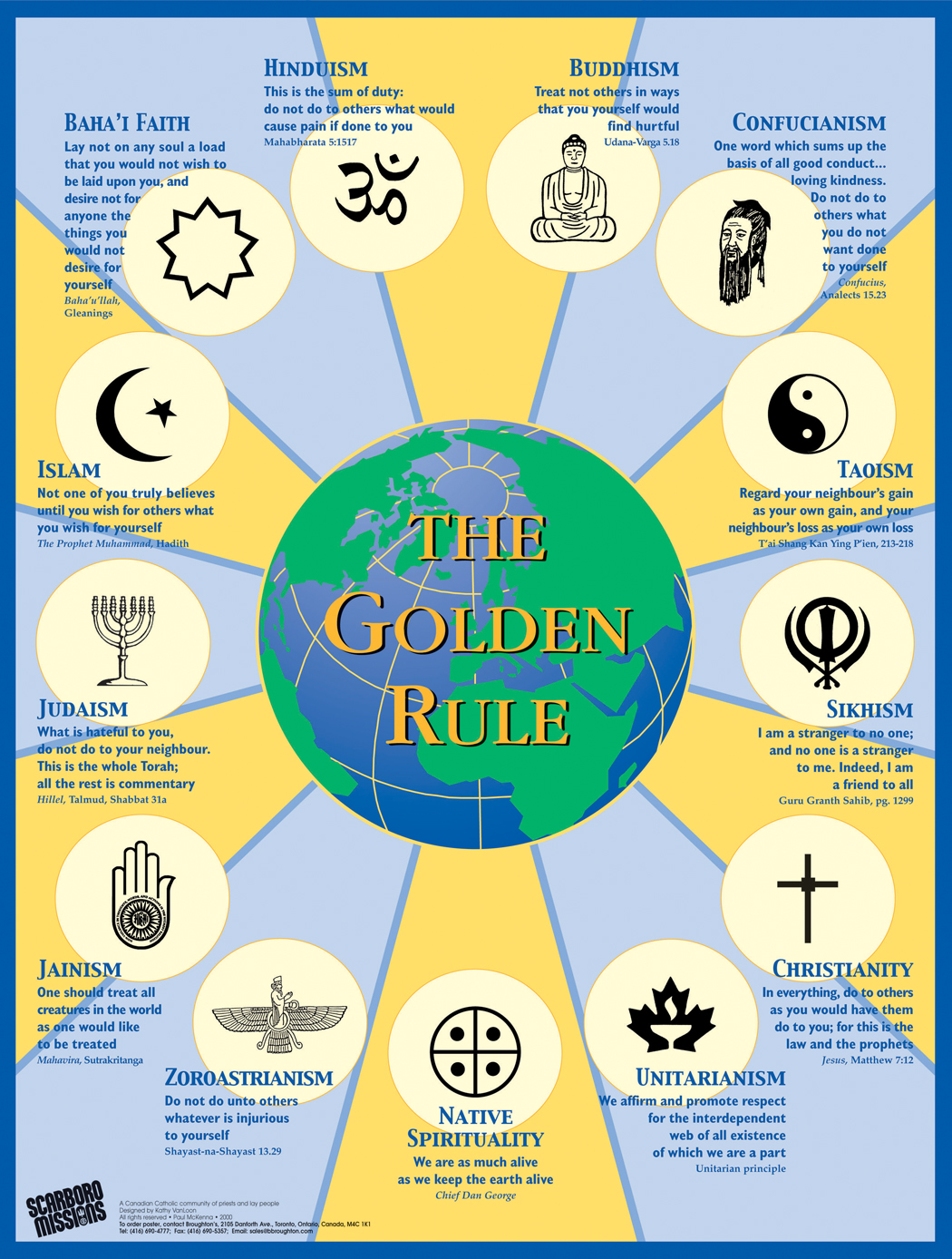
I have found endless versions of this rule, sometimes referred to as the Platinum rule or Universal Rule. You can find slightly grainy pictures like this one (because they want you to actually buy the nice clear one) depicting some of those guiding principles of other cultures.

Image result for golden rule poster

You could spend hours discussing which one is better or which fits you better. Whatever you do don’t start fighting about it or you have completely missed the point.

To avoid that kind of fight about Popper’s quote, I need to go back to it because it contains a few key words that were adequate to what he was saying at the time, but now that we have rebuilt Europe, taken down the Berlin Wall, found our way to a world beyond two super powers bent on destroying each other and entered a world where empires can fall without the inevitable grab for power involving death and destruction on a massive scale, we need to develop a new language that acknowledges how all of our cultures share common bonds.

One of those words is “spiritual”. This word gets bandied about quite often in phrases like “spiritual but not religious”. I let people use whatever terms they want to define themselves, then, if I’m interested, I ask them to describe what they mean. So I don’t need to come to a consensus on what this word means. For my purposes here, and I think adequately for Karl Popper, spiritual things are not material things. They are the hard to measure things like feelings, the value of health over wealth, and knowledge as an end itself instead of a means to something else.

In the quote, Popper is putting the “tribe”, the ones who defend a bordered territory, a set of traditions and ties of birth and history up against an idea of listening to as many voices as possible and synthesizing and harmonizing them for the good of all. Democracy in this quote is not just majority rule or an ideology tied to an economic policy and a particular constitution, it is the ideal of maximum inclusivity and plurality. At least that’s how I see it. That he says “rise of democracy” indicates to me that he still saw much work to be done.

I’ve already addressed that the idea of individual over tribe is not solely a Western idea, but Popper also makes the claim that it is the central doctrine of Christianity. This is a Western-centric statement. It even ignores the very Eastern roots of Christianity. It’s something we have to deal with when evaluating any wisdom coming out of thinkers in the mid 20th century and even more so from those before that. Popper knew his ancient philosophers. I don’t know how well he knew religions. Regardless, I’m not going to devalue him or his sentiment because he choose this particular symbol of neighborly love to express it.

The Old Testament and the New as well as commentaries surrounding them have versions of their greatest prophets being asked how to summarize their teachings. They all say something like loving God and loving your neighbor. Trouble is we also have a wide variety of scholars who spend their days trying to understand words that have been translated through a few languages and through many cultures. Even today, the word neighbor can mean the person next door, or an adjoining country. In Biblical times, it may have meant only Jews or only certain Jews. By the time the gospel of Luke was written, it appears it was starting to mean more than just that. Later letters though, like 1 John, appear to be returning to more tribal thoughts.

The rise of democracy and broadening sense of morality include the idea that we care about a wider and wider circle of people and places. If we agree on that, then it doesn’t matter so much that Christianity has it as a core tenant. It’s great, don’t get me wrong, it means they are on board with the arc of human history, but it doesn’t say anything special about that particular part of history. I suspect if I was alive in Popper’s time, I could have easily been happy knowing I was a Christian and that my traditions included loving those around me in the way I would hope to be loved. I’m glad I’m alive now in a time when I know that sentiment has a much wider reach and is derived from a wider base. I know it’s something even my enemies have some sense of.


Mark on the Golden Rule and its link to Old Testament
Luke and the Golden Rule and it’s alternatives
Leviticus early version of the Golden Rule, Matthew too, what is a neighbor
1 John


* Strong atheism involves the denial of all, or at least one god in particular. Usually it’s saying they know gods do not or cannot exist. “Hard” or “Explicit” atheism also state gods don’t exist with some degree of certainty.

Tuesday, September 4, 2018

Index to blogs about skepticism

These entries are almost all non-religious. When you leave a believe system, you have to rebuild a foundation for how you figure what is true. The same problems keep coming up, like we can't be 100% certain and that there are many experts that need to be sorted out but we don't have the expertise to challenge all of them.

I've argued with Libertarians as a way to try to understand them, with gun advocates to try to find a peaceful solution and with my liberal friends who often use the same flawed logic that they accuse conservatives of using.

I put what I think are the best in bold. They are in reverse chronological order, but only a few mention something topical.


Complexities of fighting for peace http://winter60.blogspot.com/2016/11/veterans-day.html
Wrote this one to a young person who linked to this rapper who was saying everything needs to be torn because it’s so messed up http://winter60.blogspot.com/2015/07/why-i-think-this-world-should-end.html

I link to this one whenever someone tries to tell me that we can’t really know anything http://winter60.blogspot.com/2015/05/out-of-philosophical-trilemma.html

Would letting starving children die solve the hunger problem? http://winter60.blogspot.com/2015/05/shouldnt-we-just-let-them-die.html
This is my ongoing challenge, to speak to the problems and to acknowledge the beauty and genius we meet every day http://winter60.blogspot.com/2015/03/everyday-wisdom.html
Reconciling personal and social responsibility http://winter60.blogspot.com/2014/01/it-takes-two-wings-to-fly.html
Another GMO, how anti-GMO news uses inflammatory language (about the so-called Monsanto Act) http://winter60.blogspot.com/2013/04/frankenfoods-are-coming-to-kill-our.html
A little more geared toward woo, but I think I made a decent point here about how Aquinas actually forwarded the conversation, while Chopra takes us backward http://winter60.blogspot.com/2012/06/aquinas-and-chopra.html


Friday, August 3, 2018

Jesus didn't say that

A response to a response, from the Counter Apologist.

http://counterapologist.blogspot.com/2018/08/atheism-is-preferable-to-christianity.html

There are few ways to go with this. CA’s original statements stands well on its. Also, in any current form of religions I know, there is no preferable universalism that I know of. My problem with Randal is, he doesn’t go far enough with interpreting hell out of Christianity. I think that can be done, although it strips Christianity down to its Jewish roots, even into some type of Reformed Judaism, so it probably is not a popular route. My problem with the Counter Apologist is the use of assuming beliefs by the gospel writers when it’s convenient while claiming we don’t know what they meant most of the time. I think this hinders the very reforms we want to see in religion.

Starting with the reforms; I don’t think it’s a stretch to say the arc of the Biblical narrative is that history has a goal, that there is some inherent reason for our existence, and it’s something good, and we need to discover our part in making it happen. This is the MLK thesis on justice and even if you take the atheist view of meaning created by the individual, it is compatible with a goal oriented form of utilitarianism as a theory for morality. To have this discussion across cultures, we need to be reasonable and accept that neither modern philosophers nor the Bible have a clear sense of what “justice” and “good” are. Modern philosophy accepts that, practically as a premise. The Bible has its moments, like Job arguing with God, but for the most part modern day practitioners of Abrahamic religion believe a supernatural force is the source of “good” and don’t care if they can’t prove it with scripture.

The above point is somewhat proven in the way Randal backtracks on his own religion when confronted with a rather straightforward problem like eternal or long lasting punishment. So let’s look at how CA supports the argument.

If atheists want to make the point that the Christian version of hell is wrong, I don’t think they need to stray deep into what the Bible says hell is. The Bible is not clear on that, that’s clear. Atheists don’t need to quote Jesus to prove Jesus was saying something. This degrades their own arguments since they begin with the understanding that the gospels are a poor reflection of any actual Jesus. This is the consensus of scholars, including religious scholars, but it seems to get forgotten when atheists start looking for proof texts. We are always quoting unknown authors and worse we might be quoting many authors in the course of just one passage.

For example, “torments” and “flame” in Luke 16 might be an allegory of justice for the rich man who neglected to care for the poor man at his gate. The thrust of the parable up to that point is about upending the power structure, and rewarding goodness for goodness sake instead of rewarding the powerful just because they do their rituals. This passage looks like a Greek version of hell getting tacked on to an earlier tale. Whether that was for better marketing of the book or because that belief was creeping into Jewish culture is debatable and barely relevant to a debate on the reality of hell.

What I think is important here is to recognize the opening Randal gives us. Christian scholars are quick to say things like Hellenism had crept into and corrupted Judaism at the time the gospels were being written, but they are slow to say exactly how. Christian scholars probably won’t lead those discussions because they suspect or fear they will result in less believers. This is exactly why atheists should be pushing in that direction.  Two passages from Revelation were included in CA’s list. Maybe Randal is open to eliminating Revelations from the canon. It has been debated since it was first proposed and is not in some Bibles. If it is an inaccurate depiction of hell that is incompatible with 1st century teaching, then let’s settle that and then move on to the next misinterpretation, redaction or mistranslation.

This might sound daunting, but I don’t think every line of scripture will need to be addressed before Christian culture begins to change. This approach to the Bible has been happening for a long time and has altered many denominations and led to reforms like women and gays being accepted. Atheists would do well to understand it.


Friday, February 16, 2018

Humanize Me

Two former pastors talk about how to reach understandings with people who are different from us.

If you are unfamiliar with Bart or uninterested in his whole story, you can skip to about minute 15 for the part I’m highlighting here. The movie he is talking about is about him and his dad and their religious differences. Bart left his dad’s ministry work and became an atheist. He was a Humanist Chaplain at USC up until recently and is interviewing Ryan Bell who just took over that job. Ryan is also a former pastor. 

The story Bart wants to tell is how people seeing the movie were not so interested in the reasons for choosing or not choosing religion, rather they enjoyed how a father and son worked to understand each other and discussed their shared values. He maps this on to the work they both do with young people.

In the secular groups they work with, people with different foundations come together and they aren’t interested in taking away their foundations, instead they want to know how that foundation generates their values. He lists three layers; the values, then the worldviews that generates them, then the reasons you adopt that worldview. The lowest of these is the reasons. It’s the least interesting and we often aren’t aware of why we believe what we believe, yet we spend a lot of time there.

Ryan points out it’s interesting to explore the reasons if you have the time and interest in philosophy and psychology, but that’s not essential to living a good a life. “You don’t need a master’s degree in philosophy to be a good person, thankfully, otherwise we’d all be a bunch of jerks.”

For many people, beliefs and identity are wrapped up, hard to separate.If you question why they believe something, they react as if you are attacking them, as if you are attacking who they see themselves as. This comes up when a value comes up, like how we treat children or should teens have sex or who should own what kind of gun.If instead of asking how they came to hold that opinion or why they hold it, ask, “how does your belief generate your value?” Like, what does Christianity make you want to do? Or, how does belief in some principle inform your political decisions? People can talk about that. They want to say how their beliefs function, not their validity or some logical explanation for them.
As Ryan says, we want people to explain their reasons when we are critical of their beliefs or actions. But when someone criticizes us, we find it hard to separate the reasons from our identity.
It may not be satisfying to hear their story, and by definition, not logical, but it’s more likely you will find common ground with the values. When we meet someone we don’t know much about we find more success if we don’t go looking for foundational differences. We talk about kids and grand-kids and how we want to see them grow up healthy with an honest view of the world and to be able to explore choices and to apply their talents to maintaining and improving an open society so they can pass it along to another generation. You will eventually bump into those differences and some people can’t get past them, but this approach Bart and Ryan discussed seems more likely to lead to continued relationships with a wider range of people.

Ryan sums it up by thinking about his goal for life, how he will look back and judge himself. His goal isn’t to get people to have his same philosophical underpinnings. He’s not going to judge his accomplishments based on getting 87 people to adopt his beliefs. But he will think about the lives he’s touched and how that expanded into the world. He hopes his being alive will make some small improvement on the overall well-being of others.

Saturday, January 6, 2018

New Year 2018

I know some of you might find this surprising coming from me, but looking back over this last year, the world is actually pretty awesome. I know about the bad things, you know I do. I argue for change all the time. I want things to be better. That’s why I speak up. I considered moving to a cabin in the woods a long time ago, but I decided it’s better to stay engaged with the world.

I fight because I can. I have accumulated advantages from previous generations and I paid my dues to show that I return value for what I have. Life isn’t fair so that formula doesn’t work for everyone. As we found out this year, a lot of women didn’t have that choice. If they had spoken up, their careers would have been over and we would have never heard of them. Some of them lived long enough to see justice. They are preceded by many who did not.

I know the word “divided” has come up a lot this year. As if generations were always on the same page before, or North/South and East/West are some never before known demographics that have been discovered. But we don’t fight the same kind of wars over these like we use to. We respect boundaries and cultures. We don’t pillage. We vote. We don’t conquer. Not everywhere in the world of course, but a least in the US that means no matter where you are, you’re going to bump into someone who didn’t vote the way you did. You can argue with them if you want, or you could celebrate that our children are healthy and are getting an education despite those differences. Maybe we should make sure that happens first, then get back to arguing about a policy that only affects people who have more than 10 million dollars in the bank.

This idea that people with slightly different values than us are tearing apart the fabric of society is very old. It used to be that you were sacrificing the wrong things on the wrong altar. More recently it’s about how wealth is distributed and how ownership is claimed. It has become less of an academic exercise and more of a spectacle. As it becomes more of a farce, the easier it is for the looters to walk off with whatever they want. It’s not a secret conspiracy, they do it right out in the open.

Meanwhile, we keep making progress. We see farther into space which means seeing back in time. We understand our bodies and minds better. We can read things from thousands of years ago that very few people, even those from the time they were written, have ever read. We see connections between keeping our hair in place and ripping a hole in the protective layer on the edge of space. We take corrective actions before we kill ourselves. Hopefully.

In case you didn’t get the reference:https://news.nationalgeographic.com/2016/06/antarctic-ozone-hole-healing-fingerprints/

Sunday, December 10, 2017

Behold, I bring you tidings of great joy

We all know the verse that Linus recites at the climax of Peanuts Christmas. Charlie Brown is questioning what Christmas is all about. Linus ends his reading with “Peace on earth and goodwill toward men.” That’s great, and by 1965 when that was made, most Christians throughout the world agreed this is the meaning of Christmas. Trouble is, this was written before there was the modern version of Christmas and it originally said, "Peace on earth for those whom God likes." You need to understand a bunch of Greek and Latin to understand that, but simply, you drop one Greek letter and you have to also change the whole subject/object stuff of the sentence and that’s what you get.

I heard this a few times, and it just sort of passed by me. It’s an interesting artifact of history from a time when there were no copy machines. A simple mistake. No real harm done. Except, when you start digging through the various copies throughout history, it was not a mistake at all, it was quite deliberate. This didn’t just happen in the third century and now, with better tools of historiography, we are discovering it. This has been known throughout the history of Christianity by the few people who had control of these books. Just like now, where we have neighbors who are happy to break bread at their ecumenical gatherings and multi-denominational dinners and also fundamentalists who want holy war, there were people who said they wanted peace in the world and others who knew their scripture said only some of them should see that peace. Sometimes it was the same people, saying one thing while knowing the other.
http://ntvmr.uni-muenster.de/manuscript-workspace?docID=20022

The difference between now and then is the balance of power. For the most part, those who truly believe in tolerance and peace are in power. But every day we see signs that it is still a struggle. Mainstream religion may appear to hold these values, but the facts of these discrepancies in our manuscripts raises some questions. If you accept the expert opinion on this, if you accept that people who spend their days pouring over these fragments of paper and studying the ancient languages actually got it right, then why don’t we change the Bibles? That is, correct them to what they originally were. Even if we don’t change the Bibles, why don’t preachers tell us this is only what modern people believe, not the people who first wrote the words. Those were the people who were closest to the events that inspired the words. If we are saying that we should listen to what they say, that their ancient wisdom has value, why shouldn’t we be listening to what they really said?

There are a few ways to go from here. We could believe that peace should be for only a select group. We can believe that something from outside of the physical universe somehow guided these hands and created these words on paper once, then had another hand erase it or misspell it and somehow that series of changes was slowly revealing this truth to us. We can believe that the original authors had some special vision, maybe divinely inspired or maybe just some special set of circumstances that they observed that helped them tap into this wisdom. Or, we can believe we are creatures with the ability to reflect on the past and future, trying to figure out what to make of our existence on this lonely planet. There may be millions of other planets like ours, but the universe is rather large, and we can calculate the odds of contacting one of those other planets, and they aren’t good. We might want to figure out how to get along with just each other for the time being.

To put it simply, we need to say that whoever wrote the gospel according Luke, was wrong. And when I say “we”, I mean it needs to come from the people who make a living interpreting this book. Those authors were wrong on this account, and they were wrong about some of the other things they said. We have fought wars based on religion. That includes Christians fighting over the meaning of words like these. We have had Kings anointed by gods and we have died for them. We have believed that the world could unite under one set of laws, inspired by some spirit, and experience a thousand years of joy. We were wrong.

We have found that allowing for borders and respecting the sovereignty of others is a way to deal with our differences. We found we have universal values despite theological differences and tried to create international laws, and sometimes we even got it right. Sometimes, nations put aside their differences to keep one nation from getting out of control and imposing its will on weaker people. It’s rarely pretty, but we muddle towards a world where we talk more than fight.

Instead of looking to something that was said hundreds or thousands of years ago, we look to what can be demonstrated by our senses. We extend our senses with tools created by an understanding of basic principles that have been tested over and over again. We know the sun has come up every day regardless of what sacrifices were made, so we don’t make ritual sacrifices anymore. We know the earth compressed the organic material from millions of years ago to give us fuel to light our universities so people can work late into the night curing what was once called a curse. To make that happen, we also know that we need to have some degree of peace with the people who are sitting on a lot of that organic material. The same goes for copper and materials needed to create more sustainable energy infrastructure. What is important is, so far, we just have this one planet.

You can accept what I’m saying or not. You also have the tools to research this yourself. The manuscripts with these words on them have been cataloged, numbered, digitized and are available to you free right now. The 1% of today only have power over us because we don’t do this work. The 1% in the time of Luke had a much easier time of it because they were the only ones who could read at all. The fact that I learned these things is the result of the accumulated knowledge I mentioned above and the cooperation of people across borders. The internet began as a way for scholars to share their work. It has become a way to avoid the lines during the Christmas rush. How it will be used tomorrow is our choice.


Thursday, September 28, 2017

How many partners do you need?

When I ask people what we should do when we disagree, most people say we should go find people who do agree with us and work with them. At best they might make some sort nod to inclusivity. This worked fine for most of human history, but then we found out that what we do affects people on the other side of the planet. What we wear and what we eat can cause suffering for children on other continents. What we don’t do can result in death and disease just down the road from us. Even if we want to be selfish, ignoring that suffering will eventually result in problems for us and our loved ones.

There are answers to the question. We have rules of order for running meetings. We have neighborhood groups and community organizations. We have Constitutions and International Law. We have the Rule of Christ if you prefer, Matthew 18:15-20. But very few people know how these systems work and even fewer actually use them or use them wisely. All of them are designed to regulate common decency; take turns speaking, respond to what was said before starting a new topic, when consensus doesn’t exist take a vote, seek facts, agree on how to determine truth then stick to that agreement. Drawing a boundary and keeping some people outside of it is the last resort.

I left the 3rd largest denomination of Christians because they couldn’t agree on how to deal with the issue of homosexuality. The United States moved on and I realized my church was no longer a leader on one of the most important issues of our time. But I didn’t blame all Christians. I blamed half of the people in my church and I blamed the poor system of decision making they all inherited. But I still acknowledge and support those who are fighting that fight from the inside of what I consider a flawed organization.

That’s around 6 million people I consider allies, not enemies. I’m sure I have many differences with many of them. But they have a voice that gets heard in tiny villages all across Africa where they still have the death penalty for loving someone in the wrong way. They have ways and means of building community that I don’t. My facebook post congratulating my friend and his husband doesn’t have that kind of impact.

I just picked this one issue. If you think this post is about advocating for LGBTQ or whatever initials I forgot, you missed the point. Pick your issue; GMOs, Afghanistan, vaccines, big government, big organic, sending food to Kenya, choice, life, free speech, then think about who you can’t talk to because you disagree on those issues. Then pick an issue like breathable air or drinkable water or creating communities where children can grow and discover their place in the world. How many partners do you need to make that happen?


Friday, July 28, 2017

You're own evil demon

I came across this rather interesting use of a very old thought experiment. Descartes was trying to figure out if he existed independently, or if something was controlling him, like an evil demon. He eventually concluded his ability to think proved his independence. This still left him with a somewhat circular argument but some people start this thought experiment, and can't passed the evil demon. I see people doing to themselves or trying to do to others. They try to make people into their own “Cartesian demons”.
You can do it to yourself by thinking you are a failure, then believing it. You can let others do it by allowing them to tell you that you are in some way flawed. You can let them convince you that they are smarter, or that all humans are incapable of understanding some fundamental truth or that none of us know the real way things work. Of course they have the answer, and if you believe them, you give yourself up to them to get it. Or, you just give up to the idea. Either way you’ve let an imaginary “demon” take control.
The extreme case is a cult, but less extreme cases can be seen every day with fake headlines or fake science and claims that reality is fake. Well established facts become a conspiracy of the elite. Extensive investigations into voter fraud are tossed aside because one paper ballot was counted twice. Always left unmentioned is that the problem was caught and corrected, otherwise, how would we know it ever happened?
People believe we can’t make a difference and that we are being controlled by invisible forces. They fear poison in the water, in our food and even in our medicines. We accept the status quo that there will always be poor despite centuries of solving social problems. There is always some disaster or someone being slighted to prove the point.

The good news, no special powers are required to escape this demon. Just think for yourself. If it’s a claim about science, then find all the research you can and learn how a scientific consensus if formed. If it’s government, get involved. The US just had two polar opposites in the presidency. I’m guessing no one is controlling this. If your evil demon says we can’t know everything and we’re just animals, then how do you know that? You would need to know everything to know that we can’t know it. There is nothing to do but learn more. You don’t know what your limits are.

Thursday, July 13, 2017

Truth Pledge

People say I argue a lot on facebook. I’m not going to argue about that. But most of the time, I’m trying to just get the discussion on to an honest track. I try to find agreement about basic facts, like pain hurts, and people die, and life is risky, and there are things we don’t know, and love is better than hate. Okay that last one is not a fact, but you get the idea.

 I Pledge My Earnest Efforts To:

 Share truth

  • Verify: fact-check information to confirm it is true before accepting and sharing it
  • Balance: share the whole truth, even if some aspects do not support my opinion
  • Cite: share my sources so that others can verify my information
  • Clarify: distinguish between my opinion and the facts

 Honor truth

  • Acknowledge: acknowledge when others share true information, even when we disagree otherwise
  • Reevaluate: reevaluate if my information is challenged, retract it if I cannot verify it
  • Defend: defend others when they come under attack for sharing true information, even when we disagree otherwise
  • Align: align my opinions and my actions with true information

 Encourage truth

  • Fix: ask people to retract information that reliable sources have disproved even if they are my allies
  • Educate: compassionately inform those around me to stop using unreliable sources even if these sources support my opinion
  • Defer: recognize the opinions of experts as more likely to be accurate when the facts are disputed
  • Celebrate: celebrate those who retract incorrect statements and update their beliefs toward the truth

I heard about this through Bart Campolo’s podcast where he pointed out the people who sign this are going to be the people you already trust. Maybe. Or they are going to be those “others” that you don’t trust and you see as people who sign pledges and don’t understand them. Yep. But it’s a start. If enough people, important people, people who are in positions that are supposed to be trustworthy, sign it, it will begin to carry some weight.

It’s very short and all you do is click the orange button. Email is required, which I know will scare a few people off. It’s not for everyone.

Meanwhile, we can actually start doing this with each other. It’s like recycling. We can shake our fists at the big polluters of the world, but if we aren’t reducing our plastic consumption and separating our garbage, nothing is going to change. As Bart says, “Science can’t proceed unless people agree to be honest with each other about their results. Everything has to be verifiable. When people lie about their results, it slows down the whole process. Science is a conversation and this conversation can only go forward if we agree to these ground rules. In the same way, collective governance, the social contract, social cooperation can only really do well if we agree to have the conversation where we all use the same facts. If we are going to live together, have a community, large or small, we’ve gotta agree to some rules of conversation. The first of those is everybody’s gotta tell the truth about physical things, money that can be accouted for, etc. Without that, we can’t make any decisions, we can’t even argue.”

Oddly enough, I’m now going to cite a study on Buzzfeed. It was also mentioned in the podcast. Usually I don’t trust Buzzfeed, but this one has been reviewed and cited by more reputable sources. It compares the top 20 fake news items on facebook in the last election cycle to the top 20 real news stories. The fake news engaged 8 million people, while real news only had 7 million shares. That’s you. That’s every time you share something and say, “I’m not sure about this, but I’m sharing it anyway.” Or even when you say, “This is dumb.”

I know that’s hard not to do sometimes, but it’s something I’m trying to do lessof myself. There are ways to avoid it and still engage the issues.Share an article that discusses the bad science or “alternative facts” and provides the facts that were left out, or explains the bad analysis. Sometimes, in the case of bad science, the counter argument is to simply show the actual scientific study underlying the discussion. Often, the summary of the study tells you the opposite of what the fake news story says. If we do that we’ll have a facebook full of actual data instead of the interpretation of someone who knows little or nothing about the field. With politics, link the full speech, or to a chapter from Adam Smith, or the Supreme Court decision that is being claimed as supporting evidence, or a longer story of the historical event in question, or a Pew poll,anything but the fake news. You can refer to the fake article by giving the source, title, author and date if you want. I can usually determine fakeness just by examining those four things.

There is also a menu item in facebook to report fake news. This of course requires that you read it and do a little fact checking, but it’s the tool we have for now. Some of you have already figured out to just not join facebook, but I’m assuming you aren’t reading this, so I’m not talking to you. This is for all of my online relationships.

One little story before you go. I participated in my first online discussion group back in 1993. It was a computer group supporting getting technology into the community. In the middle of some other discussion, someone popped in and said we should all be concerned about congress wanting to tax email. He included a number identifying the bill. I dismissed it. This urban legend continued to make the rounds on the Internet for years, making it all the way to the 2000 presidential debate between Al Gore and George W Bush. Neither of them knew how to answer the question or had heard of this bill, because it never existed.

Back then, I learned about Snopes.com and started educating people about this and other stories that only existed in emails and discussion forums. It took over a decade to get rid of that one story. It would have been great if Al had known about fake news, but the term wasn’t on anyone’s radar at the time.It sure is now, but it is already out of control and it played a yuge part in the 2016 election. We owe it to ourselves to create a public square filled with honest discussion.

Sunday, June 11, 2017

Accidental Courtesy

http://accidentalcourtesy.com/

Available on Netflix and elsewhere. To say this movie is controversial or provocative would be an understatement. A jazz musician, and would-be diplomat is the star. You see his successes; a couple dozen KKK robes that men have given to him when they quit the Klan. Later, you see how difficult it is when he sits down with a couple of young men from Black Lives Matter.

Unfortunately, whatever it is he does, is not easily taught. He does speak publicly, we'll see if his ideas grow in the future. I like his basic premise, that sitting in a room full of people who agree with your point of view and discussing how to be more "diverse", is not going to solve anything. We need to sit down at tables with the people with whom we disagree.

There are a few of those conversations throughout the movie. I suspect they are like nothing you've ever seen.

I've tried to have these myself. I've tried to understand the racist mind or the libertarian ideas. I do some of the things I see Daryl doing. I ask why they think government should not provide services to all people equally. If they think services are provided unequally, I ask why they think that. I ask what it takes to create a free and open society at all. To me it means accepting, even embracing ideas from other cultures while finding common ground. To them there is something dangerous about that. They cite failures in the past when cultures were mixed. But if I cite historical precedents of success, they say they don't apply.

I try to talk about values, because "free and open" does not mean anything goes. Some libertarians will actually say anarchy is possible, as long anyone is free to leave a given boundary. Within the defined boundaries, the rules can be that there are no rules, except for the rule that if you want to leave you can. Somehow, that rule has to apply to everyone. If this sounds like a science fiction premise, I think you're right. There are too many problems with it for me to even begin.

If it's not anything goes, then what should everyone agree to? Fire departments? Police? Libraries? Defending of borders? Food safety? This leads to a discussion of legal agreements, which leads to a need for agreements about what a law is and how they can be enforced. Things break down around that time because they are starting to define governments, not agreements between individuals, but they still think they are talking about a system where if they want to say white people rule, it can work.

I like to talk about when the modern idea of nations was created. I know, I'm using that history that doesn't count as evidence, and in conversation, you usually don't get to do this. In 1638 in Westphalia, the treaty called The Peace of Westphalia was signed, ending decades of religious war. A few years later, Isaac Newton was born and the science that was used to get us to the moon was created. I kind of see those two things as related. When we can stop arguing about how our cultural beliefs are more important than some other culture's belief's and start looking at the problems of survival themselves, we can begin to work together and build that peaceful world we all say we want. When I try to talk about love, that's when things really tend to get out of control.

They tell me that their opinion is sharing of their views and my opinions indicate I am closed minded and that I am not listening. That the values that the government supports that they agree with are the right ones, and the ones they don't agree with are the equivalent of them being forced to do something at gun point. They tell me their evidence, even if they can't show it to me is correct, and my scientific studies are the fallacy of an argument from authority. Eventually, we get to where there is no way to demonstrate truth, no one can prove anything, we don't know if we exist and it's just everyone for themselves. Basically a return to the stone age.

People observing these conversations tend to focus on the emotional argument. The person getting upset often gets the benefit of the doubt that the upset was caused by how the argument was presented. This ignores anything about the logic or reasoning of the argument itself. There is no excuse for presenting an argument poorly or for shaming someone who lacks background information or berating them for failing to understand. But someone's failure to understand is not always the fault of the person making the argument. It's good to remember Bertrand Russel's rule of allowing others time to absorb new information when these conflicts arise.

Some of this is basic ignorance. Not stupidity, just not knowing. In the documentary, Daryl goes to the Lincoln Memorial, with the big statue of Lincoln in a chair. He walks around and asks a couple people to please take a step or two from where they are standing, because that is where Martin Luther King Jr. stood when he gave his famous speech. He knows it's the spot because it is engraved in the marble they are standing on. That's it. No statue, No plaque. It's not even in color. If it's not pointed out to you, you miss it. A lot of history of non-white European men in America is like that. Daryl calls this "standing on the dream". We do it all the time, without thinking about, without knowing what we are missing.

Sunday, April 30, 2017

Doubt

From the book, Doubt by Jennifer Michael Hecht, her closing statement:

Cicero ended his study, “The Nature of the Gods”, by picking a winner among the doubters and the tradition is worth keeping up. The contest I want to judge however is not between various doubters but between the great doubting tradition and all the other traditions of religious thought. Theistic religions all have in them an amazing human ability; belief. Belief is one of the best human muscles. It can be very good. The religions are all beautiful and horrible, filled with feasts, sacrifices, miracles, wars, songs, lamentations, stained glass, onion matzahs and intense communal joy. Everyone kneeling, everyone rocking, everyone silent, everyone nose to the floor.

The religions have also been the energy behind much generosity, compassion and bravery. The story of doubt however has all this too, it also has a relationship to truth that is rigorous, sober and when necessary, resigned. And it prizes this rigorous approach to truth above the delights of belief. Doubt has its own version of comforts and challenges. From doubt’s beginnings it has advised that if you create your own desires and model them after what you actually experience, you can be happy. Accept that we are animals, but ones with special problems. And that the world is natural, but “natural” is just an idea that we animals have in our heads. Devote yourself to wisdom, self-knowledge, friends, family, and give some attention to community, money, politics and pleasure.

Know that none of it brings happiness all that consistently. It’s best to stay agile, to keep an open mind. Anyway, if you live long enough you’d likely find yourself believing something that you’d never believe today, or disbelieving. In a funny way, the one thing you can really count on is doubt. Expect change, accept death, enjoy life. As Marcus Aurelius explained, “the brains that got you through the trouble’s you have had so far, will get you through any troubles yet to come”.

Throughout history many great thinkers have argued that the study of these questions could give life meaning, grace and happiness. Many heartily suggest, indeed insist that doubters should do some practices, some therapy, some art to tune themselves to a manageable relationship with a universe that very possibly has no humanness at all. Doubters in the modern world have all sorts of philosophies and communal experiences in which to engage and participate. And it is not uncommon for doubters to compose a sacred but secular for themselves out of reading philosophy of some sort, taking part in psychotherapy, art and poetry, meditation, dance, secular solemnities and festivals.

The only things such doubters really need that believers have is a sense that people like themselves have always been around, that they are part of a grand history. I hope it is clear now that doubt has such a history of its own and to be a doubter is a great old allegiance deserving quiet respect and open pride for its longevity, its productivity, its pluck, its warmth, its service to friend and foe and its sometimes ruthless commitment to demonstrative truth. I give the palm to the story of doubt.

Saturday, March 18, 2017

Resistance is inevitable

I was at a Christian camp the other day, not as a Christian, it was a cross-country skiing group. I like to poke around their libraries. This one was just a bookshelf will old Bibles, old Sunday School guides, except one book from 1982 by Francis Schaeffer, The Christian Manifesto. I didn’t have time to read the whole thing, so I’m not sure just what the “manifesto” was, but I’m pretty sure he was promoting violent overthrow of the US government. That might sound like something from a 60’s radical rather than a leader of evangelical conservative Christians, but it was definitely in there. His justification was that the government was allowing, and in fact supporting the killing of innocent children, via abortion.

I’m not going to dwell on the violence part too much, and he doesn’t lay out any kind of plan. What was interesting was how he made parallels to those 60’s radicals and lots of other radicals through history. He kinda of made violently overthrowing your government sound completely rational and logical. I’ve seen this sort of thing in my travels with counter cultures. When I took a paid position as a canvasser against the transportation of nuclear waste for example; it would have been right about the same time Francis was writing this book. One night, an anarchist joined us and took a few minutes to explain that she thought the only way to ultimately end the nation’s support of nuclear weapons was to violently overthrow the government, take control of said weapons, and of course, she and her minions would do the right thing and dismantle them. She didn’t say too much about killing untold numbers of people in gaining that power, but it seemed to be her plan. No one joined her army that night and I have no idea what became of her.

Schaeffer takes a longer view of history. In this book for instance, he builds his case by listing many of the wars that took place between Protestants and Catholics. When the Protestants won, he tells the story about an evil Catholic King who was deposed and the people of that kingdom were saved further oppression, because they now had a Protestant ruler and were free to be, well, Protestants. When the Protestants lost, he said they were martyred. Just as modern news of war talks of the brave soldiers defending freedom and is less generous about those who die daily from our constant shelling, these stories soften you up for the call to action.


He then further builds his case using a “just war” theory from Lex, Rex, or The Law and the Prince; a Dispute for the Just Prerogative of King and People, published in 1644. Apparently this is a quite famous work. As shown in the bottom paragraph here, Shaeffer, using Rutherford’s logic, believed it was the duty of the people to execute God’s will when the government body does not. On the next page, he compares this to Bob Dylan. He says the differences in language changes nothing, although I would say Rutherford is a little stronger in his suggestion of an actual uprising, and Schaeffer later minces no words at all.

There certainly were those who listened to Dylan and were inspired to shot at cops or bomb government buildings, but Dylan was not telling them to do that anymore than the Beatles were sending secret messages to Charles Manson. I couldn’t copy the whole book, but on page 110 Schaeffer says it is time to use appropriate forms of protest, and in other places, he is definitely leaning toward what Rutherford called “lawful resistance”. He was suggesting doing more than marching around with cardboard signs. On this page he is talking about how the ACLU  has taken God out of the schools. In later pages he speaks to the problem of the government supporting abortions.


To be very clear, I advocate none of this. I don’t want people to have abortions, but there are better ways to reduce the need for them than by picketing abortion clinics. Until it becomes a regular part of our government to throw people out of their homes, or force people to worship one way or the other, or to lock people up for their thoughts, I’m not ready to take up arms against them. I know those things happen, and more often than I’d like, but we still have legal means to undo them and to punish our police when they need to be policed. There was a time in my life when I broke the law on a daily basis, but I never thought that the system of law itself was unjust. It has unjust aspects, but that’s part of living in a democracy, you aren’t supposed to like everything about it. Nor are you required to. If you don’t, you can work to change it.

So, back to this book. I could be wrong about what Francis Schaeffer actually meant. A central point of it though, and I think he does a good job of making this point, is that the idea of there being a higher law, one that transcends temporary governments and power structures, has been around for a long time, perhaps for as long as there have been power structures. There has always been a resistance of some sort. Most of them we don’t hear about, because they don’t have the power and never get it.

It doesn’t matter if that resistance is fighting for “free love” or for “moral power”, the rhetoric will sound very similar in either case. They will call the law makers law breakers, or worse they will call them rapists and murderers. What Schaeffer is a little less quick to mention, is they, or someone who hears them, will then justify bending the rules just a little in the name of their higher authority. When you can convince someone that you have tapped into the transcendent reality, and that they are now privy to that special knowledge, you can get them to do just about anything.

I’m trying to present all of this without judgment. When you are unfamiliar with the background information of a culture, something like a doctor being shot in cold blood for performing abortions or a protest erupting into violence can be a shocking story with no rhyme or reason. But rarely do such things come out of nowhere. Manifestos by people living in shacks in the woods are rare, and typically less coherent. Anarchists like the one I met, show up, break a few windows and fade into the background. But organizations like the ACLU and the Evangelical Church will probably be around for a while. We’re going to need to find ways to get those two camps together.

If you click around the link to the L’Abri Institute above, it’s more than just an introduction to who Francis Schaeffer was. It tells of his work that included trying to understand just what the 60’s counter culture wanted, something I'd like to see more of from that side. If you follow the link to the ACLU, you’ll see they fight for everyone’s rights, not just against religion or for liberal causes. And as we found out last November, there is something they are not listening to either. If you are unfamiliar with one or the other of these histories, I can see how it would seem like there is some evil force in the world that needs to be countered. If you are unfamiliar with both, the world would seem chaotic indeed.