Showing posts with label Bible. Show all posts

Sunday, May 12, 2019

Atheism for Religious and/or Spiritual 9

Previous                            First                     

Before I go on, I promised back in the 2nd of this series that I’d talk about the problems of the early Catholic Church. I hope I have spent enough time discussing the Enlightenment era and the flaws in Western philosophy in general. But there are good reasons why I still choose them over Christianity. There are a few things that started gnawing at me about Christianity and the more I looked into them, the more I realized they were foundational problems that could not be solved. That is, they weren’t just cracks in the foundation of Christianity; they were demonstrations that there is no foundation.

The first is the consensus on the existence of Jesus. That’s it really. That is, the entire extent of the scholarly consensus on Jesus is that he existed, and maybe that he was crucified. The dates of his life are disputed, his name is in dispute, everything he said is debatable, let alone what he meant, his family life, if he was a spirit or a man who was inhabited by spirit or if he was born God. All of these questions are played out in the scriptures and some of them have led to wars and schisms (John 14). Holy wars are not cool as they used to be. Claims about what someone did in the past are expected to come with data that can be confirmed and facts that are agreed upon by a number of experts. Part of the statement of the consensus on Jesus is that we can’t recreate any of these details from the documents we have, not the four gospels or with the help of the apocryphal documents.

They spent centuries trying to work back to some original theme and what they discovered was there isn’t one. Instead, we get Peter arguing with Paul (Acts 10), Thomas painted as an unbeliever who repents (John 20), and a fourth gospel that is out of sync with the other three. This was expected and normal at the time the scriptures were written. Authors added to and reworked the stories to bring their new insights to them. But now we have modern history which is expected to be accurate and to let us know when something is uncertain. This leads to a confusing mixing of these two different genres. A historical fact like “Jesus existed” is used to claim that everything written using the name “Jesus” is also historically true. It may be true that Jesus died at the hands of the Romans but that says nothing about how that death washed away sins or the details of how he rose or who found him or who saw him later. The truth of one historical fact has very little effect on the truth of most of what is found in the New Testament.

This leads to the second thing, the order of the New Testament. If that collection of books was simply reordered to the order in which they were written, I think we would all have a very different view of the meaning they are attempting to convey. The first book in the New Testament, Matthew, begins with a birth narrative, connecting Jesus back to King David. That makes sense if you are attempting to tell a story that you think is real. But many believe the story of the virgin birth was concocted later to sell people of that time on the idea of Jesus being God. Gods of that time were born of virgins, so Jesus should be too, so you need a story.

If you want to follow how the stories began and were copied and embellished, start with the Book of Mark. It was written first. It has no birth story. It doesn’t have a resurrection story either. Maybe I should say it didn’t have a resurrection story. Many Bibles have footnotes telling you that the last verses of Mark were added on later, to harmonize it with the other gospels. Matthew and then Luke were written after Mark, sometimes copying, sometimes changing stories slightly, sometimes adding a new story. The gospel of John was written decades later.

To further correct the chronological order, all of the works of Paul need to be shuffled to the beginning. All of them were written and its author died before the first gospel was even heard of. Acts talks about Paul, but it was most likely written by the same author as the Book of Luke. Making sense of the different stories and contradictions is hard enough, but if you were to be presented first with a story of a man who only met Jesus in a vision and mentioned virtually nothing of a family or any earthly travels, it would be disconcerting indeed to then find out about Kings hearing of a virgin birth, to read of encounters with priests, of a man having meals, and telling parables. Was Paul unaware of all of this? For me, it’s led me to consider that this is a legend that developed, not a history that was poorly documented.

This project of ordering the books chronologically is complicated by the difficulty of assigning dates to the writings. That is an inexact science, and the authors sometimes attempted to mask who they were and when they were writing. The complete reordering might begin with the “undisputed Paulines”, Romans, 1 and 2 Corinthians, Galatians, Philippians, 1 Thessalonians, and Philemon. These would be followed by Mark, Matthew, Luke/Acts then John. The job would get more difficult after that as we would need to sort out the psuedepigrpaha (like 2 Thessalonians), the works that were falsely attributed to Paul or other figures of the time. These were either assigned authorship in error by people who didn’t know any better, or deliberately claimed to be an author other than the actual one as a way to legitimize the message.

This is not just a New Testament problem either. Deuteronomy is the fifth book in the Old Testament, but is now known to have been written much later. Maybe most significant is the story of Eve tempting Adam with the apple. Besides simple facts like no apple appearing in the Bible, the story itself might not be a creation story. It may have been written earlier but it was given its place in the Bible by the people who assembled it, not some original author attempting to write a coherent narrative. It’s a folk tale, probably not intended to be an account of the first man and woman. So the entire reason for Jesus, to save us from the sin that got us kicked out of the Garden of Eden, is a mistake of some scholars in the centuries around the Fall of Rome who received a text and did not question its authorship or authenticity. They were told Moses wrote it and that was good enough for them.

With all of these competing narratives and a lack of scholarship, we arrive in 381 AD at the third thing. In that year, soon after Theodosius became emperor of Rome, he declared that he knew the correct version of all of this. Rather than honor other ancient traditions and allow for freedom of expression of a plurality of religions, it was time to get everyone under one system. To do that would require enforcement of these Catholic ideas using his military power and in many cases, the burning of anything and anyone who didn’t agree. This included not just pagan or Jewish places of worship, but Christian churches that didn’t preach the correct doctrine.

The page Theodosius gets at Catholic.com calls him a “just and mighty emperor” and puts it this way,

“In January, 381, the prefect had orders to close all Arian chapels in the city and to expel those who served them. The same severe measures were ordered throughout Theodosius’s dominion, not only against Arians, but also in the case of Manichaeans and all other heretics.”

It tries to soften exactly what these “severe measures” were but that’s why you shouldn’t get history from only one source, and especially from a source that is biased. By the way, “Arians” here have nothing to do with Nazis. The big problem with them was they were not Trinitarians. They said Jesus was subordinate to God, not part of him. My problem is no one can explain what the Trinity is. Instead of discussing it that though, Theodosius just said he was bored with all the talk and started killing people.

This wasn’t just an establishment of a strong military rule or just a wedding of religion with government it was a closing of minds that had been developing philosophies of democracy and science for centuries. In his book, Confessions, from around 397 AD Augustine wrote, “There is another form of temptation, even more fraught with danger. This is the disease of curiosity. It is this which drives us to try and discover the secrets of nature, those secrets which are beyond our understanding, which can avail us nothing and which man should not wish to learn.” Granted I’m taking this out of context in this short piece. He was confessing his thoughts as a young man and how they led him away from a more pious life. However, from archaeology we can see that technology stopped advancing around this time and we see less works of literature over the next few hundred years. I’m not blaming the Fall of Rome on Christians, but they didn’t prevent it and didn’t even seem troubled by it.

You should check all of my facts here and draw your own conclusions. Nothing I said here necessarily cancels out everything the Church has ever done. It shouldn’t change your relationship to your favorite parable or the community you consider your spiritual home. For me, it led to questions and it was the reaction to those questions from church leaders that eventually led to my lack of a belief in the divinity of Jesus and ultimately anything supernatural.

Saturday, December 15, 2018

Atheism for the Religious and/or Spiritual 4

It might seem like this would be a good time to summarize the previous entries and start to converge toward a philosophy that I believe in or that is expressed in some sort of non-believer terms. That’s not where I’m headed. Atheism is not a philosophy. There is no atheist creed. At its simplest, it means a lack of belief. People love to complicate it and add qualifiers like “strong” or “hard”*. Some like to say that agnosticism is the only correct choice. Those are all points worth considering, but also not where I’m headed.

Previous                    First                       Next

Where I’m headed is better expressed by someone like Karl Popper. If you don’t know who that it is, you will be surprised to find out how much of how you see the world today was shaped by him or at least expressed by him. He wrote “The Open Society and Its Enemies” as the world was embroiled in its Second World War, a time when it was uncertain if decent democratic societies would survive. He wanted to preserve as much of the accumulated wisdom of our cultures as he could. He got it so right that his ideas are pretty much taken for granted so it just doesn’t seem necessary to quote him.

One thing you might hear Popper’s named attached to is the scientific concept of “falsifiability”. For something to be considered scientifically true, you must be able to state it in a way that you could create an experiment and prove it false. If repeated experiments provide data demonstrating evidence in support of the facts, then it’s a pretty good chance it is true. There are plenty of philosophical discussions about this, and it is being questioned more and more lately, but it has been a guiding principle of science since 1963.

Popper also wrote on government, ethics, and much more, including this statement about the Golden Rule,

“The emancipation of the individual was indeed the great spiritual revolution which had led to the breakdown of tribalism and to the rise of democracy.” 

He says this in a discussion about Plato and how he attacked individualism. Plato was an advocate for a caste system. But I don’t think we need a complete history of Western thought to get the point about loving our neighbors. As Popper says,

“This individualism, united with the altruism, has become the basis of our western civilization. It is the central doctrine of Christianity (‘love your neighbor’, say the Scriptures, not ‘love your tribe’); and it is the core of all ethical doctrines which have grown from our civilization and stimulated it.”

He goes on to say how even Kant, who believed morality is derived from reason, not the divine, said, ‘always recognize that human individuals are ends, and do not use them as mere means to your ends’.  Nor is this limited to Western culture. I would go so far as to say there are no cultures that survived or have left behind any kind of legacy that did not have some version of this idea in their core guiding principles.

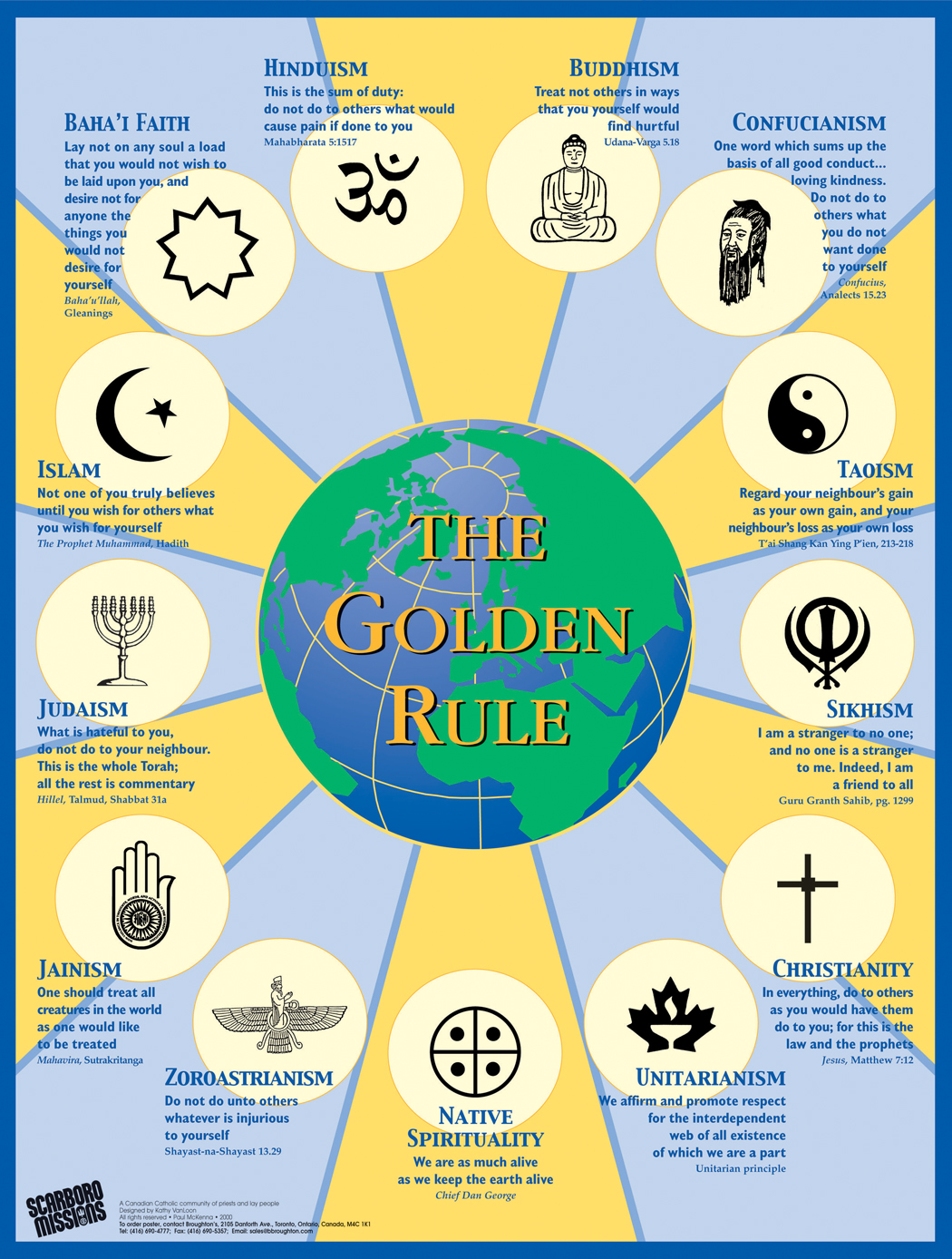
I have found endless versions of this rule, sometimes referred to as the Platinum rule or Universal Rule. You can find slightly grainy pictures like this one (because they want you to actually buy the nice clear one) depicting some of those guiding principles of other cultures.

Image result for golden rule poster

You could spend hours discussing which one is better or which fits you better. Whatever you do don’t start fighting about it or you have completely missed the point.

To avoid that kind of fight about Popper’s quote, I need to go back to it because it contains a few key words that were adequate to what he was saying at the time, but now that we have rebuilt Europe, taken down the Berlin Wall, found our way to a world beyond two super powers bent on destroying each other and entered a world where empires can fall without the inevitable grab for power involving death and destruction on a massive scale, we need to develop a new language that acknowledges how all of our cultures share common bonds.

One of those words is “spiritual”. This word gets bandied about quite often in phrases like “spiritual but not religious”. I let people use whatever terms they want to define themselves, then, if I’m interested, I ask them to describe what they mean. So I don’t need to come to a consensus on what this word means. For my purposes here, and I think adequately for Karl Popper, spiritual things are not material things. They are the hard to measure things like feelings, the value of health over wealth, and knowledge as an end itself instead of a means to something else.

In the quote, Popper is putting the “tribe”, the ones who defend a bordered territory, a set of traditions and ties of birth and history up against an idea of listening to as many voices as possible and synthesizing and harmonizing them for the good of all. Democracy in this quote is not just majority rule or an ideology tied to an economic policy and a particular constitution, it is the ideal of maximum inclusivity and plurality. At least that’s how I see it. That he says “rise of democracy” indicates to me that he still saw much work to be done.

I’ve already addressed that the idea of individual over tribe is not solely a Western idea, but Popper also makes the claim that it is the central doctrine of Christianity. This is a Western-centric statement. It even ignores the very Eastern roots of Christianity. It’s something we have to deal with when evaluating any wisdom coming out of thinkers in the mid 20th century and even more so from those before that. Popper knew his ancient philosophers. I don’t know how well he knew religions. Regardless, I’m not going to devalue him or his sentiment because he choose this particular symbol of neighborly love to express it.

The Old Testament and the New as well as commentaries surrounding them have versions of their greatest prophets being asked how to summarize their teachings. They all say something like loving God and loving your neighbor. Trouble is we also have a wide variety of scholars who spend their days trying to understand words that have been translated through a few languages and through many cultures. Even today, the word neighbor can mean the person next door, or an adjoining country. In Biblical times, it may have meant only Jews or only certain Jews. By the time the gospel of Luke was written, it appears it was starting to mean more than just that. Later letters though, like 1 John, appear to be returning to more tribal thoughts.

The rise of democracy and broadening sense of morality include the idea that we care about a wider and wider circle of people and places. If we agree on that, then it doesn’t matter so much that Christianity has it as a core tenant. It’s great, don’t get me wrong, it means they are on board with the arc of human history, but it doesn’t say anything special about that particular part of history. I suspect if I was alive in Popper’s time, I could have easily been happy knowing I was a Christian and that my traditions included loving those around me in the way I would hope to be loved. I’m glad I’m alive now in a time when I know that sentiment has a much wider reach and is derived from a wider base. I know it’s something even my enemies have some sense of.


Mark on the Golden Rule and its link to Old Testament
Luke and the Golden Rule and it’s alternatives
Leviticus early version of the Golden Rule, Matthew too, what is a neighbor
1 John


* Strong atheism involves the denial of all, or at least one god in particular. Usually it’s saying they know gods do not or cannot exist. “Hard” or “Explicit” atheism also state gods don’t exist with some degree of certainty.

Saturday, November 17, 2018

Atheism for the Religious and/or Spiritual 3


To understand this search for who we are and how what we think of ethics and morals has evolved, it helps to look back to the time when religion still dominated. If you go back too far it gets impossible to know just what people were thinking, not that it’s possible to know what anyone is thinking at any given moment even in the present, but at least we start to find more articulate writing sometime around the 12th century. To get to those early Humanists, I’ll first tell what I think is the fascinating story of how Western ideas traveled east then returned over the course of a millennium.

Previous                  Next                            First

The 4th to the 14th centuries

As Rome fell, Plato and Aristotle fell out of favor. And when you fall out of favor in a warring ancient empire, it’s a lot worse than having your facebook account revoked. Anything written that contradicted an emperor could be burned, sometimes along with its author. Much of their works were taken east to Istanbul, which became Constantinople, the center of the Byzantine Empire. This was a Christian empire so they weren’t too interested in what the writings said, but they kept them. Language was also changing so even if someone wanted to read them they would need special training.

When the walls of Constantinople were finally breached by the Muslims, the writings were passed on to that Empire. They didn’t do much with them either, other than create copies and translate them into Arabic. Four hundred years later Ibn Rushd (also known as Averroes), schooled in law, theology, medicine, physics and more was commissioned to figure out just what those men were trying to say. He had to do this while maintaining his position in a theocracy. That is, he tried to balance the godless world of reason with his employers who were working to spread the word of Allah throughout that same world.

By this time, the Muslim Empire had reached its peak and was beginning to fall apart because it’s just plain difficult to maintain an empire that size and they continued to choose emperors based on the inheritance of kings instead of any merits of those kings. Also, the theologian Al-Ghazali had become popular with his Revival of the Religious Sciences, saying they needed to get back to their spiritual roots. He sparred with Averroes, writing Incoherence of the Philosophers and Averroes responding with Incoherence of the Incoherence. Averroes spent much of his last years in prison, so you can see how that went. In the next century, the Mongols sacked Baghdad and the Muslim Empire has never recovered. Fortunately, they survived long enough to ally with European Christian armies and prevent the spread of the Mongols further west. Not only did we never send them a thank you note, we took the works of Averroes and other translations and philosophy and made it our own.

With the works of the Greeks now reunited, it fell on the likes of the Christian Thomas Aquinas and the Jewish scholar Maimonides to take another stab at unifying the ancient with the modern. The 13th century version of "modern" anyway. Teaching of Aristotle’s works was already under the watchful eye of the religious leaders. They were fine with logic and biology but wary of the metaphysics, psychology and anything touching on values. Professors had to stop teaching these subjects at the University of Paris or move to Oxford or Toulouse. These debates continued on to 1277 when a somewhat hastily thrown together list of Condemnations was published.

The idea of churches controlling what universities teach seems ridiculous today, so this is often seen as a horrible period of suppression of knowledge. It is also seen as the beginning of science since the result of the Condemnations was to divide the areas of the study of religious matters, like who or what ultimately controls the universe or what is or isn’t a miracle from areas allowed to be studied methodically like the motion of objects in space or the workings of living creatures. There was also dogmatic adherence to Aristotle and these bans forced the professors to develop proofs of his ideas. There is no one point of the beginning of science. Applications of scientific principles can be found in pre-Christian Rome and throughout the Muslim Empire as well as India, China and the Americas; however 1277 was a turning point in human history. At least Aquinas got sainthood not long after he died, which meant the Condemnations pertaining to him had to be adjusted. The world was changing quickly from then on.

Early Humanism

Not much was going on in the development of philosophy for that thousand years, but then voices like Erasmus began to emerge. His training was in the priesthood because that’s pretty much what you did if you wanted an education, you studied the Bible, in Latin. Hardly anyone spoke it, but it was the language of the Vulgate Bible, the one that was assembled in 382.  It remained The Bible until scholars tried to reconcile it to the original Greek and began to question the meaning of words, verses and whole books. This scholarly work grew out of the Renaissance and it has direct parallels to the work being done today to rescue Christianity from the hands of the Fundamentalists. With his reinterpreted version of the New Testament, Desiderius Erasmus hoped to restore and rebuild the Christian religion. He did not care for the 4th century theology of St. Augustine preferring that of the earlier Origen of Alexandria who only garnered the title of Church Father, not sainthood.

Augustine wrote extensively on what horrible creatures we are and how we can be nothing but sinners due to our fall from grace in the Garden of Eden. Wikipedia summarizes his text titled On the wretchedness of the human condition thus; The text is divided into three parts; in the first part the wretchedness of the human body and the various hardships one has to bear throughout life are described; the second lists man's futile ambitions, i.e. affluence, pleasure and esteem, and the third deals with the decay of the human corpse, the anguish of the damned in hell and the Day of Judgment. Origen and then Erasmus did not see it that way. Reading critiques of Christianity today, you would never know this debate ever occurred. You would most likely be familiar with Pope Innocent III who launched one of the crusades. Innocent was a fan of Augustine. But most likely you have not heard of the response to it On the Dignity and Excellence of Man by the early humanist and Christian writer Giannozzo Manetti.

Manetti and others developed the principles of Christian humanism; every person is sacred and autonomous, we are participants in our salvation, not passive actors waiting for the end times, and religious pluralism. Pluralism was also being expressed by Sufi writers at the time like Ibn al-Arabi who said god is not limited by any one creed. With all of these men, a connection to their traditions was still maintained. Al-Arabi famously said, “So for wherever you turn, there is Allah.” He may have seen the divine in every face, but the divine was the god he grew up with. He did not relinquish his faith. Since their ability to get published was highly dependent on maintaining a faith statement, they may have hid their private thoughts.

An art historian who believes he has uncovered some evidence of this dynamic between artist and patron is Antonio Forcellino. While cleaning a sculpture made by Michelangelo he found a flaw and theorized that in the middle of making the piece, it had been changed. His theories about Michelangelo might be wrong, but they are interesting to consider. In 1505 Michelangelo was commissioned by Julius II to paint the Sistine Chapel. In 1513 Julius dies. Michelangelo has been paid to sculpt statues for his tomb but this is a time of contention among Catholic leaders and they pull him into other work. His work continues to be pulled in two directions by Popes and Cardinals.

They are also vying with each other to either split off the newly forming Protestants or work on reform within. Some of them, including Cardinal Reginald Pole, start a society called the Spirituali. Michelangelo is known to have attended some of their meetings. They eventually had to start meeting in secret when Pope John Paul III established an official Congregation of the Inquisition. When Michelangelo finally completes the tomb of Julius II it appears he may have included symbolism indicating his leanings toward that group, rather than the Church that was actually paying him. He included a torch, which could be a symbol of the power to enlighten and the Protestant belief that works alone can’t bring you to Christ, and Moses is looking to the left, not at the altar where the church leader is but instead searching for the light and contact with God. When Michelangelo died, his body was whisked away by his Spirituali friends and many of his papers went with it, so we may never really know

I used the book God’s Philosophers as a source. This link is to a negative review, but it links to rebuttals right at the top. I wanted to provide more than one perspective on this book. 
Randall Poole Alsworth lecture on humanism 


Friday, November 9, 2018

Atheism for the Religious and/or Spiritual 2


If this [the Mysterium cosmographicum] is published, others will perhaps make discoveries I might have reserved for myself. But we are all ephemeral creatures (and none more so than I). I have, therefore, for the Glory of God, who wants to be recognized from the book of Nature, that these things may be published as quickly as possible. The more others build on my work the happier I shall be.
— Johannes Kepler (1595)

Beginning of this series                                                                               Next

I am goingto get into the problems of 4th century Christianity and other dark periods, but first I want to talk about the problems of the Enlightenment. These are less often discussed. I don’t mean that the Enlightenment was a problem or that it is at the root of “our” problems today, but there were aspects of it left incomplete and some of its reasoning was misused. We have not corrected for these errors and we can’t if we remain unaware of them.

To be clear, I think this was one of the most significant phases of human development. From the time of the Buddha and Socrates until into the 15th century if a person who had absorbed all the knowledge of their day could time travel throughout those centuries and sit down for a discussion about the universe and how it works, they would be able to understand each other. Barriers of language aside. By the end of the 16th century so much had changed that parents would have trouble conversing with their children. Anyone who didn’t have a cell phone when they were a child knows this feeling.

Douglas Adams calls these the first two ages of sand. We took sand and molded it into lenses and looked out at the stars and realized they weren’t what we thought they were. We looked closer at everything with microscopes and began to deconstruct how things were made. We applied first principles and built on what we could demonstrate to be true. These concepts had been incubating since the dawn of human tribes but now they were seen not just as tools but as a philosophy. This new philosophy said we could experiment with everything around us and learn from it. We could read the book of nature. The concepts and discoveries from people like Newton led to the third age of sand, the silicon chip. Formulas developed at that time were used to put us on the moon and theorize how the universe began.

But I’m getting lost in the arc of progress and wonders of science and that is perhaps one of the mistakes I said I was going to talk about. There was an overwhelming faith in the ideas coming out of the Enlightenment. I’ll leave the philosophical discussions of what is good or bad about scientific progress for now and look at the problems created by this shift to rational thinking.

Rationality was not invented 500 years ago. Even if you are trying to figure out if your neighbor is a witch, you will use a certain degree of investigative thinking. Once you accept that there are witches, and come up with some basic ideas about what they are, the process of working out the logic is very much like that used in a laboratory. If the experiment you devise involves dunking in water, because witches float, this could work out bad for the person being tested, so when we talk about rationality today, we mean a much larger context, one that involves not just a single test, but proven techniques, repeated trials, and the ethics of the test as well. But still, the idea of performing an experiment was always there.

This era that led us away from burning witches and produced so much of what we now considered the modern world, also has an end. The effect of it never ended, but the movements and the people who can be said to be part of it, ended. As Martin Luther King Jr. said, “the arc of history bends toward justice”, but it is an arc, not a straight line. What began as a reaction to a bloody 30 years of war (1618 to 1648) ended with more war and more conquering by people like Napoleon. One of the last, perhaps the last, philosopher of this age was MarieJean-Antoine-Nicolas Caritat, Marquis de Condorcet.

Condorcet was a contemporary of Jean-Jacques Rousseau. His philosophies, like the “general will” were the inspiration for revolutions against despotic rulers with slogans like “Liberty, Equality, Fraternity”. A century before the abolition of slavery in the United States, Condorcet founded the Society of the Friends of the Blacks. But these ideas, no matter how noble, still had detractors and they required enforcement. Other men, like Robespierre did not have the patience for them to permeate into the world peacefully. The king was replaced by the assembly and anyone who deviated from what the assembly determined was the general will would be subject to its force.

This new idea of laws coming from nature was an early Enlightenment idea put forth by the likes of Francis Bacon. He felt that our destiny was in our hands and if we deny that dream we will return to barbarism. But perhaps we didn’t spend enough time understanding our nature before some decided to start enforcing its laws. In his final work Sketch for a Historical Picture of the Progress of the Human Mind, Condorcet applied to ethics and morality the idea that there are laws of physics that are consistent throughout time and space and that principle can extend to how we operate in the world. But even as he wrote this, the dream seemed to be dying.

Robspierre and the Jacobins were in the process of arresting some 300,000 and killing nearly 17,000, eventually this included Condorcet. These numbers sound terrible and they are in fact called The Reign of Terror, but as with all such state sponsored terrorism, they were justified by the political climate. France was surrounded by monarchies and they were prepared to join forces and restore Louis XVI. To preserve the newly formed country, they needed to ensure the loyalty of all of its citizens. A prime focus of this was religious authority and its ties to the aristocracy. While America was forming around states founded by religious groups seeking a place to practice their faith freely, France was stripping power from the Church and killing priests. Religious ideas that many Americans say their country was founded upon were considered barriers to the new government of France.

People who have faith in gods or spirits or anything non-material will criticize proponents of scientific methods by saying they put their faith in reason. The above brief look at the history of the movement toward science and reason demonstrates there is some validity to that sentiment. Much more could be said about the advancements in our ability to feed and heal the ills of human race, and that again could be countered by the ills that have been wrought by our own hands. This is the conversation in which we are currently stuck. The work of science is not likely to stop any time soon. The answers it provides lead to more questions and they provide the impetus to keep looking for answers. Faith is not likely to disappear any time soon. The answers it provides often resonate with us in a way we can’t necessarily articulate and scientific explanations for those feelings are not coming quickly.

Religion spends a lot of time addressing the big questions of meaning. Books like The Purpose Driven Life have been wildly successful while books by 17th century philosophers continue to collect dust. This could be more a matter of public relations rather than actual content. People say they get something from going to church, people who read philosophy might also say so but not in a way that is terribly inspirational. Philosophers of course have something to offer in that market, but they also have detractors and they argue amongst themselves. Comparing and contrasting philosophers is part of how you do philosophy. Some people shop for a church, but most go on the advice of someone close to them, and once they find one they are comfortable with, they don’t keep comparing.

Enlightenment philosophy and the movements that came with it took power away from the church. This had the appearance of taking away a moral anchor for society. Friedrich Nietzsche said, “God is dead”. He on went to say that it was we who killed him and to note that there was a great danger to this. In Thus Spoke Zarathustra he portrays a man who seeks only his own comfort, unaware of what he has been given by previous generations. Men like that are subject to those who understand and use their will-to-power. Interpretations of these characters are endless, but there is definitely a shift to seeking human will rather than the will of any gods. Eventually, these philosophies came to be blamed for everything from slavery to Nazis.

Without going off into a long history lesson, slavery was not invented by Columbus or plantation owners in the Southern United States. It may have been one of the longest running and most brutal forms of institutionalized human trafficking, but the idea of people owning people was around before written language. The oldest decipherable writing of significant length is the Hammurabi code, a code of laws that includes slavery. Empires conquered smaller tribes and brutal dictators reigned back in Biblical Times. Separating this warring nature of ours from our higher aspirations is one of the promises of the Enlightenment that has been left unfulfilled.

The modern world can be blamed in part for these ills. Certainly it has provided new and improved tools for warfare. Strong militaries have always included protecting trade as part of their mission. The Golden Triangle of tobacco and sugar to Europe, manufactured goods to Africa, and slaves to America is no exception. But there are no simpler idyllic times to return to. The Romans had the Pax Romana. Pax means peace, but what it meant was criminals who interfered with trade along their roads were strung up to set an example for others who might consider anything similar. Many examples can be found in between. Any culture carries with it the baggage of our baser instincts, making it difficult to sell its ideology as more progressive than any other.

This list of problems with the Enlightenment is not exhaustive, but I’ll end with the bogeyman; postmodernism. Whatever you think about religion and its ability to deliver on a meaning for life, it’s hard to argue its ability to claim that it is doing just that. The early Enlightenment thinkers made similar claims, but then didn’t deliver. Philosophers today might be coming together around something called Moral Realism but of course it has its detractors and it mostly suffers from a century of more esoteric moral arguments that led to ideas about nothing having any meaning. And morality isn’t necessarily a reason for being anyway. As the world has shrunk, cultures have come into constant contact and although you could say it is progress that we are living next to each other without killing each other, we are also having trouble figuring what strange behaviors we should accept in our neighbors and what we should consider just plain wrong.

It didn’t help that around this time Einstein came up with his theory of the physical world and the phrase, “it’s all relative” became popular. His theory involves travel at very high speeds and calculations that only come into play if you are trying to land a probe on Mars, but no matter. In the past, the realization that Muslims were enslaving Christians was used as an argument for why Christians should not be enslaving Africans. Either owning another person is wrong or it is not. Now, a justification based on a tradition can be dismissed because it is a tradition in a certain part of the world. It might be wrong to discriminate against women and not educate them according to people who live in the Midwestern United States but it is okay in Afghanistan because it has always been that way. This is not a way of determining what is ethical that can be traced to any particular Enlightenment thinker or writing, but many consider it an effect of that movement.

I can’t summarize the centuries that it took to develop this strange way of thinking, but it probably has something to do with the sudden unmooring of that anchor of morality, the Catholic Church. Once that curtain was pulled back, and the arbiter of all that is good in the world was accused of perpetrating evil, it could not be covered up again. Once the constant fighting stopped, when we realized one religion was not going to win out over the others without killing us all in the process, we had to figure out how we could live together. We’re still working on that.


Monday, October 29, 2018

Atheism for the Religious and/or Spiritual


I have been working through the 3 year Lectionary cycle of the Christian Bible. People ask me why, given that I don’t believe in the Christian God. It’s not a simple answer. It lies somewhere in the people and ideas I discovered along the way. They don’t fit neatly in a box.

"Mystery generates wonder, and wonder generates awe. The gasp can terrify or the gasp can emancipate. As I allow myself to experience cosmic and quantum Mystery, I join the saints and the visionaries in their experience of what they called the Divine,..."
Goodenough, Ursula. The Sacred Depths of Nature. 

The God Box

In William R. Herzog II’s book Jesus, Justice and the Reign of God, he summarizes Robert Funk’s and Robert Miller’s work, Finding the Historical Jesus: Rules of Evidence, saying, “The Gospel writers ‘invent narrative context’, provide interpretive overlays, soften hard sayings, ‘attribute their own sayings to Jesus’ and translate Jesus’ words into ‘Christian’ language.” This was acceptable and expected of writers at the time. Anything you wrote was expected to be your perspective on it, not unbiased reporting of what someone else said.  This is especially true in the genre of storytelling. The teller adds their unique voice.

For Herzog, this doesn’t diminish what the Gospel writers were doing. He wants to understand what they were thinking by understanding how they developed their narratives. He isn’t attempting to make a case for or against the existence of a man named Jesus, although occasionally in his books he will make a comment about words having come from such a man. His main goal though is to determine what the words were attempting to teach.

Thomas Sheehan, in his lectures on the Historical Jesus (available on iTunes University), puts this search in a slightly differently light. He says the Old Testament legends are “read into” Paul. Paul’s writings came before the writing of the gospels, despite their order as they appear in the Bible. Paul's words are then “read into” the gospels. Looked at this way, you see their influence and how the story of a man became the story of a god. How the Kingdom of God Became Christianity

He begins his lecture series by saying you might be challenged to rethink Jesus. It’s not his intention, but it is a possible consequence of the study. He uses the name Yeshua ben Josef, because he is starting the history at a different point than the New Testament. He, as well Herzog and most scholars agree that the Gospels alone do not provide a consistent picture of a historical figure. Yeshua, or whomever it was that inspired the Gospels, cannot be accessed through the lens of the Jesus that has been handed down through the centuries.

Much of the effort to reconstruct how this was handed down to us was conducted by well meaning and devout Christians and Jews. This deconstruction and reconstruction has not thwarted the efforts to maintain the relationship between the God of the Bible and humankind. Some young people, called to ministry, don’t survive the education they receive at seminary. Once they learn how the Bible was assembled and the church came to be, the magic is gone. This could explain why those details are not heard from the pulpit. Religious education for the congregations might be offered on a Wednesday evening, but those are not well attended. Perhaps people just aren’t interested and would rather keep the mystery just as it is.

Some can bridge the gap between the literary and the historical. Eugene Peterson, who created The Message Bible, offers us a way to approach this academic exercise of attempting to understand what these ancient authors were trying to tell us. In his interview with Krista Tippet on NPR’s On Being, he talks of metaphor. “A metaphor is really a remarkable kind of formation because it both means what it says and what it doesn’t say. Those two things come together, and it creates an imagination which is active. You’re not trying to figure things out; you’re trying to enter into what’s there.” As a metaphor for metaphor, he refers to the hoop one uses for embroidery. The fabric is us, loose and unfinished, so it is stretched by the hoop then you can work with it, create the needlepoint art. He offers people poetry like the Psalms or sometimes Dickens and says, “just let your mind stretch around it, and see what happens.”

It’s important to note that you don’t leave the fabric in the hoop. At some point you move to a different part of the piece and hopefully you actually finish it and put it to good use. Peterson also said “People ask, ‘How do you mature a spiritual life?’” And he responds that you should eliminate the word “spiritual.” “It’s your life that’s being matured. It’s not part of your life.” The idea is not to get lost in these words, but to move with them and bring them into your life.

For others, the investigation into what’s factually true as opposed to what’s factually false but holds some metaphorical meaning that can be understood leads to a path that can no longer be called religious. Ryan Bell, a pastor who became increasingly liberal in his teaching until he was told he could no longer keep his position as a pastor, took this investigation about as far as it can go. As he put it, he kept learning new ideas, like the forgeries and mistranslations in the Bible or the science and psychology of LGBTQIA+ people and the limitations of inclusiveness that he found in his traditions, even in the words of Jesus. He applied the gospels to teachings of peace and justice and found he sometimes had to skip parts when preaching about them. He kept trying to fit all of this into his “God box”. He knew the ideas were right and he felt Christian teachings should include them, but what he had been taught did not always comport to what he was learning. The God box had to expand with each new thing. One day he realized the box was as big as all of his understanding of the world, and he no longer needed the box.

You might land anywhere along this spectrum. I make no claims here. The overwhelming number of people throughout history who say they have found inspiration in the Bible is not an argument I care to take on publicly. I can only report what I found and hope to engage a few people and listen to their perspectives. My own investigations have taken me through many books on philosophy and history and how they fit in with The Enlightenment and The Dark Ages and that elusive first century. I have almost as many questions as I did when I started. I don’t need to repeat that history, but I’ll connect a few dots, hopefully correctly.

More importantly, I hope to expand your definition of “atheist”, just as pastors and lay people I have met over the last few decades have expanded my definition of “theist”. I’m not sure if this quote is attributed to anyone in particular, but I think it came from Buddhism, “There are as many religions as there are people.” You don’t need to join the church to enjoy a hymn and you don’t need to leave it to be inspired by the exploration of the stars.

So with no particular goal in mind, I’ll start the conversation with a Psalm. You may find “stretching” yourself around a Psalm is perfectly comfortable and is a place you want to return to again and again. If you’re like me, you may it find it hard to see what all the fuss is about. Psalms are frequently drenched in allegory. With “saving horns” and “Cherubs” and “bulls of Bashan” and words that defy translation I wonder what they are talking about. Are they just pleas for mercy and justice, or something more? But sometimes, as in Psalm 40, I can feel the poetic tension pulling toward something we aspire to while knowing we will inevitably fall back. Year A, Week 2

Next in the series

Friday, August 3, 2018

Jesus didn't say that

A response to a response, from the Counter Apologist.

http://counterapologist.blogspot.com/2018/08/atheism-is-preferable-to-christianity.html

There are few ways to go with this. CA’s original statements stands well on its. Also, in any current form of religions I know, there is no preferable universalism that I know of. My problem with Randal is, he doesn’t go far enough with interpreting hell out of Christianity. I think that can be done, although it strips Christianity down to its Jewish roots, even into some type of Reformed Judaism, so it probably is not a popular route. My problem with the Counter Apologist is the use of assuming beliefs by the gospel writers when it’s convenient while claiming we don’t know what they meant most of the time. I think this hinders the very reforms we want to see in religion.

Starting with the reforms; I don’t think it’s a stretch to say the arc of the Biblical narrative is that history has a goal, that there is some inherent reason for our existence, and it’s something good, and we need to discover our part in making it happen. This is the MLK thesis on justice and even if you take the atheist view of meaning created by the individual, it is compatible with a goal oriented form of utilitarianism as a theory for morality. To have this discussion across cultures, we need to be reasonable and accept that neither modern philosophers nor the Bible have a clear sense of what “justice” and “good” are. Modern philosophy accepts that, practically as a premise. The Bible has its moments, like Job arguing with God, but for the most part modern day practitioners of Abrahamic religion believe a supernatural force is the source of “good” and don’t care if they can’t prove it with scripture.

The above point is somewhat proven in the way Randal backtracks on his own religion when confronted with a rather straightforward problem like eternal or long lasting punishment. So let’s look at how CA supports the argument.

If atheists want to make the point that the Christian version of hell is wrong, I don’t think they need to stray deep into what the Bible says hell is. The Bible is not clear on that, that’s clear. Atheists don’t need to quote Jesus to prove Jesus was saying something. This degrades their own arguments since they begin with the understanding that the gospels are a poor reflection of any actual Jesus. This is the consensus of scholars, including religious scholars, but it seems to get forgotten when atheists start looking for proof texts. We are always quoting unknown authors and worse we might be quoting many authors in the course of just one passage.

For example, “torments” and “flame” in Luke 16 might be an allegory of justice for the rich man who neglected to care for the poor man at his gate. The thrust of the parable up to that point is about upending the power structure, and rewarding goodness for goodness sake instead of rewarding the powerful just because they do their rituals. This passage looks like a Greek version of hell getting tacked on to an earlier tale. Whether that was for better marketing of the book or because that belief was creeping into Jewish culture is debatable and barely relevant to a debate on the reality of hell.

What I think is important here is to recognize the opening Randal gives us. Christian scholars are quick to say things like Hellenism had crept into and corrupted Judaism at the time the gospels were being written, but they are slow to say exactly how. Christian scholars probably won’t lead those discussions because they suspect or fear they will result in less believers. This is exactly why atheists should be pushing in that direction.  Two passages from Revelation were included in CA’s list. Maybe Randal is open to eliminating Revelations from the canon. It has been debated since it was first proposed and is not in some Bibles. If it is an inaccurate depiction of hell that is incompatible with 1st century teaching, then let’s settle that and then move on to the next misinterpretation, redaction or mistranslation.

This might sound daunting, but I don’t think every line of scripture will need to be addressed before Christian culture begins to change. This approach to the Bible has been happening for a long time and has altered many denominations and led to reforms like women and gays being accepted. Atheists would do well to understand it.


Tuesday, July 24, 2018

Light at the end of the tunnel

I'm getting very near the end of the 3 year Lectionary cycle at www.milepost100.com. 

When I started, I didn't want to start in Christmas or Easter, because I thought they would take more research. I started in the first week of "Proper" time in year C, which was about May 2016. As it turns out, the summer time readings are much more interesting than those classics most people are familiar with. You know, the coming of the baby Jesus and the whole thing with the tomb.

The downside is, I just missed a really interesting entry from the book of Nehemiah. It's the only entry for that book. The book firmly sets the stage in the time after people are released from exile in Babylon. There is no ambiguity about the historical context. Then Ezra starts preaching. As he does he explains the meaning of text and clears up what might be seen as contradictions.

This is time in history when the ancient scriptures were being assembled and sometimes redacted and here is a story that essentially tells you they are doing that. How we got from there to people to believing that the Bible is the exact word of God that anyone can read and get the same message, I can't explain. It took centuries to screw it up that bad. The opposite is true, that is, you can read it and it tells you that is a collection of writings written by men attempting to convey a variety of meanings throughout time.

Basically the theme of my Lectionary helper in one chapter of scripture.


Wednesday, March 7, 2018

Work for Peace

This is a continuation from last week.

Quitting religion for me was somewhat like quitting smoking, I did it several times. I probably could have gone on having positive moments with that community and just accumulating the good memories, but I kept thinking something about it wasn’t good for me. I could have focused on observing people going to church around me and then acting in the world in positive ways. In a slightly different world, that could have been enough to allay the doubts and just dismiss them as the normal human condition of not knowing the answers to the ultimate questions.

Church is very good at handling these doubts. They love to bring the lost sheep back into the fold. They have a wide of variety of books and techniques to deal with loss and pain. Not quite as well advertised, they are also willing to cut you loose if you don’t respond the way you are supposed to. I’ve heard more than a few stories of kids getting kicked out of Sunday School for asking too many questions. Adults need to figure it out for themselves and for some it can be quite painful. Some people leave behind their whole system of community support when they leave a church.

I was lucky. I was able to observe all of this safely and find an alternate community just by asking around. It took effort and time, but it was something I could afford to do. Some people are isolated and only have one version of religion presented to them. You can be isolated even in a densely populated urban environment, especially when you are young and still need the support of the people who raised you.

If you find yourself in that situation, the only advice I have is that of Charles Eastman’s father. Eastman, also known as Ohiyesa, was a Lakota, born in 1858 when the US government was forcing his tribe to relinquish their ancestral knowledge. His father, who had almost been killed as part of the largest mass hanging in US history, told him to not fight it, to learn as much as he could about the ways of the people who had conquered them. Eastman became a doctor and wrote about Sioux ethnohistory and even got invited to the White House as a sort of ambassador to the tribes.

Anyway, that wasn’t my experience, but in 2009, a book came out, 50 Voices of Disbelief. It told stories of people who had experienced that isolation and indoctrination. Many of them had gut wrenching experiences making the transition from their isolated worlds to the real one. Those stories really hit me and were difficult to not think about. I’ve since talked to many people who were raised in what we might consider a normal Middle American fashion that included religion and didn’t find the transition quite so hard.  They were given resources like a college education and understood they had choices, even if those choices caused a little disappointment with their parents.

I think we dismiss these stories a little too easy. There is a spectrum. There are certainly abusive churches out there and I don’t have a problem focusing on them, but I have heard the same fundamentalist half-truths and apologetics in the most liberal of churches. In one of my Bible study classes, back when I was still Christian, someone came to class having just read an article about the Leviticus 21 passage about slavery. She was concerned that the Bible clearly supported slavery. The pastor smoothed it over by talking about how slavery then was more like indentured servitude from a few centuries ago. We didn’t open the Bible and examine the verses in question or address the problem at all. She didn’t even get a chance to talk about them, so at the time I didn’t know the verse I just linked. I just filed the concern in the back of my head as a minor problem. Years later I had to have Matt Dillahunty, an atheist podcaster, shove those verses in my face before I understood my mis-education. 

I’m sure that pastor was just repeating what he’d been told. He probably avoided looking at those passages and that is exactly what he wanted us to. Any similar or more direct questions I have asked of religious people of all calibers since have been met with similar dismissal or, my favorite, “that’s not our church”. The story of the pastor above is someone I care about very much. I have other stories of churches that I have and still consider wonderful communities that are doing great things. That’s how I tell these stories. The entire point of the stories is that they are doing great things, and, and, they can’t reconcile that with the fundamental founding documents of their organization. But it doesn’t matter how well I paint those communities, when I tell the part about the slavery apologetics, or the kid who had to be excused from Sunday School, the response is, “that’s not our church”.

They might even have some evidence. They might say they learned from the pulpit that the book of Timothy was not really written by Paul and the anti-feminist stuff in there does not apply. They might just consider it obvious that slavery is bad and not understand why they even need to address it. If I point out that good Christians of the not too distant past supported slavery and patriarchy they still say it’s not them, that it’s in the past. When I point to Christians today not accepting homosexuality, they are at a bit of a loss for words.

What’s missing in these aborted attempts at a conversation is that these changes in morality were not guided by or sourced from any religious authority. It may have been Christians who led the abolitionist movement but they had to draw on secular philosophy and modern data to make their case. If people claim “their church” is modern and open to new data, it is data that is coming from outside the teachings of 1st century Judaism. For that matter, the gospels include the teachings from people outside of 1st century Judaism. This is the one of the paradoxes of modern religion. To be modern you acknowledge that change has happened throughout the history of the church, but when I try to get one religious person to address a particular needed change today, suddenly they don’t act so modern.

People who try to tell me that their church is different and wouldn’t act the way I describe people in my experience are, most likely, not asking the questions I asked or reading the books I’ve read or accumulating the doubts like I did. To remain in a church, or possibly any organization, you have to allow for some parts of it that you don’t like. It’s a matter of degree of how much is tolerable and explainable. For example, I have on occasion considered leaving my country due to some of its policies and actions, but overall, I like it here and prefer to follow the advice of Carl Schurz, an immigrant who fought in the civil war. In 1872 he said, “My country, right or wrong; if right, to be kept right; and if wrong, to be set right.”

There is no particular wrong that caused me to leave church. It was the inability of it to address what was wrong. Religion is uniquely designed to avoid change. It holds up the ideal at the highest levels of decision making that if you sit quietly in a darkened room with your eyes closed and just ask for answers, they will come to you. Change comes through claims of revelation and requires that you connect your revelation to an earlier figure in the tradition, an earlier figure that might not have even existed. This is the opposite of using reason and evidence and observation and worse, the opposite of listening to the voices of those around you.

Being frustrated with an organization you are member of, or your country or your family or anything in between is not that unusual. We all settle on family having done the best they could, well, most of us, I realize some families are really messed up. We accept that we get something for the taxes we pay and we hope that next time we’ll have better candidates to vote for. No matter what, we look for underlying principles of fairness and some sort of logical progression from biological needs of love and support up to the day to day fulfillment of those desires. The Bible fails at that. Sure, Jesus said to “love thy neighbor as thyself”, but a lot of traditions said that before. And that was his second commandment, the first was to “love the Lord thy God with all thy heart, and with all they soul and with all they mind.” That part is not very well explained and has some serious problems.

Monday, February 19, 2018

Seeking Caring Community

I laid out the highlights of my not religious journey a few weeks ago, and it got me thinking about details along the way.

Some people have specific events that made them quit religion, but I’m not one of those. If anything, there were a few things I can remember that kept me hoping that I could get continued value from that community. One of those was meeting Rabbi Michael Lerner. He had written some books on applying his Jewish traditions to liberal politics and for a few years had been an advisor to the Clintons who were Methodists, just like me. Ideas like the Jubilee year where debts are forgiven or the Sabbath where you unplug all your electronic devices for a weekend. This was before smart phones. A lot a people talk about this as a good idea now.


https://www.tikkun.org/nextgen/images/header_lernerpage.png
A community formed around these and other ideas and that work continues. It’s good stuff, but the Biblical connections were not that direct. His work is a good response to fundamentalism. It shows you can go to church or synagogue or mosque and be inspired to work for justice and peace and equality. But if you’re looking to make a case that the Biblical narrative leans more to the left, I didn’t find that there.

For more detailed Bible study that does look for modern messages in the text, there was the Jesus Seminar. This group of authors was active the 1990’s. Dominic Crossan is still writing and speaking. Marcus Borg died recently. Robert Price has since become atheist, but he still studies the Bible. In the first book I read from that group, they put the gospels side by side and showed how they are irreconcilable. I have since come to see these things like this more cynically. They are things you can learn, but really not apply. It’s an anti-fundamentalist statement, but doesn’t tell you much about what the gospel authors were trying to say.

They are a way a church can show it is progressive and opening up to new scholarship, but they don’t integrate the study into the full mission. I read that book as part of an adult study class. That’s where this kind of study usually ends up, relegated to the basement with a small group. They are a spoon full of progressivism for those who are asking for it, but they are still feeding the same old buckets of liturgy every Sunday.

So, that’s my cynical view, but I have to admit that some of this education included the political messages of the narratives. These are stories of an oppressed people under the rule of a conquering empire that had co-opted their religious leaders by sharing some of their riches with them in exchange for keeping the populous in line. That’s a universal story that repeats itself throughout history up to this day. What the Bible offers are stories about how they dealt with it.

For example, when Jesus says, “render unto Caesar that which is Caesar’s”. He doesn’t mean, pay your taxes and shut up. Before he says that, he gets a Pharisee to pull a Roman coin out of his pocket. That coin has Caesar’s face on it, and he is considered a god. This is idle worship, and without saying it directly, Jesus just pointed out how the leaders of his religion are corrupted. We do this today by calling out Joel Osteen for not helping people during Hurricane Harvey.

So going down to the basement was one way to find deeper discussion about interpreting scripture, the other direction is up the leadership chain. There are a variety of seminars available to help potential leaders grow, and although you are again meeting in smaller groups, at least there is a sense this is the direction of the national organization, not just some pastor who found a book he liked. One of those classes I attended talked about something called the “Rule of Christ”. If you Google that you will get a ton of hits about Christ being the ruler of the kingdom. That’s not the one I mean.

The one I’m talking about is found in Matthew 18:15-20. It’s about how you handle a member of your group who is not on board with the mission. You speak to him privately then bring in more people if more understanding of the situation is needed. Then if needed go to whatever decision making body you have. If the situation still can’t be worked out, it may be the person has to go.  Now, there’s some danger of this being used to enforce “group think”, so 5 verses isn’t enough to cover that, but it’s a good start. It’s better than letting rumors fly or of letting one disruptive person poison every meeting.

That kind of study was going well for a few years then I thought it would be a great idea to become a lay speaker. A lay speaker can fill in for a pastor on Sunday and usually has some other leadership duties. I went to an all day event where we talked about what it was about and what the United Methodist Church was up to. One of their programs was called “Open Hearts, Open Minds, Open Doors”. Sounds pretty self descriptive, and from the diverse group of people attending the class, it seemed like openness was the direction we were all headed. The church that was hosting the event had an entire set displaying the idea with doors and banners.

Then one of the speakers gets up and a few minutes into his talk, picks up one of the brochures for that “open” program and says, “we don’t need to worry about open doors, we need to get back to the miracles in the Old Testament.” A little later at lunch, he floated this idea again, asking rhetorically, “what would happen if we all got up in front of our churches and started saying that miracles were real.” No one said a word, probably a pretty common response to someone saying something like that. He tried answering it himself, saying it would cause miracles to happen or something.

I wrote the district Bishop about it and received no response. I talked to a couple pastors and got sympathy, but not much else. One of the other leaders at the event said she wasn’t happy about it either, but there wasn’t much she could do. What I saw was, the church leaders believe they need to keep as much of the old ways as possible even as they try to move forward. This is obviously about keeping butts in pews but it is also simply a lack of vision.

There are people like me who want to be part of an organization that is serving those who want to work for a better world. We can, if we want, find groups that address specific topics and volunteer our time doing something we consider worthwhile. It’s harder to find a place that addresses our need for community, our need for places where we celebrate our accomplishments and counsel each other on our failures, where we discuss the foundations of our values. You can see the numbers by looking at the declining church going population. There are polls showing many of those people left because the church is not open to new ideas. But churches are not good at addressing that population. They are experts at welcoming the fallen back into the fold, but when someone is going through serious doubts, they are almost silent.

When I tell stories like this, I often hear the response, “that’s not my church. We’re not like that.” I’ll address that next time.

Saturday, January 6, 2018

Discipleship plan

I recently happened upon a plan for discipleship from the United Methodist church in the US. It perfectly demonstrates a big problem with church in the US today. I’m not talking about the bad arguments for god or fundamentalist handbooks telling you to watch out for your children turning gay. I’m talking about churches that want to be active in their communities, working for peace and justice and helping people who need food, shelter and clothing. The kind of things we want non-profit community organizations to be doing. The kind of things that reflect universal human values.

You may already know where things like this go. You could skip to the end. I try to bridge the gap between humanist values and expressions of faith like this. But if you’re not familiar with what goes on in church planning meetings, read on.

The workbook attempted to help leaders find new members and new ways to motivate the congregation to do good things. Like most workbooks of this nature, it wasted a lot of words, but that’s not what was really wrong with it. The problem was, when it finally got to saying what the underlying motivation should be, it didn’t say anything. It addressed this as a potential problem then solved it with Bible verses. It said you can’t just tell people “because god said so”, then it said, “because god said so”. Like this:

 Go therefore and make disciples of all nations, baptizing them in the name of the Father and of the Son and of the Holy Spirit, and teaching them to obey everything that I have commanded you. And remember, I am with you always, to the end of the age.  (Matthew 28 NIV)

This is known as The Great Commission. Not really a difficult choice for a passage in a pamphlet about mission statements. And, just to be sure you know the leadership is on board, he cuts and pastes from the 2016 Book of Discipline (the book the Methodists vote on to restate their theology in modern terms) "The mission of the UMC is: To make disciples of Jesus Christ for the transformation of the world."

He focuses here was on the word “go”, saying “Methodists are a going church”. There is some tradition to that, some historical evidence. There are Methodist hospitals. There are community support groups. Their international aid arm functions more like a non-profit than a missionary group. They do actually help people build infrastructure and become self-supported. They were chosen by the Gates Foundation for one of the largest secular/church collaborations ever.So, I’m not saying they don’t do things, but I think it has more to do with them having the resources, not some magic that has roots in the 1st century.

He suggests the “Why, How, What” approach. I was first introduced to this by my sales training from Apple computers. You’re supposed to start with the “why”, but he goes straight to “what”. A couple pages later, he shows the outward growing circle from Simon Sinek’s book “Start with Why”. You would be better off just reading that book.

I can see why he thought this workbook needed to be made. He sees the problem. He shows the numbers. 80% of the people who are Methodists were born into a family of Methodists and raised in the church. It’s hard to get members any other way. The early church offered something new and once it had established a base it helped that a person could travel from Jerusalem to Rome and find that community. But what the church offers can be found in so many other ways now, that is no longer an advantage.

He continues with quotes, this time from the founder of the denomination, John Wesley. It is from his sermon “The Scripture Way of Salvation” that is just as vacuous, but it is responded to by the pamphlet writer as if it is the way the truth the light. I’ll spare you that one.

I can see how he gets the problem he is up against. After a half page about children asking “why” and parent’s responding “because”, he says, “So why is it that when we ask, Why do we make disciples? we often respond, Because Jesus said so? … ultimately it is not a good “why.” But this is exactly what he has been doing, giving you “not good whys”. When he gets to suggestions for how to write your own mission statement, he comes up with an example like this, “A disciple is one who knows Christ, is growing in Christ, serving Christ, and sharing Christ.”

What I can’t tell by reading it is; what did the author of this think? As he was compiling it, I can see how he was motivated. He knows what experiences he has had, but it can be a challenge to translate that motivation into a workbook. At some point, he needed to find Bible verses that describe the feelings of joy in fellowship that he experienced and express them in a way that inspires others. I can relate, because I tried to do that.

When I did, I found there just wasn’t anything there, unless I believed it was there. The feelings I had of community were more due to the people I was in relationship with than my relationship with a text or a worldwide organization or with a holy spirit. This is why you will often hear people talk of their local church when they are defending the idea of church. You might begin by asking them what motivates them, and asking if they believe in what the Pope says or whomever their leaders are. When they realize they are not completely in line with their own denomination’s theology, they will switch to saying that you need to come to their church and experience their community, and then you will see. That’s fine. I understand the sentiment, but it’s true of any organization that is accomplishing anything worthwhile. You don’t need a god to get that.

When I look at things like this, I often wonder what doubts are arising in the people writing it. Are they, as I once did, realizing that it is a struggle to find just what Jesus was talking about? Are they even further along, seeing that he was talking about blood sacrifices and ultimate battles of good vs evil that have not survived modern rational thought and scientific inquiry? Or, do they believe that if 3 wise men followed a star to a virgin birth, then there must be something to all this and it’s not for them to question?

Do they at least believe that a man who spoke of peace, and then acted peacefully, even when given the death penalty, actually caused a significant shift in the history of the world? Do they believe the thoughts of this one man are more important than the few people who wrote them down as well as the thoughts of everyone who has read them and thought about them and built on them and expanded on them and interpreted them? Do they believe that the changes in theology over the ages are explained by God slowly revealing his truth, or is it us discovering the truths of nature and adjusting theology to fit them?

In a sense, the answers to these questions don’t matter, because we can arrive at the same place without answering them. We can all agree that we should educate our children in the history of thought and culture as well as the amazing details of how things work. We all need food and air and water and there is just this one planet where we can get those. We can be in constant battle over those resources or figure out how to cooperate and make them available to more of us. You can address all those questions with universal ideas like “love your neighbor” and a maybe a few more technical details.

In another sense, the answer to whether or not Jesus caused anything matters very much. It changes our focus. If Jesus can affect our lives directly, we should know that. If the fate of our eternal soul is in jeopardy, we should know that. If not, it’s a distraction. It might be a good inspiring story that helps us remember to reach out and touch the sick and bring them into the community, but reading those same stories over and over again takes time away from doing the work.

If, to get people motivated to work with us, we need to frighten them with hell or convince them there is something unseen that has consequences, or promise there are supernatural forces available to them, then maybe the problem is with the work we are asking them to do, not the motivation for doing it. If the work is good, but they are not inspired by the child who’s teeth are straightened or eyes are corrected or who learns a trade and goes on to help another village somewhere, then maybe we need to help them understand how helping others helps all of us.

After 30 pages, he finally gets to a list of actual things to do. Most of them are lifted straight from Matthew 25; feed the hungry, visit the sick. He also lists “works of Piety”, like public worship and fasting and reading God’s word. Brief phrases like this are all the Bible has to offer as far as I can tell.

There isn’t a passage that spells it out in simple terms, but I think the message from the early gospels is that we only have each other. It is a story of people who want to get rid of the temple culture that required constant sacrifices. They were written at a time when leadership was partnering with the ones who had conquered them and were oppressing them. In Mark 2:23-28 Jesus says the Sabbath is made for man, and in Romans 13:8-10 Paul says the new law is the law of love. That’s inspiration enough for me.

Sunday, December 10, 2017

Behold, I bring you tidings of great joy

We all know the verse that Linus recites at the climax of Peanuts Christmas. Charlie Brown is questioning what Christmas is all about. Linus ends his reading with “Peace on earth and goodwill toward men.” That’s great, and by 1965 when that was made, most Christians throughout the world agreed this is the meaning of Christmas. Trouble is, this was written before there was the modern version of Christmas and it originally said, "Peace on earth for those whom God likes." You need to understand a bunch of Greek and Latin to understand that, but simply, you drop one Greek letter and you have to also change the whole subject/object stuff of the sentence and that’s what you get.

I heard this a few times, and it just sort of passed by me. It’s an interesting artifact of history from a time when there were no copy machines. A simple mistake. No real harm done. Except, when you start digging through the various copies throughout history, it was not a mistake at all, it was quite deliberate. This didn’t just happen in the third century and now, with better tools of historiography, we are discovering it. This has been known throughout the history of Christianity by the few people who had control of these books. Just like now, where we have neighbors who are happy to break bread at their ecumenical gatherings and multi-denominational dinners and also fundamentalists who want holy war, there were people who said they wanted peace in the world and others who knew their scripture said only some of them should see that peace. Sometimes it was the same people, saying one thing while knowing the other.
http://ntvmr.uni-muenster.de/manuscript-workspace?docID=20022

The difference between now and then is the balance of power. For the most part, those who truly believe in tolerance and peace are in power. But every day we see signs that it is still a struggle. Mainstream religion may appear to hold these values, but the facts of these discrepancies in our manuscripts raises some questions. If you accept the expert opinion on this, if you accept that people who spend their days pouring over these fragments of paper and studying the ancient languages actually got it right, then why don’t we change the Bibles? That is, correct them to what they originally were. Even if we don’t change the Bibles, why don’t preachers tell us this is only what modern people believe, not the people who first wrote the words. Those were the people who were closest to the events that inspired the words. If we are saying that we should listen to what they say, that their ancient wisdom has value, why shouldn’t we be listening to what they really said?

There are a few ways to go from here. We could believe that peace should be for only a select group. We can believe that something from outside of the physical universe somehow guided these hands and created these words on paper once, then had another hand erase it or misspell it and somehow that series of changes was slowly revealing this truth to us. We can believe that the original authors had some special vision, maybe divinely inspired or maybe just some special set of circumstances that they observed that helped them tap into this wisdom. Or, we can believe we are creatures with the ability to reflect on the past and future, trying to figure out what to make of our existence on this lonely planet. There may be millions of other planets like ours, but the universe is rather large, and we can calculate the odds of contacting one of those other planets, and they aren’t good. We might want to figure out how to get along with just each other for the time being.

To put it simply, we need to say that whoever wrote the gospel according Luke, was wrong. And when I say “we”, I mean it needs to come from the people who make a living interpreting this book. Those authors were wrong on this account, and they were wrong about some of the other things they said. We have fought wars based on religion. That includes Christians fighting over the meaning of words like these. We have had Kings anointed by gods and we have died for them. We have believed that the world could unite under one set of laws, inspired by some spirit, and experience a thousand years of joy. We were wrong.

We have found that allowing for borders and respecting the sovereignty of others is a way to deal with our differences. We found we have universal values despite theological differences and tried to create international laws, and sometimes we even got it right. Sometimes, nations put aside their differences to keep one nation from getting out of control and imposing its will on weaker people. It’s rarely pretty, but we muddle towards a world where we talk more than fight.

Instead of looking to something that was said hundreds or thousands of years ago, we look to what can be demonstrated by our senses. We extend our senses with tools created by an understanding of basic principles that have been tested over and over again. We know the sun has come up every day regardless of what sacrifices were made, so we don’t make ritual sacrifices anymore. We know the earth compressed the organic material from millions of years ago to give us fuel to light our universities so people can work late into the night curing what was once called a curse. To make that happen, we also know that we need to have some degree of peace with the people who are sitting on a lot of that organic material. The same goes for copper and materials needed to create more sustainable energy infrastructure. What is important is, so far, we just have this one planet.

You can accept what I’m saying or not. You also have the tools to research this yourself. The manuscripts with these words on them have been cataloged, numbered, digitized and are available to you free right now. The 1% of today only have power over us because we don’t do this work. The 1% in the time of Luke had a much easier time of it because they were the only ones who could read at all. The fact that I learned these things is the result of the accumulated knowledge I mentioned above and the cooperation of people across borders. The internet began as a way for scholars to share their work. It has become a way to avoid the lines during the Christmas rush. How it will be used tomorrow is our choice.