I have changed my tune. I used to say "Facts don't change people." It's one of those poorly developed slogans, like, "defund the police." The change I want to see takes at least a paragraph to start to develop the idea. Facts are of course important. I could simply add, "alone", as the second word. It takes a little more skill and practice to get to the "how" of presenting facts. When I try to have these conversations, I get plenty of counter examples, sometimes data (anecdotal or otherwise), and my favorite, "they will never change." That last one is conversation ending, but it doesn't have to be "the end."
This post will be updated as I find examples of people using their listening skills to build relationships and finding that the person they disagree with has something valuable to say. The stands on the issues might not change, although sometimes they do. The perceptions that the people have of each other change in most of these. They also find that even though their ideas remain more or less intact, they can work together toward a common goal.
In 2017, a journalist from the very liberal Seattle Oregon loaded up a bus of people like herself and went to a small town that had voted the opposite of her own. It went better than expected.
Dual State Theory: A Contribution to the Theory of Dictatorship, 1941 Ernst Fraenkel
The War on Science, Shawn Otto 2020
Witches, A Tale of Terror, Sam Harris narrates the audio and has commented on how, once you accept a few basic principles as if they are factual, the men who prosecuted witches proceeded in a scientific manner. They were the "evil" ones, the men, but the managed to get others to believe the witches were working with Satan.
Calling In - It took years for this to come out but it's finally available. Just got the eBook.
I Never Thought of it That Way
Misguided, Matthew Facciani 2024
Which has a massive bibliography and footnotes of studies
Karl Popper
The Righteous Mind, Jonathan Haidt
Politics of Meaning
The Ideological Brain
https://www.youtube.com/embed/P6KTCjwmdzs
Daryl Davis https://en.wikipedia.org/wiki/Daryl_Davis
Recently I have been reading some good analysis of where we
are and how to improve the civil landscape, those places where we meet our neighbors
and try to create a healthy environment for our kids to learn and for all of to
enjoy clean air and water.
There are plenty of sources for how division is created by
media, by rich people, by people trying to make a buck off other’s pain, so I’ll
keep that brief:
The formula for creating division is to speak loudly and
often about common values and claim to be a supporter of that high ground. Then
when the details are being worked on, claim that anyone who disagrees with you
does not support those values. The confusion then feeds on itself as the disagreement
gets the attention and working from the values get lost.
Common values can be found across philosophies and religions
but throughout history we have fought over who has the better religion and the best
philosophy. Sometimes that is peaceful discourse in an academic setting,
sometimes it’s all out genocide. Politicians speak in terms of coming together
as a nation and listening to those who are not being heard and rewarding
everyone for their contributions. When that is translated into complex
legislation, it can be hard to trace the proposed solutions back to those basic
values.
Personally, I don’t care for the political process*. There
is too much about personality and cheering for one side over another. I have my
favorite politicians, and I’ve been to live events. I quickly get tired of clapping
along and uncomfortable as the emotions rise. I have heard the secret to a good
political speech is to present some data, then tell a story or say something
that reflects an emotional response, then go back to data again. Lately I see
more purely emotional speaking.
My interest in finding common ground and looking for
candidates outside of the two major parties began a few decades ago when I noticed
that if I questioned a policy of one of those favored candidates, I would be
questioned. That is, my values, my foundational beliefs would be questioned.
This would happen when I was with groups of people that I agreed with on most
issues and policies.
The same experiences are laid out by Allie Beth Stuckey in
her book Toxic
Empathy. She has a podcast too, of course. Her book is a series of vignettes
about people speaking their truth about political issues and paying a price for
it. She uses the tough issues, like abortion and immigration to illustrate. It’s
sometimes hard to hear the pain she reports. She paints a picture of a world
where we can’t talk about the difficult choices people face without being told
that we aren’t tolerant enough or accepting enough or don’t believe in justice.
I don’t claim to have
all the answers to these difficult issues, but I know we need to find ways to
talk about them. A common value is free speech. But now we are dividing on that
issue. We are mired in a discussion of whether our votes count, meanwhile significant
legislation doesn’t get passed. It is common now for bills to be supported
almost entirely by one party. A President signs an executive action and when
the opposite party has the Presidency an opposing action is signed.
There is some hope when people I vehemently disagree
with on most issues still speak for common values that form the basis for my political
beliefs. Tucker Carlson spoke in the wake of rhetoric around the death of Charlie
Kirk.
“You hope that a year from now, the turmoil we’re seeing in
the aftermath of his murder won’t be leveraged to bring hate speech laws to
this country,” Carlson said. “If that does happen, there is never a more
justified moment for civil disobedience, there never will be.” “If they can
tell you what to say, they’re telling you what to think, then there is nothing
they can’t do to you,” Carlson said. “They don’t consider you human, they don’t
believe you have a soul. A human being with a soul, a free man, has the right
to say what he believes.”
Charlie Kirk was also good with statements of basic values. I
don’t like interacting the way he did, but I think he was sincere in his belief
that we should find ways to have difficult conversations. He said,
“Free speech is not just saying what you want to say, but it
is having to hear things you don’t want to hear.”
There is also a partial quote from Charlie about empathy.
This partial quote is along the lines of Allie’s book above, but the full context
switches to the term “compassion”. It is similar to how I would critique Allie’s
thesis,
“I can’t stand the word empathy, actually. I think empathy
is a made-up, new-age term, and it does a lot of damage. I much prefer the word
compassion, and I much prefer the word sympathy. Empathy is where you try to
feel someone’s pain and sorrows as if they’re your own. Compassion allows for
understanding.”
It’s unlikely that I would have come across all the above if
I was not exposing myself to people and sources that hold wildly opposing views
to my own. Searching for common ground is part of how people have resisted
tyranny and authoritarianism throughout history. It’s the same for communist,
socialist, or corporate tyranny.
A friend sent something to me that included this one item in a
larger plan for creating a movement that embraces the values of free speech,
caring for everyone, and working together. I added a note in parentheses to
clarify the context,
4. Build a coalition bigger than the base (that you are opposing).
They are most powerful when their opponents are divided. Create common
ground between groups that might not agree on everything but share a goal
of protecting democracy, fairness, and stability.
That is from a much longer piece that comes from a
particular political view, so I’m not including it. My point is, common ground
is common, look for it.
* BTW, I’m not moderate. I don’t seek compromise just for
the sake of compromise. I find there are very few people who believe in and
adopt a complete platform of one of the two national parties. Those platforms
change every year at their conventions, so it would be difficult to change
along with them.
There was a new Bill and Ted excellent Adventure movie this year, gotta give a nod to that. It was about the fulfillment of their original mission, to bring the whole world together with their music, which keeps seeming to happen and then not happen in each of the movies. I've followed a similar pattern through the years. You could review last year's New Year's post for example.
In February, I almost got a local chapter of Braver Angels off the ground, then, that thing that 2020 will be most remembered for happened. Braver Angels has continued online, so that's good, but getting people together in living rooms has not been happening so much.
The article marks this year as the year that we will probably stop referencing the "Reagan legacy" and start using "Trump legacy". Before Reagan, we were very much under the influence of the "Roosevelt legacy", The New Deal. Today, we have people who are confused about all of this, who are afraid of "socialism" but don't want "the government" to take away Medicare or Social Security. The details of this battle between the social safety net and big business are in the article.
It also describes how racism has been used as a weapon in this battle. That legacy goes back to the Civil War and the years that followed; Reconstruction. It mixes our identity as strong individuals who have high morals and ethics with a focus on vague enemies, like "communism" or "terrorists". It leverages these tools and uses legal maneuvers to selectively apply votes so it appears to be democratic and patriotic. It draws lines, and sets up each side to believe they are the "real" America. I'm using tons of scare quotes because all of these definitions are in flux. Photo: Deconstructing Reconstruction
Many genies have been released from their bottles lately and they don't like being put back in. They will continue to impress us with their magic tricks. But as everyone knows, you have to be very careful what you wish for because genies can be so literal in their interpretations of your words and the trick is then played on you.
As the article notes, we are at a point where millions of people are openly asking for votes to not be counted and questioning the entire system and willing to overturn the results of our duly run democratic process. It is not logical, but it is the inevitable result of playing on people's righteous belief in their ideology.
There are scenarios where the same righteousness could have resulted in a Left Wing disaster. But don't confuse the danger of government that is too liberal with the reality of one that was captured by and run by conservative big business. Both can lead to oligarchy; rule by a rich elite. The "liberal" and "conservative" labels lose their meaning when you look at who makes the rules, that is, the ones with the gold.
I recently listened to a discussion with Coleman Hughes and Douglas Murray on Coleman’s podcast. At times I had trouble figuring out what world they live in. These are not small players and they covered many major talking points, so if someone can explain this to me, maybe I’ll find out what I’m missing. The title is “The Intersectional Crackup with Douglas Murray“, but intersectionality is far from the only topic.
If you aren’t familiar with the term “Intersectional”, it covers the interconnected nature of the categorizations that people fall into. As we began to address centuries old oppression, we addressed them separately, such as women’s issues or rights for people of African descent. Intersectionality recognizes the dynamics when a person is a member of more than one of those groups. It sounds simple when you look at the definition but it gets convoluted when people want to make it so, like in this podcast.
The podcast starts with a commercial, so you can skip that.
Hughes seems to head into an important discussion about leading a meaningful life at about 4 minutes in but he keeps the discussion to how difficult that is in a world of identity politics. He says the current culture has taken on a “religious” like form. From then on he focuses on how not to build a sense of self.
Murray’s first answer to Coleman’s opening question is to agree about the religion shaped hole in society. You can trace this back to Nietzsche, who famously said “God is Dead” and less famously said, “and we killed him”. He (Nietzsche) then went on to speculate what people will use to fill the missing answers and moral judgments provided by religion. Murray says the “intersectionalists” use guilt, atonement and heresy, just as religions have. He does not see a discussion about purpose. He denigrates youth on both the left and right. The conservatives don’t have a “how”. The Left does, but he rambles about some sort of “abdication” by adults that I don’t get.
He says he could give his views on how people found meaning in the past, but then he is vague. He says “literature” without naming much. He says this is a failure of atheists. I have seen him interact with atheists, so I can’t figure out why he doesn’t see them doing this. It was the atheist thinkers and writers, past and present where I did find meaning and purpose. The only purpose I can glean from religion is “read the scriptures, pray, and if you don’t find purpose, you did it wrong.” Anything specific, anything meaningful, can be found in a non-religious source from writers contemporary to those sources. The non-religious ones are usually not only better, but they don’t require you to memorize any names of prophets or their movements. You just need to work through the ideas.
Around this time in the podcast, 10 minutes or so, both of them have started using the term
https://www.facebook.com/WeStayWoke/
“woke culture”. This is the latest term that began with a positive meaning but is used in a derogatory manner. I understand why to some extent. Some people are actually aware and paying attention, thus “woke”, and some are pretending to care about the issues of the day but are really not well informed. Hughes and Murray are going after the latter group.
Coleman then says something I couldn’t be sure I heard correctly it was so strange. He said, “If you are Right Wing, you can’t be unapologetically Christian”. I think he’s saying Right Wing Christians feel they have to hold back on expressing their religion because it is associated with oppression of the past. In the podcast, or any of the other times I’ve heard these two speak, I have not heard any awareness of a liberal version of Christianity. It is a wing of Christianity that has been growing for decades, with roots that go back to the 13th century and early Christian humanists.
Hughes however grew up with what seems to be a narrow-minded sect of liberals that saw themselves as a rebel force, as he says, a ‘resistance’, ala Star Wars. Instead of finding the many more nuanced messages and movements in the country, he has become ‘anti’ to whatever that was.
After the 13 minute mark, Murray pushes this even farther, saying these recent Left ideologies are not based on intellect. Occasionally, he does hit on something worthwhile. He notes that when a group of any kind presents a prepackaged system, it can gain followers, but there is a downside. He cites the Catholic Church and how Ireland, once a Catholic stronghold has lately been divorcing itself from that. I would say something simplistic, like Murray just hasn’t found a Liberal group that he likes, but that’s his job, to seek out and evaluate groups. So something else is going on here.
Hughes makes a similar worthwhile statement, then messes it up. He says he is not comfortable with the idea of “my country, right or wrong”, but then ponders why all those brown people are coming here. He figures if they are coming here, we must be doing something right, and apparently doesn’t figure much beyond that. It does not occur to either one of them that they are coming here for the promises in our Constitution. They come here for the education system we subsidize, the business assistance, the protection of rights, the things they don’t have in their country. The things Liberal politicians vote for and fight for.
Instead, at about 21 minutes, they launch into how amazed they are that we still get excited when another barrier is broken, like a black woman becoming Vice President. Hughes says Obama broke the final barrier and that should have “changed the model”. I’m not sure what that means, but he does not give the slightest nod to what happened to the culture during the Obama years.
Another good point from Murray is that young people, or anyone else, should not “hack into history”, looking for something wrong. Instead we should try to “reconcile” who we are to that past. But he sets up a straw man to knock down. He says people then ask him, “what about injustice”. He accepts there are struggles but dismisses them, giving no examples of one that was fought and won. He does not make a case for why it’s time to put discussions of racism, inequity, or misogyny to rest. He alludes to “rivers of thought” that we should attempt to navigate, but never says what those are. And I’ll repeat that this is not the first or only Douglas Murray I’ve listened to.
At 27 minutes, he makes a comment that he doesn’t want there to be “types” of books or studies, there shouldn’t be “women’s books” for example. He backs this up by citing Bayard Rustin, a strategist for Martin Luther King Jr who was against the rise of Black Studies in Universities. It seemed like segregation, just what the White people wanted. He jokes at something he apparently has heard, that people say there are no gay writers in the canon.
I don’t know who Murray is talking about because he rarely gives quotes or names. Of course
Getty images
there are gay people who wrote books, ancient to current, because there were always gay people. The problem is, many of them hid it, or if they didn’t, the next generation erased it. It’s harder to erase history now, it is not “written by the winners” as it once was. This is an unusual time, when people of all stripes are gaining positions of power, crossing borders easily, working across cultural barriers. The only thing I can make of this is Hughes and Murray don’t want that. They play on the fact that they are each members of a category that has experienced disadvantages, Hughes is black, Murray is gay. They take their own example and claim that it proves these problems are behind us. They see none of the history of changes in norms, they never compare our time to any empire of the past that came close to the level of inclusivity we are experiencing. I can only speculate, but my guess is they see a zero sum game, and they are on the winning the side, so they want change to stop to reduce the risk of losing what they have.
It gets worse but the details are just a different flavor of the same theme. At 36 minutes, Murray calls the Left’s ideas “simple”, saying it’s easy to understand and the Left makes it more complex. The man has a platform as big as just about anyone, but I can’t find this simple message he says he knows.
I’ll give Murray credit for one more item, on the topic of cancel culture. If you’ve seen it, you know what I mean. It’s when someone who has found fame, position, and hopefully even has said something worth saying but, then says something off the mark. Some group, large enough to get an audience, amplifies that mistake and calls for resignation or demotion or some other form of cancelling. This puts a damper on anyone who is even thinking about speaking up. It takes our open forums where ideas are incubated and encouraged and turns them into echo chambers where everyone fears offending the next fringe group. Murray speculates that this behavior might bring down the “woke” system. I think it might already be happening.
After that he has a couple doozies. The one that tops them all was “we don’t need people to come along and pretend to us that we are things we’re not.” It’s at 52 minutes and 45 seconds. I agree that there are people who call themselves Liberal but don’t bring with it all of the liberal values that go with that label. They bring a set of standards that may not match the values and ideas that got us to the current enlightened era we are enjoying. We should all be vigilant of that. I don’t know how Murray misses that people in history who “pretend to us that we are things we’re not”, are the same types of people he is speaking against. Back in time, they were priests and princes and town constables and local sheriffs. Now they are bloggers and influencers and talk show radio hosts.
What’s missing is, we have to base our decisions to “call out” problems on the values that built our free and open society. “Calling out” is not the problem, it’s what you call out. We can discuss the “how”, but don’t let that bury the “what”.
Deb Haaland. Secretary of Interior Nominee
These two might be tired of people identifying themselves with a traditionally oppressed group. For myself, I am far from tired of hearing about barriers being broken. A Native American in the position of Interior Secretary for instance, is quite meaningful and worth noting. But these guys, now that it’s not just straight white guys getting everything, want to say, “oh yeah, that’s what we all wanted the whole time, see it’s fine, don’t say anything about it now and it will all go away forever”. They are getting paid by the system as it is, and they aren’t interested in why they are despite their intersectionality. Easier to denigrate anyone who does question it or blame them if they have not received their piece of the pie.
What I’m hearing here is that they feel very much the same way that large groups of people have felt in the past. Blacks felt marginalized, and in the South with voter suppression and everywhere with housing red lining, they were. Women were harassed at work and it was portrayed in sitcoms as a joke. I understand that men like this are not treated as special as men were just a generation ago, and that probably feels like they have lost something. But the people they are talking about are not asking to be treated specially, just equally.
I’d like to cover just one more term, “identity politics”. The way Hughes and Coleman are using it here, they are pointing to the people that claim that say you have to be a member of a certain group to understand that group’s plight. They are complaining about people that are asking for something extra based purely on their membership in some group, identified by skin color, sexual orientation, or similar traits. I agree with this for the most part. It should be that equality is just that, equal. I think human beings are capable of empathizing with others and understanding the needs of others, without actually experiencing all possible circumstances.
Hughes and Coleman aren’t limiting their solutions to just this narrow issue however. They are expanding it to claim that no policy should consider any type of identifying characteristics. When evaluating history, they ignore the basis of nations, wars, religions, hiring practices, and budgeting that was the norm until the middle of the last century. There were no black senators. Women could not get high paying jobs or leadership positions. Girls did not have sports programs. These facts matter. People who are born in a system that gives them privileges will rarely change the rules to reduce the privileges. Change requires legislation that identifies those traits that were used to identify those who were barred from those privileges in the past.
So, I’m a blogger, so I guess I should do this. It’s about change, about lots of changes through history and what that means to us now. I might seem a bit annoyed. If you want to get a teenager to read this, preferably one who doesn’t want to, they might get the proper tone of voice for it.
Everybody is talking about change. Of course we will change. Hasn’t every President run on that platform for the last 50 years? Make America Whatever or Hopey Changey, I don’t care. Throw the bums out. That’s a desire for change. But there is always tension, against the fear. Too much rapid change to greater rights for more people and a move toward socialism resulted in populism, on the left and the right. I have watched the constant battle between the dawning of the Age of Aquarius and the good old traditions since I was born in 1960. Look at what’s happened in the last 100 years since the 1918 flu pandemic. That’s in your parents’ or grandparents’ lifetime if you are older, so hopefully you talked to them. If you are younger, hopefully you know someone in the next generation up. They might have an old recording or at least some pictures.
They went through:
Nuclear weapons
Invention of vaccines
1918 flu
World War I (1914 to 1918)
Despite the pace of change having increased in the recent centuries, we haven’t developed new ways to cope with it. I don’t have much to suggest for that, but for me, getting some perspective on how much has happened, how far we have come in a short time, and how it has always been the people pushing leaders to change. That has helped me understand it.
My Public Education history spent too much on the days before the Revolution in this country, that’s my opinion. I always wanted to get to the World Wars and why those happened.
It was a major change in how the world worked. Before then, we were a world of royal families. Generals road on horses with colorful uniforms and battles lasted for a few days. With the arms buildup of the late 19th century, a result of the industrial revolution, these in-bred idiots who had no idea how to live in a time of electronic communication and world travel, put a match to the powder keg they built. To defend against heavy artillery, they created trench warfare, to breakthrough that they invented tanks, and on and on.
Going back through the 19th century further you had:
The Industrial Revolution, steam engines, mechanics, oil. Horses were no longer the best source of power, but we still use the term “horsepower”.
Darwin published the Origin of Species in 1859.
Michael Faraday, who died in 1867, advanced our understanding of electromagnetism. That’s kind of important to whatever device you are reading this on.
Pause for a moment on this guy. He discovered the mysterious energy floating around that we could use to move things and to communicate across miles. Click to see David Tong giving a lecture in the same hall where Faraday gave his. Tong is talking about the newly understood forces of quantum physics, that we now understand are the fundamental forces behind all things. He’s giving that lecture in the same hall, with the same desk, that Faraday did. It’s like we just figured out stone tools yesterday, and now we all have scalpels in our medicine cabinets.
While Faraday was alive, we were finally throwing off the last myths about race and changing laws so we could no longer justify slavery. There are still slaves in the world, I know, but most people know that’s wrong now. What will be commonly thought of as wrong by end of your lifetime?
Change takes a little longer in the centuries before that, but let me connect just a few more things. Once the empires that grew out of ancient history started bumping into each other and “discovering” each other, we started accumulating our knowledge, sharing it actually, but not always in a nice way. You might have heard of Thomas Aquinas, who tried to reconcile the Catholic religion with Greek philosophy. He had a little help from the Muslims by the way. Not too long after that, we had Protestant kingdoms, so there was a lot of fighting with the Catholics.
At the end of all that fighting, after the Thirty Years War, 1648, a treaty was signed called the Peace at Westphalia. It took away powers from the Pope and created a new type of nation. That’s what you live in, a Westphalian nation-state. Sure, your way of life is rooted in a Judeo-Christian/Western Civilization/Constitutional Republic/Democracy/melting pot, sure. But the basic structure of our politics has only been around for 400 years, and it was formed under duress, and it’s not working. A bunch of morons from the Middle Ages made it up to get the Pope out their business and we can get the billionaires out of our pockets if we create the next system.
Something else happened once the European Princes and Bishops quit making us kill each other. It was the British Royal Society, founded in 1660 to promote scientific thought and learning. It was the fertile ground where Isaac Newton flourished. Newton created the mathematics that got us to the moon (along with some of those other folks above). Computers were first put to the test during that work. That pretty much brings us up to where we are now.
To have that sort of creative energy, to allow the brilliant people of the day to discover something, you have to first have some degree of peace. You have to have a little extra left over at the end of the day to give to the general welfare, to build some roads, to have some nurses ready to take care of us instead of working overtime to pay off student loans and a mortgage from that house they bought before the bankers destroyed the economy.
What gets left out of historical discussions like this is none of it happens if we don’t care about people that we will never meet; people on the other side of the world and people who are not born yet. If we aren’t keeping the world clean and free from violence and filled with beauty, if we aren’t nurturing the people who grow our food, or who are sitting in a room somewhere coming up with formulas that who knows what they will do, but we can bet they will do something, then none of this happens. Then we slip back into using those stone tools to harm each other and take whatever we can just because we can. None of this happens if we don’t realize we need each other.
A note on the present: We aren’t purposely crashing the economy by shutting it down, just so we can save a few million lives. The economy would have crashed if we didn’t do anything because the hospitals would have been overrun. People would have chosen to quit interacting with others after it was far too late. Services would be much more disrupted because the closures would be random; we wouldn’t be choosing to keep groceries open as opposed to restaurants, we would be choosing from far fewer options.
It would not be some simple math of 2 or 3% more people dead. We would be surrounded by sick people and no one would want to touch them for fear of getting sick themselves. This would multiply the problems. Any normal illness or regular medical attention needed would be almost impossible. We would have new priorities, like disposing of the bodies.
The stock market selloff was recognition by those who understand how their system works, that it is not working, that it is not designed to respond to a problem like this. It is not designed to take care of the people that actually create the wealth that they accumulated. Ironically, it created the problem by changing the environment, putting workers under stress, and prioritizing profits over health. It put messaging over science. They know this, they saw it coming. They didn’t tell us until they cashed out. But cashing out is a strategy of the dying system. I don’t know what the next system will be, but it won’t be the current leaders who create it.
I saw this graph at a lecture, and I couldn’t find it, so finally I was able to screen shot it. The lecture was on atheism, but it shows something pretty amazing that has happened in the last 80 years. That’s grandparent age, so it’s not that long of a period of time in political terms. Unfortunately the years were cut off, but as it says, Gallup started asking this question in 1937, so that’s on the left. It goes to 2012 on the right. It’s only asking if you would support your party endorsed candidate if they were one of these categories, so one person could say yes to any or all of them.
Note, that at the time, a black, gay, lesbian or atheist President is not something they even considered asking about. Catholic, Jewish or a woman, that’s it. And women did not do too well. Women rose steadily, probably due to their prominence in the war and work efforts around World War II. They started including blacks and atheists after that war as those were both things being talked about. Blacks started out low, but the civil rights movement moved them up within a few decades. Anyone who reads anything about that time knows this was no easy ride for any of these groups. Finally, somewhere around the 60’s it was recognized that Gay/Lesbian is also a category that someone might answer “yes” to.
I could say a lot more about the two groups who are still polling low, and there are other polls where Muslims come in around the 50% or less level too. I’ll link the talk, where Hemant Mehta did talk about it. What really struck me though is this is the dream of democracy and diversity coming true. Another 100 years earlier, just about anywhere in the world, the only people who could lead their country were people who had a royal blood line for that country. Either that or they killed whoever was there before. This question wouldn’t even make sense to the man on the street in feudal Europe or any other continent. Those two lower lines have continued to rise since 2012 and I believe it will not be that long before the strangeness of this question, because the answer is obviously “yes”, will be as strange as asking someone from a monarchy if they would support a king from a different country or of a different religion.
As a line graph, it looks like more and more people are crowding up at the top. But in terms of population the proportions of people hasn’t changed that much, it’s just that they can openly be who they are without needing to compromise and more of us are fine with all of us getting the benefits of working in and living in this modern world we’ve built. The 70% who once said “no” to these questions are seeing that it’s better to say “yes”. Granted some of them are no longer around but statistically this graph is showing people who changed their minds. Even the younger people participating had to learn this from somewhere. Culture does not usually change that fast, but lessons like this can be learned that fast.
1. There are lots of different types of atheists, and we don't all feel the same way about religion.
For me, I've felt differently at different times. Many people have some anger immediately upon leaving their church. As they find more people who have already worked through that, that might subside and give way to more reasoned thoughts about why people think the ways they do.
2. Atheist organizations are starting to do better at helping people and promoting social justice.
Really, secular groups have been around for a long time. Religion might inform your values, but different worldviews can and do lead to the same values. There have always been people who believed in the good works of religion but had private doubts about the theology.
3. Seemingly little things that religious people might not even notice can really drive us atheists bananas, and for good reason.
What Jay is saying here is that religion is everywhere. It's our calendar, many of our holidays, in political speeches, on our money, everywhere. It would be nice if they at least noticed this and acknowledged it.
4. There's a big difference between private individuals promoting their religious beliefs and the government doing the same. But this doesn't mean the government cannot promote facts and ideas that are inconsistent with some religious beliefs.
This one is a little more complicated. There are subtle differences between "freedom of religion" and "freedom from religion". This goes way back to before the Constitution was written.
5. Atheists and other secularists are getting pretty good at participating in public.
This relates to #2, plus, more people have grown up without religion in their homes now. More than that, they have found other ways to develop their world view and value systems and to articulate why they feel the way they do. It's help that they are able to do with less threat of being ostracized from their community. There are now strong secular groups on campuses and those people will go on to fund those groups and they will likely continue to grow.
This is the first time I missed a February for this blog. The Ides of March have already been upon us. No excuses. I even had an idea brewing. I have a few favorite podcasts and I want to relate a couple recent episodes from one of them. It’s Bart Campolo, and he includes something from another favorite, On Being. In fact, I’ll go ahead and start with the poem, rather than try to lead up to it.
Your great mistake is to act the drama
as if you were alone. As if life
were a progressive and cunning crime
with no witness to the tiny hidden
transgressions. To feel abandoned is to deny
the intimacy of your surroundings. Surely,
even you, at times, have felt the grand array;
the swelling presence, and the chorus, crowding
out your solo voice. You must note
the way the soap dish enables you,
or the window latch grants you freedom.
Alertness is the hidden discipline of familiarity.
The stairs are your mentor of things
to come, the doors have always been there
to frighten you and invite you,
and the tiny speaker in the phone
is your dream-ladder to divinity.
Put down the weight of your aloneness and ease into the
conversation. The kettle is singing
even as it pours you a drink, the cooking pots
have left their arrogant aloofness and
seen the good in you at last. All the birds
and creatures of the world are unutterably
themselves. Everything is waiting for you.
The story doesn’t quite complete the answer to the question posed, can insignificance be liberating? Bart spends about a half hour filling in the blanks. It’s not some simple folksy wisdom. We’re all at different places with regards to how well known we are and how others judge our significance, but our approach to the idea of significance can have an effect on our happiness and maybe significantly more than that. He mentions the Tiger Mom who drives her kids to succeed. Whatever you think about that, it will most likely lead them to more success than if she had not done what she did. What her philosophy doesn’t talk about is that at some point in their lives, those kids will be able to make their own decisions, based on that success, and they will no longer need to be driven to succeed strictly for the goal of succeeding. They will be able to enjoy the journey they find themselves on.
With memes and commercials and self-help books and helicopter parents and just everything that is available to us at any moment, we receive a lot of wisdom in small bites, and a lot of it is not for us at this moment in our lives. Like, stopping to smell the roses is a good idea, but if you are on your way to your final exam, better not stop for too long. People will tell you all sorts of reasons for working hard and others will tell you to spend more time with your family. Others will tell you that you can have it all. What I love about Bart’s podcast is that he’s spent some time thinking about what “all” actually is.
In the story that starts this podcast, Conan O’Brien uses the example of President Calvin Coolidge and Bart has referred to Franklin Delano Roosevelt, people who have changed the world in significant ways. We don’t know much about Roosevelt’s private life, and very few people visit Coolidge’s grave. While they were alive perhaps only a hundred people knew them intimately, maybe less. When Albert Brooks tells Conan, “none of it matters”, he’s talking about his movies and his legacy and even the lives he touched because even those will pass and be forgotten. But of course, something matters. It’s true that all of us will be forgotten, so if we despair our individual inevitable end and dwell on the comparison of our accomplishments to those of great Presidents, we have miscalculated where we should be spending our emotional energy, because in the end, we all end up in that same place.
If you are focused on survival then you probably aren’t reading this. If you need to focus on survival, then do that. Hopefully you aren’t creating a sense of panic where there is no need for it. But if needed, you can find help and get to a place of comfort. There are tribes that have room for more and there are ways to find help, so do that first. If you’re already there, reflect on how that happened, what did your tribe do for you, what do you have to be thankful for? Bart tells the story of a chess mentor who teaches a young man not just to play well, but to love the game. Unfortunately, we don’t all get coaches like that, but we can hear about a story of someone who did. It comes around the middle of the podcast. I won’t spoil the story for you.
In the first one, Bart tried to come up with some analogies, like riding a wave. You don’t control the wave, but you can control the surf board and make it to the end of the ride without getting dunked. He gets a bit dark at times and he apologies for that. He tries to end on a positive note about love. No matter when the end times occur or how, it’s still important to love your kids and appreciate the world we have now. The difficulty of this type of question is a matter of focus. The wave analogy breaks down when you start thinking about where our “waves of life” come from, the things that push us along, some of them are man-made and have levers behind them that we can get control of, and maybe we should try to grab them, instead of just going along for the ride. Or, I’d like to spend time appreciating the world, but there’s a lot of crap going on, and I’d like to fix some of it while I’m here. Bart posits that if the choices we make as individuals lead to a life well lived, then those same values should also apply to what we do as a species, as a whole.
After doing some research and giving it more thought, Bart comes up with some more solid answers to the question in episode 409. One of those is; we just aren’t wired for thinking about the future. Throughout history we’ve survived many disasters, of our own making or not, either by luck or ingenuity and that survival is both due to and feeds back into our optimism bias. I’m not even sure that’s a bad thing. You can check out the optimism bias Wikipedia page and TED talks about it.
Josey, the one called in the question, is a student, so she is just learning about this looming disaster and wondering why everyone is not acting like it’s coming and like it’s the highest priority for all of humanity. Her teacher is not wired to act that way and he has other things to teach. We could get hit by a meteor, our economic system could collapse or we could create nanotechnology that gets out of control and destroys everything. He has to teach all of those things knowing that his students understanding of any one of them could cause a lot of worry. He has also known about them for a long time and has continued to keep his job and feed his family throughout, so he might not see them as worrying. I don’t know what he is thinking, but it’s poor reasoning to equate all doomsday scenarios and conclude they are all wrong because we are still here, but that is part of how our brains work.
This is a problem for anyone trying to get others to adjust their actions to actual threats. Some people will respond to fear but many will get fatigued with constant warnings that don’t appear to be near or present. If you can show that people are trying to solve this problem, even if they are failing, you’ve just shown that someone is working on it, and we can hope they succeed. There are other problems, many more immediate, that also need attention. A constant drum beat becomes background noise. Bart didn’t defend this way of thinking, he just pointed out that we do it.
This isn’t just some psychology problem to deal with when you are talking to your friends either. It is built in to our political structure. To solve the problem of despotic kings a few centuries back, we created a democratic system where leaders can be voted out every couple years. This works great for slowing the accumulation of power but it is not designed for a change in climate that is occurring over many decades. We didn’t plan for this because it is only recently that we can predict such events. It’s only the last couple hundred years that we knew the earth was more than a few million years old. It’s even more recently since we have been able to predict the weather, let alone long term climate trends. We survived a long time without thinking on these scales.
It may be that the action we need is not the technological solution, although we’ll need that too, but we won't get to that if we don’t adjust our thinking first. We need to figure out how to accept and understand the science, understand our place in a vast universe and deep time, see our part as cooperative social creatures including future generations, and learn to discuss all of this with a diverse set of people and cultures knowing our survival depends on all of us getting along in ways we have never seen in human history. That’s a pretty tall order.
At the end of this episode, Bart says the answer to the question is to listen to all his other episodes. That might sound like a cop out or a marketing ploy, but I have listened to a lot of them, so I know it’s not. Bart’s theme of building community attempts to address all of these concerns at different times and in different ways. It takes hours of discussion to even begin to chip away at this and Humanize Me is one effort to do that. They answer it from the perspective of providing comfort to each other in difficult times, even up to and including the end of the world and how to be in a world of difficult choices so we can get together and solve all the world’s problems. The bottom line answer to all those is to care and nourish those close to you and do it in a way that helps to expand that caring and nourishing out into whatever surrounds you.
I don’t have a link to this one unfortunately. I heard this story while driving years ago. It’s one of those stories from listeners on NPR. They set up some theme and people call in and tell a personal vignette. The theme for this one was something about introducing kids to religion when you are not a regular church-goer.
This particular dad picks out some mainstream Protestant churches and takes his daughter to a couple of them. They go to a Christmas service, which is about a baby arriving, so the kid relates to that. If I remember right, it was questions about the meaning of Christmas that got her started. That is a message of hope and the coming of something that will bring peace and joy, so everything was going pretty well.
After Christmas, we get Martin Luther King day. While all this learning about Jesus is going on she’s learning about that in school. They didn’t choose a home church so she was getting accustomed to noticing churches while they were driving around and considering if it looked like one they might like it. Dad doesn’t really have a curriculum in mind and has not thought about any potential pitfalls of this whole endeavor until one day they drive by a Catholic church. There’s Jesus on a cross. Suddenly all the questions and the innocence of discovery take a deeper and darker turn. He hadn’t covered the bloodiness of the crucifixion yet.
He has to quickly update her on the story of how that message of love and hope was not received so well by everyone. Some people don’t want everyone to love everyone else. Some people don’t think everyone is equal and don’t want to afford them equal respect and equal opportunity. When Jesus showed up and started suggesting they all should do that, they wanted him to be quiet, so they killed him. Oh, the little girl said, you mean like Martin Luther King Jr.? He ended his story there. There was really nothing left to add.
Sam Harris has a thought experiment that actually plays out every time a new person is born and goes through the experience of something like this. The experiment is to imagine that you wake up tomorrow and you and everyone else can remember how to do your jobs and the basics of survival, but you’ve lost all cultural memory. There are books on your shelf, but you don’t understand their significance or how one relates to the others. You know you live in a country, but you don’t know why there are boundaries or why we need police. At what point in our attempts to rediscover our own past would we prioritize a story about people in a desert and voices they heard and their choice of clothing or food? How would we choose from all the other stories about beings that we can’t see and can’t find anywhere except in these books? Would we believe in their promises and expect results from the actions they tell us to take?
My answer to those questions is probably obvious, so I don’t need to explain myself further. I wonder how someone who feels compelled to bring the message of Jesus to every remote culture would answer that. An Inuit Eskimo was once given an introduction to Christianity and afterwards he clarified that now that he knew of Jesus, he had to either choose to believe in him, or suffer an eternity in hell. He was also told that if he had never heard of Jesus, he wouldn’t have this problem. So he rather angrily asked why then did they tell him about Jesus at all.
Most of us don’t live at these extremes, but most of the people reading this probably grew up in a culture that had some version of Santa. Even those who didn’t include that story in their traditions saw Santa at every store and at some corner ringing a bell and suffered the music along with the rest of us. I’m noticing this year more than ever, people talking about a meaning of Christmas that transcends the trappings. The “war on Christmas” has become cliché and it seems most agree about over commercialization. The problems of the crazy uncle in the family are juxtaposed with the happiness of being with family.
I even read an article where old Scrooge was defended. Poor guy, everybody keeps using his name as if it means being cranky and unloving, even though, in the end, he becomes “better than his word” and helps the little boy heal and keeps Christmas in his heart throughout the year.
It might seem like this would be a good time to summarize the previous entries and start to converge toward a philosophy that I believe in or that is expressed in some sort of non-believer terms. That’s not where I’m headed. Atheism is not a philosophy. There is no atheist creed. At its simplest, it means a lack of belief. People love to complicate it and add qualifiers like “strong” or “hard”*. Some like to say that agnosticism is the only correct choice. Those are all points worth considering, but also not where I’m headed.
Where I’m headed is better expressed by someone like Karl Popper. If you don’t know who that it is, you will be surprised to find out how much of how you see the world today was shaped by him or at least expressed by him. He wrote “The Open Society and Its Enemies” as the world was embroiled in its Second World War, a time when it was uncertain if decent democratic societies would survive. He wanted to preserve as much of the accumulated wisdom of our cultures as he could. He got it so right that his ideas are pretty much taken for granted so it just doesn’t seem necessary to quote him.
One thing you might hear Popper’s named attached to is the scientific concept of “falsifiability”. For something to be considered scientifically true, you must be able to state it in a way that you could create an experiment and prove it false. If repeated experiments provide data demonstrating evidence in support of the facts, then it’s a pretty good chance it is true. There are plenty of philosophical discussions about this, and it is being questioned more and more lately, but it has been a guiding principle of science since 1963.
Popper also wrote on government, ethics, and much more, including this statement about the Golden Rule,
“The emancipation of the individual was indeed the great spiritual revolution which had led to the breakdown of tribalism and to the rise of democracy.”
He says this in a discussion about Plato and how he attacked individualism. Plato was an advocate for a caste system. But I don’t think we need a complete history of Western thought to get the point about loving our neighbors. As Popper says,
“This individualism, united with the altruism, has become the basis of our western civilization. It is the central doctrine of Christianity (‘love your neighbor’, say the Scriptures, not ‘love your tribe’); and it is the core of all ethical doctrines which have grown from our civilization and stimulated it.”
He goes on to say how even Kant, who believed morality is derived from reason, not the divine, said, ‘always recognize that human individuals are ends, and do not use them as mere means to your ends’. Nor is this limited to Western culture. I would go so far as to say there are no cultures that survived or have left behind any kind of legacy that did not have some version of this idea in their core guiding principles.
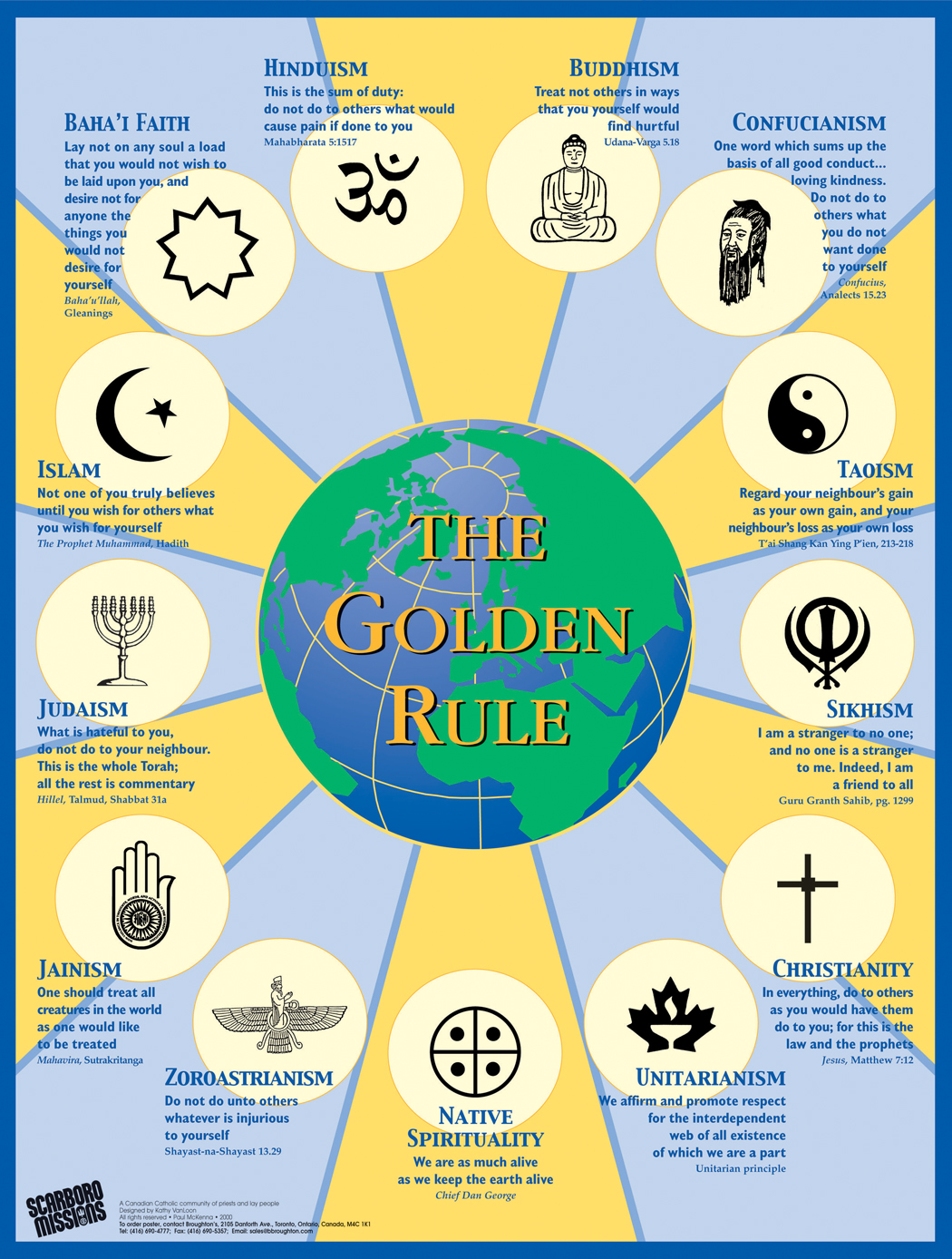
I have found endless versions of this rule, sometimes referred to as the Platinum rule or Universal Rule. You can find slightly grainy pictures like this one (because they want you to actually buy the nice clear one) depicting some of those guiding principles of other cultures.
You could spend hours discussing which one is better or which fits you better. Whatever you do don’t start fighting about it or you have completely missed the point.
To avoid that kind of fight about Popper’s quote, I need to go back to it because it contains a few key words that were adequate to what he was saying at the time, but now that we have rebuilt Europe, taken down the Berlin Wall, found our way to a world beyond two super powers bent on destroying each other and entered a world where empires can fall without the inevitable grab for power involving death and destruction on a massive scale, we need to develop a new language that acknowledges how all of our cultures share common bonds.
One of those words is “spiritual”. This word gets bandied about quite often in phrases like “spiritual but not religious”. I let people use whatever terms they want to define themselves, then, if I’m interested, I ask them to describe what they mean. So I don’t need to come to a consensus on what this word means. For my purposes here, and I think adequately for Karl Popper, spiritual things are not material things. They are the hard to measure things like feelings, the value of health over wealth, and knowledge as an end itself instead of a means to something else.
In the quote, Popper is putting the “tribe”, the ones who defend a bordered territory, a set of traditions and ties of birth and history up against an idea of listening to as many voices as possible and synthesizing and harmonizing them for the good of all. Democracy in this quote is not just majority rule or an ideology tied to an economic policy and a particular constitution, it is the ideal of maximum inclusivity and plurality. At least that’s how I see it. That he says “rise of democracy” indicates to me that he still saw much work to be done.
I’ve already addressed that the idea of individual over tribe is not solely a Western idea, but Popper also makes the claim that it is the central doctrine of Christianity. This is a Western-centric statement. It even ignores the very Eastern roots of Christianity. It’s something we have to deal with when evaluating any wisdom coming out of thinkers in the mid 20th century and even more so from those before that. Popper knew his ancient philosophers. I don’t know how well he knew religions. Regardless, I’m not going to devalue him or his sentiment because he choose this particular symbol of neighborly love to express it.
The Old Testament and the New as well as commentaries surrounding them have versions of their greatest prophets being asked how to summarize their teachings. They all say something like loving God and loving your neighbor. Trouble is we also have a wide variety of scholars who spend their days trying to understand words that have been translated through a few languages and through many cultures. Even today, the word neighbor can mean the person next door, or an adjoining country. In Biblical times, it may have meant only Jews or only certain Jews. By the time the gospel of Luke was written, it appears it was starting to mean more than just that. Later letters though, like 1 John, appear to be returning to more tribal thoughts.
The rise of democracy and broadening sense of morality include the idea that we care about a wider and wider circle of people and places. If we agree on that, then it doesn’t matter so much that Christianity has it as a core tenant. It’s great, don’t get me wrong, it means they are on board with the arc of human history, but it doesn’t say anything special about that particular part of history. I suspect if I was alive in Popper’s time, I could have easily been happy knowing I was a Christian and that my traditions included loving those around me in the way I would hope to be loved. I’m glad I’m alive now in a time when I know that sentiment has a much wider reach and is derived from a wider base. I know it’s something even my enemies have some sense of.
* Strong atheism involves the denial of all, or at least one god in particular. Usually it’s saying they know gods do not or cannot exist. “Hard” or “Explicit” atheism also state gods don’t exist with some degree of certainty.
These entries are almost all non-religious. When you leave a believe system, you have to rebuild a foundation for how you figure what is true. The same problems keep coming up, like we can't be 100% certain and that there are many experts that need to be sorted out but we don't have the expertise to challenge all of them.
I've argued with Libertarians as a way to try to understand them, with gun advocates to try to find a peaceful solution and with my liberal friends who often use the same flawed logic that they accuse conservatives of using.
I put what I think are the best in bold. They are in reverse chronological order, but only a few mention something topical.
Someone recently asked about the problem of in/out groups and how we treat not just our neighbors, but the rest of the world. We've never had this many people on the planet and the questions of how we live together are getting more pressing.
There are
two levels to explore this; how I approach my local tribe and on the world
stage. My bumper sticker answers; I would never refuse someone a meal or
shelter if they came to me in need and I could provide it. For the big picture,
I believe anything I do to benefit the billions of people who have so much less
than me, benefits me. I’m from the land of Paul Wellstone, where we all do
better if we all do better.
Granted,
there is a lot of devil in the details. That one word “could” in the part where
“if I could provide” leaves a lot of wiggle room. I don’t have a sign on my
door that welcomes everyone and I don’t bring home a homeless person every
night. If I did that, I would exhaust my resources and I no longer COULD
provide. That’s the hypothetical situation that gets presented by people who don’t
think these things through, when I say we should open borders or just NOT build
a wall. I can’t save the world, I need the rest of the world to help me with
that.
So, let’s
look at the hypothetical. Let’s say we are somewhere that doesn’t have grocery
stores or homeless shelters or other excess resources that we can spread
around. I have friends who are growing their own food and live off the grid or
are otherwise prepared for a day when there is no grid. They do this out of a
sense of love for the planet and with an eye toward a communal lifestyle. I’ve
also heard a few of them talk about what they would do if they were surviving
while most of the people, the unprepared people, were not. A few of them have
said they would defend their homes, violently if necessary.
I would not
do that. Partly because I just don’t want to prepare for that. I don’t want to
buy weapons and learn to use them or even consider combative types of self
defense. I’d lose against almost anyone except the feeblest. But let’s same I’m
just part of a group and I could just cook the food for the warriors. I still
wouldn’t do it. If I did that, I’d no longer be the person I am now. I would in
essence die. I would rather die a death of starvation while trying to feed and
house as many people as I could, than live a life that depended on the deaths
of others, deaths that I caused.
I realize as
an American, I’m already living that life. My safety and security depends on a
vast military supported by my taxes. That is not the same as the kind of direct
action discussed above. As a citizen in a modern nation, actually for any
nation or kingdom going back thousands of years, we have all benefitted from acts
of violence. If we were not the beneficiaries, we wouldn’t be here. The refugee
depends on the country that lets them in and defends its borders from the place
they escaped. The conquered ones benefit from the peace treaty that prevented
their complete annihilation. We are all born into a world with these acts in
our history and most of us don’t have the power to stop it.
So what do
we do in a world where the lines of good and evil are not always clear?
First, to
the person who asks me why I don’t take that immigrant from Nicaragua into my
home, I say, we all do that every day. As a modern democracy, we’ve decided to
pay for housing for criminals. It’s called a prison. Almost half of our taxes
go to take care of men and women in the military all over the world. We take of
children that we’ve never met because we know something could happen to us, and
that could be our kid. This is just basic altruism on a scale of millions. When
we understand a need for the world, we work together to satisfy it. Obviously
we don’t all agree on how to do that. That’s a conversation about democracy that
is beyond my scope here. The point is we muddle through.
But what of
my statement that I’d rather die than stand by while others die. Why am I not
out there right now doing everything I can to save every one of those people
that my military is threatening, or the kids closer to home who are hurting
because of the oppressive environment and sub-par schools. I’m not going to
defend my every action or list my community involvement, that’s a losing game.
What matters is we aren’t all starving. This is not a post apocalyptic
landscape we are living in. Truth is the things that have been important to me
for most of my life have improved. There is less pollution, less hunger and
more education.
Also true, I
could do more. If I had better leadership skills, I could get more people doing
the things I’ve done and more kids would be fed and maybe even more men would
understand that it benefits them to have educated daughters. I know I’ve made
some difference in the world. I’ll leave judgments up to some other power.
Meanwhile, I’ll leave you with a theory I have. We talk about the “1%” and how
they make all these higher ideas difficult to implement. We also sometimes
recognize that it’s our participation in their system that benefits them. My
theory is, if the people in the 50-99% range would focus more on the lower 50%,
the 1% wouldn’t know what to do.
Put it this
way; I’ve never known anyone to discuss helping someone who is chronically
hungry by supplying them with a new flavor of potato chips or the latest
variation of fizzy water. We don’t throw a banquet and invite someone who is
struggling with addiction. For that matter, we don’t pick up someone living on
the street and enroll them in college. Instead, we start a garden on an
abandoned neighborhood lot, we hold a seminar about how to apply for and keep a
job, we say hello to someone we see sitting on a corner. These are low cost measures
that contribute to the same economy that the 1% say they are responsible for.
That economy
depends on the participation of everyone across the entire income spectrum.
What we have right now is a few people who are secure enough that they think
they can experiment with how much poverty and starvation and all the problems
that come with it the system can stand. They don’t care about any tribe as far
as I can tell. Most of the world does not think this way and never has. History
has not turned out well when there is this much wealth disparity. It is not
tolerated. The question before us is can we make the correction peacefully?
When attempting to understand someone who holds an opposing opinion to your own, a useful exercise can be to attempt to make their argument. This can lead to more discussion with understanding and less arguing. Here, I attempt this with the immigration debate in the US. I focus on illegal immigration, but that crosses over to the general question of how we regulate all immigration. I did my best to remain neutral about what the laws currently are. I had a little more difficulty in finding data to support the conclusion that immigrants are the cause of broad social ills. In the end, I think this is a question of who we want to be as a nation and as citizens of the planet.
A nation of laws
Laws regarding immigration to the United States have been a heated political issue for as long as there have been any laws about it at all. Immigration Acts date back to the Reconstruction era, but that’s too much to cover in one blog post. Ellis Island opened in 1892 and its storied history is engrained in our culture. The World Wars led to increasing trepidation of foreigners entering the country and to the Immigration Act of 1917, which imposed quotas. Despite quotas being abolished by the Hart-Cellar act of 1965, restricting the number of immigrants continues to be central to the debate.
Fundamental to the discussion is that we are a nation of laws. There should be no debate about that. Ideas about open borders are up for discussion, but until we design and implement laws that can promote that idea and maintain a safe and civil society, we need to operate within the laws we have. There are other aspects of this discussion that are sometimes brought up but are not covered by laws. We don’t have a law that requires anyone to speak a certain language. We don’t have laws that require patriotic statements or participation in patriotic rituals. We have a law that says you are free to practice religion however you want. There is no test for how much you love America. There is a civics test for immigrants that many natural born citizens would find challenging.
A law that is central to the current debate is how a non-citizen gets into the country. To cross the border, you must use a designated US immigration border inspection point or port of entry. To do otherwise is a misdemeanor offense. Repeated attempts can carry stiffer penalties. A misdemeanor is not a crime that automatically results in deportation. The classification “misdemeanor” includes hunting on a wildlife refuge, assault, using counterfeit money, desecration of the flag, parading without a permit, and possession of illegal drugs. These can result in jail time, but often don’t. The consequences of crossing the border can also vary. There are also a wide variety of visas and permits that allow people to work, study and live here for limited times. When those expire, technically, they are in violation of the law if they don’t return to their home country.
A little more complicated is the law regarding requests for asylum. If you aren’t already in the country legally and you try to make the case that you fear going back to your home country, it can come down to the judgment of one Customs and Border Protection officer and you could be refused entry, or you could be detained. These actions are discretionary under the law and recent Presidents have varied widely in their policies regarding who they detain, why, and for how long.
We are a nation of laws, and that includes due process under that law and it extends to non-citizens. A young citizen of the US accused of assault would most likely be allowed to continue their education and their work while they awaited trial. They are more likely to receive counseling and do community service rather than jail time. A person who crosses the border because they fear for their life would most likely not be able to find any legal help or be given time to prepare their case and get a fair hearing. That is how the law currently works.
The scenario I referred to above applies mainly to our southern border, a border that can be accessed via foot and is not far from countries where we know violence is occurring. Those in countries farther away can register as refugees. They will then go through background checks, extensive interviews and even biological screening involving multiple law enforcement, intelligence and security agencies. This can take up to 2 years. Only a few of these are referred for resettlement.
When looking at a single instance and making assumptions about the innocence of the people involved, it’s easy to find flaws in the system. But there are larger issues, and policies need to be designed to protect everyone, not skewed toward a particular group. To determine if that is what is happening, we need to open up the conversation to questions of how immigrants affect our economy including our crime rates. Are they in fact, “taking our jobs”?
This shift is a reversal of the trend of the last half of the 20th century but similar to the trend of the first half. One difference is where the immigrants of those few generations ago came from versus those from the current generation; Europe as opposed to Latin America and Asia. These are all factors that contribute to the perception of the current generation of immigrants, legal or otherwise. It would be difficult to sort out the contributions of millions of people and trace the impact of immigration from 100 years ago and compare it to recent immigration. I can however address current talking points. There is ample anecdotal evidence of crime committed by people born in Latin American countries and acts of terrorism committed by Middle Eastern immigrants. There are stories of high crime and high unemployment in some areas and stories of 1st generation immigrants working as laborers as well as owning businesses and even fighting and dying in the US military. There are stories of young Spanish speaking people having babies and dropping out of school.
What I can’t find is data that says crime rates or teenage birth rates or drug abuse occur at higher rates in immigrant populations than they do in the population as a whole. Even acts of terrorism, that is, someone killing or plotting to kill people they don’t know, are committed by legal citizens of European descent. Nor can I correlate unemployment rates to the rise in illegal immigrant population. The current rate is lower compared to before that population began rising in the 1970’s and it has fluctuated while that rise has occurred.
Controlling the southern border
Some data can support actions. The rise in border crossings on the southern border from a quarter million in 1970 to over 1 million per year during most of the 80’s and 90’s was a problem for people living along that border. A sparsely populated region can’t respond to a situation of that magnitude with its normal level of law enforcement. Serious efforts to secure the southern border began under Bill Clinton and continued with the Secure Fence Act of 2006, signed by George W Bush and voted for by then Senators Barrack Obama and Hillary Clinton. Apprehensions at the border have since returned to 1970 levels.
Meanwhile the population of Mexican-born people now in the US has steadily risen from under 1 million to over 12 million. It might be that tightening the border has led to this, since it is now harder to cross back and forth. Whereas before, people came and worked temporarily, now they stay rather than risk another crossing. Also noteworthy is that annual immigration from Mexico has declined sharply since 2005, long before talk of extensive additions to border security. The policies enacted since then may be reacting to problems that no longer exist or that could be dealt with in new ways.
Economic policies
There is no question that millions of people work in the US without proper documentation. There are also gangs that consist largely of foreign born members. There are high profile cases of people living here legally who have participated in horrific crimes in the name of their religion or ideologies that are mostly foreign to our way of life. The connection I can’t make is to how additional restrictions of immigration would alter the overall data. The elimination of a class of people to reduce problem behaviors means also eliminating workers, entrepreneurs, military personnel and others who contribute to the economy. I would need to see how those contributions can be sorted out from the problems. Is their country of origin a cause, or are crimes rates the same in all groups and better correlated to age or economic status?
There is more than anecdotal evidence that immigrants use the social services provided by our government. It is a separate debate, but many of these services began around the same time we began restricting immigration. As Econofact.org states it, since we have been running at a deficit, “essentially everyone receives more in public expenditures than they pay in taxes”. So, questions about socialism aside, are immigrants causing these deficits? Do they take more than they contribute? This is a complicated question. I can’t make a case that they are a cause, but I would need more understanding of economics to make the case against it.
What is an American?
Putting all the dry data about economics aside, a key issue for many is the question of just what this country “is”, what is our essence, who are we? I’ll avoid mining our history for quotes from founding fathers because support for our Christian roots can be found just as easily as quotes about keeping government and religion separate. There is more to this than our 1st amendment and even if I provided case law that supports the separation, there are still those who feel those laws should be changed. The complicated nature of our identity as a nation of immigrants and one that desires purity can be found in our Declaration of Independence, where it is stated that King George,
“has excited domestic insurrections amongst us, and has endeavored to bring on the inhabitants of our frontiers, the merciless Indian savages, whose known rule of warfare, is undistinguished destruction of all ages, sexes and conditions.”
This appears to be a response to the Royal Proclamation of 1763 that said although the colonists had participated in defeating the French, who fought along with natives, they could not expand their boundaries into the territory they had won, across the Appalachian Mountains. This could be seen as just one of the ways we wanted to be free from British rule, but the language is unmistakable, we felt we were superior and had a right to that territory. To be clear, when I say “we”, I’m referring to a group of white male land owners from a long time ago. We can’t know the pulse of the entire population at the time. We are not beholden to every thought of the men that signed that Declaration. It is however one of our most important founding documents and something we should fully understand and come to terms with.
Conclusions
We are a nation of laws, and currently our laws restrict immigration to a degree that many more people want to become citizens than are becoming citizens. Since we export food and have experienced unprecedented economic growth over the last century, I see no reason to believe we are at any kind of a limit to capacity. It seems rather we need more people willing to come to places that are experiencing growth and are in need of people ready to contribute.
We are a nation of laws and those laws include traditions of restricting others from crossing our borders and of welcoming others. Our Constitution is designed to allow for change because our founders knew they could not anticipate the changes that have occurred in the last 250 years. I think the best question to ask ourselves is, who do we want to be?