I have changed my tune. I used to say "Facts don't change people." It's one of those poorly developed slogans, like, "defund the police." The change I want to see takes at least a paragraph to start to develop the idea. Facts are of course important. I could simply add, "alone", as the second word. It takes a little more skill and practice to get to the "how" of presenting facts. When I try to have these conversations, I get plenty of counter examples, sometimes data (anecdotal or otherwise), and my favorite, "they will never change." That last one is conversation ending, but it doesn't have to be "the end."
This post will be updated as I find examples of people using their listening skills to build relationships and finding that the person they disagree with has something valuable to say. The stands on the issues might not change, although sometimes they do. The perceptions that the people have of each other change in most of these. They also find that even though their ideas remain more or less intact, they can work together toward a common goal.
In 2017, a journalist from the very liberal Seattle Oregon loaded up a bus of people like herself and went to a small town that had voted the opposite of her own. It went better than expected.
There was a new Bill and Ted excellent Adventure movie this year, gotta give a nod to that. It was about the fulfillment of their original mission, to bring the whole world together with their music, which keeps seeming to happen and then not happen in each of the movies. I've followed a similar pattern through the years. You could review last year's New Year's post for example.
In February, I almost got a local chapter of Braver Angels off the ground, then, that thing that 2020 will be most remembered for happened. Braver Angels has continued online, so that's good, but getting people together in living rooms has not been happening so much.
The article marks this year as the year that we will probably stop referencing the "Reagan legacy" and start using "Trump legacy". Before Reagan, we were very much under the influence of the "Roosevelt legacy", The New Deal. Today, we have people who are confused about all of this, who are afraid of "socialism" but don't want "the government" to take away Medicare or Social Security. The details of this battle between the social safety net and big business are in the article.
It also describes how racism has been used as a weapon in this battle. That legacy goes back to the Civil War and the years that followed; Reconstruction. It mixes our identity as strong individuals who have high morals and ethics with a focus on vague enemies, like "communism" or "terrorists". It leverages these tools and uses legal maneuvers to selectively apply votes so it appears to be democratic and patriotic. It draws lines, and sets up each side to believe they are the "real" America. I'm using tons of scare quotes because all of these definitions are in flux. Photo: Deconstructing Reconstruction
Many genies have been released from their bottles lately and they don't like being put back in. They will continue to impress us with their magic tricks. But as everyone knows, you have to be very careful what you wish for because genies can be so literal in their interpretations of your words and the trick is then played on you.
As the article notes, we are at a point where millions of people are openly asking for votes to not be counted and questioning the entire system and willing to overturn the results of our duly run democratic process. It is not logical, but it is the inevitable result of playing on people's righteous belief in their ideology.
There are scenarios where the same righteousness could have resulted in a Left Wing disaster. But don't confuse the danger of government that is too liberal with the reality of one that was captured by and run by conservative big business. Both can lead to oligarchy; rule by a rich elite. The "liberal" and "conservative" labels lose their meaning when you look at who makes the rules, that is, the ones with the gold.
I recently listened to a discussion with Coleman Hughes and Douglas Murray on Coleman’s podcast. At times I had trouble figuring out what world they live in. These are not small players and they covered many major talking points, so if someone can explain this to me, maybe I’ll find out what I’m missing. The title is “The Intersectional Crackup with Douglas Murray“, but intersectionality is far from the only topic.
If you aren’t familiar with the term “Intersectional”, it covers the interconnected nature of the categorizations that people fall into. As we began to address centuries old oppression, we addressed them separately, such as women’s issues or rights for people of African descent. Intersectionality recognizes the dynamics when a person is a member of more than one of those groups. It sounds simple when you look at the definition but it gets convoluted when people want to make it so, like in this podcast.
The podcast starts with a commercial, so you can skip that.
Hughes seems to head into an important discussion about leading a meaningful life at about 4 minutes in but he keeps the discussion to how difficult that is in a world of identity politics. He says the current culture has taken on a “religious” like form. From then on he focuses on how not to build a sense of self.
Murray’s first answer to Coleman’s opening question is to agree about the religion shaped hole in society. You can trace this back to Nietzsche, who famously said “God is Dead” and less famously said, “and we killed him”. He (Nietzsche) then went on to speculate what people will use to fill the missing answers and moral judgments provided by religion. Murray says the “intersectionalists” use guilt, atonement and heresy, just as religions have. He does not see a discussion about purpose. He denigrates youth on both the left and right. The conservatives don’t have a “how”. The Left does, but he rambles about some sort of “abdication” by adults that I don’t get.
He says he could give his views on how people found meaning in the past, but then he is vague. He says “literature” without naming much. He says this is a failure of atheists. I have seen him interact with atheists, so I can’t figure out why he doesn’t see them doing this. It was the atheist thinkers and writers, past and present where I did find meaning and purpose. The only purpose I can glean from religion is “read the scriptures, pray, and if you don’t find purpose, you did it wrong.” Anything specific, anything meaningful, can be found in a non-religious source from writers contemporary to those sources. The non-religious ones are usually not only better, but they don’t require you to memorize any names of prophets or their movements. You just need to work through the ideas.
Around this time in the podcast, 10 minutes or so, both of them have started using the term
https://www.facebook.com/WeStayWoke/
“woke culture”. This is the latest term that began with a positive meaning but is used in a derogatory manner. I understand why to some extent. Some people are actually aware and paying attention, thus “woke”, and some are pretending to care about the issues of the day but are really not well informed. Hughes and Murray are going after the latter group.
Coleman then says something I couldn’t be sure I heard correctly it was so strange. He said, “If you are Right Wing, you can’t be unapologetically Christian”. I think he’s saying Right Wing Christians feel they have to hold back on expressing their religion because it is associated with oppression of the past. In the podcast, or any of the other times I’ve heard these two speak, I have not heard any awareness of a liberal version of Christianity. It is a wing of Christianity that has been growing for decades, with roots that go back to the 13th century and early Christian humanists.
Hughes however grew up with what seems to be a narrow-minded sect of liberals that saw themselves as a rebel force, as he says, a ‘resistance’, ala Star Wars. Instead of finding the many more nuanced messages and movements in the country, he has become ‘anti’ to whatever that was.
After the 13 minute mark, Murray pushes this even farther, saying these recent Left ideologies are not based on intellect. Occasionally, he does hit on something worthwhile. He notes that when a group of any kind presents a prepackaged system, it can gain followers, but there is a downside. He cites the Catholic Church and how Ireland, once a Catholic stronghold has lately been divorcing itself from that. I would say something simplistic, like Murray just hasn’t found a Liberal group that he likes, but that’s his job, to seek out and evaluate groups. So something else is going on here.
Hughes makes a similar worthwhile statement, then messes it up. He says he is not comfortable with the idea of “my country, right or wrong”, but then ponders why all those brown people are coming here. He figures if they are coming here, we must be doing something right, and apparently doesn’t figure much beyond that. It does not occur to either one of them that they are coming here for the promises in our Constitution. They come here for the education system we subsidize, the business assistance, the protection of rights, the things they don’t have in their country. The things Liberal politicians vote for and fight for.
Instead, at about 21 minutes, they launch into how amazed they are that we still get excited when another barrier is broken, like a black woman becoming Vice President. Hughes says Obama broke the final barrier and that should have “changed the model”. I’m not sure what that means, but he does not give the slightest nod to what happened to the culture during the Obama years.
Another good point from Murray is that young people, or anyone else, should not “hack into history”, looking for something wrong. Instead we should try to “reconcile” who we are to that past. But he sets up a straw man to knock down. He says people then ask him, “what about injustice”. He accepts there are struggles but dismisses them, giving no examples of one that was fought and won. He does not make a case for why it’s time to put discussions of racism, inequity, or misogyny to rest. He alludes to “rivers of thought” that we should attempt to navigate, but never says what those are. And I’ll repeat that this is not the first or only Douglas Murray I’ve listened to.
At 27 minutes, he makes a comment that he doesn’t want there to be “types” of books or studies, there shouldn’t be “women’s books” for example. He backs this up by citing Bayard Rustin, a strategist for Martin Luther King Jr who was against the rise of Black Studies in Universities. It seemed like segregation, just what the White people wanted. He jokes at something he apparently has heard, that people say there are no gay writers in the canon.
I don’t know who Murray is talking about because he rarely gives quotes or names. Of course
Getty images
there are gay people who wrote books, ancient to current, because there were always gay people. The problem is, many of them hid it, or if they didn’t, the next generation erased it. It’s harder to erase history now, it is not “written by the winners” as it once was. This is an unusual time, when people of all stripes are gaining positions of power, crossing borders easily, working across cultural barriers. The only thing I can make of this is Hughes and Murray don’t want that. They play on the fact that they are each members of a category that has experienced disadvantages, Hughes is black, Murray is gay. They take their own example and claim that it proves these problems are behind us. They see none of the history of changes in norms, they never compare our time to any empire of the past that came close to the level of inclusivity we are experiencing. I can only speculate, but my guess is they see a zero sum game, and they are on the winning the side, so they want change to stop to reduce the risk of losing what they have.
It gets worse but the details are just a different flavor of the same theme. At 36 minutes, Murray calls the Left’s ideas “simple”, saying it’s easy to understand and the Left makes it more complex. The man has a platform as big as just about anyone, but I can’t find this simple message he says he knows.
I’ll give Murray credit for one more item, on the topic of cancel culture. If you’ve seen it, you know what I mean. It’s when someone who has found fame, position, and hopefully even has said something worth saying but, then says something off the mark. Some group, large enough to get an audience, amplifies that mistake and calls for resignation or demotion or some other form of cancelling. This puts a damper on anyone who is even thinking about speaking up. It takes our open forums where ideas are incubated and encouraged and turns them into echo chambers where everyone fears offending the next fringe group. Murray speculates that this behavior might bring down the “woke” system. I think it might already be happening.
After that he has a couple doozies. The one that tops them all was “we don’t need people to come along and pretend to us that we are things we’re not.” It’s at 52 minutes and 45 seconds. I agree that there are people who call themselves Liberal but don’t bring with it all of the liberal values that go with that label. They bring a set of standards that may not match the values and ideas that got us to the current enlightened era we are enjoying. We should all be vigilant of that. I don’t know how Murray misses that people in history who “pretend to us that we are things we’re not”, are the same types of people he is speaking against. Back in time, they were priests and princes and town constables and local sheriffs. Now they are bloggers and influencers and talk show radio hosts.
What’s missing is, we have to base our decisions to “call out” problems on the values that built our free and open society. “Calling out” is not the problem, it’s what you call out. We can discuss the “how”, but don’t let that bury the “what”.
Deb Haaland. Secretary of Interior Nominee
These two might be tired of people identifying themselves with a traditionally oppressed group. For myself, I am far from tired of hearing about barriers being broken. A Native American in the position of Interior Secretary for instance, is quite meaningful and worth noting. But these guys, now that it’s not just straight white guys getting everything, want to say, “oh yeah, that’s what we all wanted the whole time, see it’s fine, don’t say anything about it now and it will all go away forever”. They are getting paid by the system as it is, and they aren’t interested in why they are despite their intersectionality. Easier to denigrate anyone who does question it or blame them if they have not received their piece of the pie.
What I’m hearing here is that they feel very much the same way that large groups of people have felt in the past. Blacks felt marginalized, and in the South with voter suppression and everywhere with housing red lining, they were. Women were harassed at work and it was portrayed in sitcoms as a joke. I understand that men like this are not treated as special as men were just a generation ago, and that probably feels like they have lost something. But the people they are talking about are not asking to be treated specially, just equally.
I’d like to cover just one more term, “identity politics”. The way Hughes and Coleman are using it here, they are pointing to the people that claim that say you have to be a member of a certain group to understand that group’s plight. They are complaining about people that are asking for something extra based purely on their membership in some group, identified by skin color, sexual orientation, or similar traits. I agree with this for the most part. It should be that equality is just that, equal. I think human beings are capable of empathizing with others and understanding the needs of others, without actually experiencing all possible circumstances.
Hughes and Coleman aren’t limiting their solutions to just this narrow issue however. They are expanding it to claim that no policy should consider any type of identifying characteristics. When evaluating history, they ignore the basis of nations, wars, religions, hiring practices, and budgeting that was the norm until the middle of the last century. There were no black senators. Women could not get high paying jobs or leadership positions. Girls did not have sports programs. These facts matter. People who are born in a system that gives them privileges will rarely change the rules to reduce the privileges. Change requires legislation that identifies those traits that were used to identify those who were barred from those privileges in the past.
This has been a long time coming. I’m a little late with it. It’s time to promote Tony Jones from “other theologians I’ve written about” to the “few who actually get it right”. He sealed his status in a recent podcast with Ashley Peters. Even if Tony had not made some upgrades to his theology over the years, just the way he conducts this conversation put him in the “doing it right” crowd.
Okay, I kid a little about being “right”. Tony’s fine, he’s always been fine. There are probably parts of him I did not recognize back when I first started following him. If I had started recently, I’d probably be searching back, trying to figure where this guy is coming from. It can be hard to tell what he believes or if he believes at times. No question though, a love of nature and the values that are needed for humans to express that love come through loud and clear.
The Reverend Hunter Podcast. I couldn't index to the specific episode, so look for about the 10th one, "Ashley Peters: Conservation is my religion"
Ashley Peters is no stiff either. It’s interesting to hear her philosophy that is rooted in the many ways people relate to nature, hunting as well as just watching. From her responses to Tony, apparently she didn’t go through some of the years of doubt or difficult nights of sorting out beliefs that some of us have. This provides a fresh perspective. She uses Alaska as a jumping off point for seeing the “bigger” picture. I paraphrase here, removing the feedback and extra words of a conversation;
“When you live in Alaska, you see the large everything, “you understand the scale of things and feel so insignificant. You recognize your place in the universe
You get that sense on the prairie and the woods, if you’ve been there, you understand the scale of things. You feel so insignificant. You very quickly recognize your place as a human being on Earth and you suddenly recognize that this stuff is huge. You don’t have control over any of it. You have to focus on what you do have control over and hope for the best for the rest of it.
When I go into work each day, the thing I had control over, what the outdoors has taught me is that you focus on what you do have control over. You focus on the things in front of you. I plan for what can go wrong, but it’s still the question of what I have control over and doing as much as I can to prepare and to be in that moment, but to recognize what I don’t have control over. I can worry all day long, and I still do, but you can only do so much as a human.
To relate that to a spiritual aspect, as a Christian growing up, it was “give it up to God”. That was the common narrative. That’s not dissimilar to what I do with the outdoors, but not giving it up to one deity. I’m going outdoors and laying it down, however you want to put it, it’s that same offloading of my worries and recognizing I don’t have control over ‘these’ things but I have control over these few things and that’s what I’m going to choose to focus on.”
So, I’m a blogger, so I guess I should do this. It’s about change, about lots of changes through history and what that means to us now. I might seem a bit annoyed. If you want to get a teenager to read this, preferably one who doesn’t want to, they might get the proper tone of voice for it.
Everybody is talking about change. Of course we will change. Hasn’t every President run on that platform for the last 50 years? Make America Whatever or Hopey Changey, I don’t care. Throw the bums out. That’s a desire for change. But there is always tension, against the fear. Too much rapid change to greater rights for more people and a move toward socialism resulted in populism, on the left and the right. I have watched the constant battle between the dawning of the Age of Aquarius and the good old traditions since I was born in 1960. Look at what’s happened in the last 100 years since the 1918 flu pandemic. That’s in your parents’ or grandparents’ lifetime if you are older, so hopefully you talked to them. If you are younger, hopefully you know someone in the next generation up. They might have an old recording or at least some pictures.
They went through:
Nuclear weapons
Invention of vaccines
1918 flu
World War I (1914 to 1918)
Despite the pace of change having increased in the recent centuries, we haven’t developed new ways to cope with it. I don’t have much to suggest for that, but for me, getting some perspective on how much has happened, how far we have come in a short time, and how it has always been the people pushing leaders to change. That has helped me understand it.
My Public Education history spent too much on the days before the Revolution in this country, that’s my opinion. I always wanted to get to the World Wars and why those happened.
It was a major change in how the world worked. Before then, we were a world of royal families. Generals road on horses with colorful uniforms and battles lasted for a few days. With the arms buildup of the late 19th century, a result of the industrial revolution, these in-bred idiots who had no idea how to live in a time of electronic communication and world travel, put a match to the powder keg they built. To defend against heavy artillery, they created trench warfare, to breakthrough that they invented tanks, and on and on.
Going back through the 19th century further you had:
The Industrial Revolution, steam engines, mechanics, oil. Horses were no longer the best source of power, but we still use the term “horsepower”.
Darwin published the Origin of Species in 1859.
Michael Faraday, who died in 1867, advanced our understanding of electromagnetism. That’s kind of important to whatever device you are reading this on.
Pause for a moment on this guy. He discovered the mysterious energy floating around that we could use to move things and to communicate across miles. Click to see David Tong giving a lecture in the same hall where Faraday gave his. Tong is talking about the newly understood forces of quantum physics, that we now understand are the fundamental forces behind all things. He’s giving that lecture in the same hall, with the same desk, that Faraday did. It’s like we just figured out stone tools yesterday, and now we all have scalpels in our medicine cabinets.
While Faraday was alive, we were finally throwing off the last myths about race and changing laws so we could no longer justify slavery. There are still slaves in the world, I know, but most people know that’s wrong now. What will be commonly thought of as wrong by end of your lifetime?
Change takes a little longer in the centuries before that, but let me connect just a few more things. Once the empires that grew out of ancient history started bumping into each other and “discovering” each other, we started accumulating our knowledge, sharing it actually, but not always in a nice way. You might have heard of Thomas Aquinas, who tried to reconcile the Catholic religion with Greek philosophy. He had a little help from the Muslims by the way. Not too long after that, we had Protestant kingdoms, so there was a lot of fighting with the Catholics.
At the end of all that fighting, after the Thirty Years War, 1648, a treaty was signed called the Peace at Westphalia. It took away powers from the Pope and created a new type of nation. That’s what you live in, a Westphalian nation-state. Sure, your way of life is rooted in a Judeo-Christian/Western Civilization/Constitutional Republic/Democracy/melting pot, sure. But the basic structure of our politics has only been around for 400 years, and it was formed under duress, and it’s not working. A bunch of morons from the Middle Ages made it up to get the Pope out their business and we can get the billionaires out of our pockets if we create the next system.
Something else happened once the European Princes and Bishops quit making us kill each other. It was the British Royal Society, founded in 1660 to promote scientific thought and learning. It was the fertile ground where Isaac Newton flourished. Newton created the mathematics that got us to the moon (along with some of those other folks above). Computers were first put to the test during that work. That pretty much brings us up to where we are now.
To have that sort of creative energy, to allow the brilliant people of the day to discover something, you have to first have some degree of peace. You have to have a little extra left over at the end of the day to give to the general welfare, to build some roads, to have some nurses ready to take care of us instead of working overtime to pay off student loans and a mortgage from that house they bought before the bankers destroyed the economy.
What gets left out of historical discussions like this is none of it happens if we don’t care about people that we will never meet; people on the other side of the world and people who are not born yet. If we aren’t keeping the world clean and free from violence and filled with beauty, if we aren’t nurturing the people who grow our food, or who are sitting in a room somewhere coming up with formulas that who knows what they will do, but we can bet they will do something, then none of this happens. Then we slip back into using those stone tools to harm each other and take whatever we can just because we can. None of this happens if we don’t realize we need each other.
A note on the present: We aren’t purposely crashing the economy by shutting it down, just so we can save a few million lives. The economy would have crashed if we didn’t do anything because the hospitals would have been overrun. People would have chosen to quit interacting with others after it was far too late. Services would be much more disrupted because the closures would be random; we wouldn’t be choosing to keep groceries open as opposed to restaurants, we would be choosing from far fewer options.
It would not be some simple math of 2 or 3% more people dead. We would be surrounded by sick people and no one would want to touch them for fear of getting sick themselves. This would multiply the problems. Any normal illness or regular medical attention needed would be almost impossible. We would have new priorities, like disposing of the bodies.
The stock market selloff was recognition by those who understand how their system works, that it is not working, that it is not designed to respond to a problem like this. It is not designed to take care of the people that actually create the wealth that they accumulated. Ironically, it created the problem by changing the environment, putting workers under stress, and prioritizing profits over health. It put messaging over science. They know this, they saw it coming. They didn’t tell us until they cashed out. But cashing out is a strategy of the dying system. I don’t know what the next system will be, but it won’t be the current leaders who create it.
Theologians throughout the ages have attempted to straddle the worlds of belief and non-belief, of faith and reason. Thomas Aquinas was banned by the Catholic Church for his writings on this and then given sainthood not long after his death. In the last century, Catholic monk Teilhard de Chardin was told not to publish his thoughts on bridging these two worlds, but not long after he died, a friend published his works, (according to Teilhard’s wishes) and some gave him credit for contributing to the liberal ideas expressed at Vatican II. I find these philosophical thought experiments interesting, and although many do not, and even though I can show they ultimately don’t lead to a conclusion, I also hope to show that having the discussion has brought the people who hold those opposing beliefs closer together so we can work on the common goals.
Chardin became a Catholic monk not long after the turn of the 20th century and then began writing about his thoughts about spirituality. He was rewarded by being sent to a remote monastery in China. That’s sarcasm in case you didn’t catch it. He was also a paleontologist and his work with hominid fossils brought him a degree of fame. Evolution was a big challenge to the church at the time, and here was one of their own making strides in that area. As a contemplative and peaceful man, outwardly it appeared he was at peace with this. We can only speculate how it felt to him to have to choose between expressing his most important thoughts openly and keeping his job and position in the Church that he loved.
Teilhard tried to harmonize evolution and creation by saying that God does the creation thing while evolution builds the physical world. The two are not separate, but happening together all the time. God created and continues to create the world, and evolution is the mechanism that moves that creation forward. Our conscious is part of that evolution, so we have become co-creators with God. There isn’t one without the other, just as exhaling and inhaling are needed for there to be breath.
For him, this helped to solve the problem of evil in the world. The existence of evil is used as an argument that an all loving and all knowing God does not exist, because if one did, it would not allow such pain and suffering. Teilhard said that God does not will that suffering occurs. God is not intervening in the world on a regular basis to cause people pain because of something they did. Rather, God sets the world in motion toward the end, which is a world without suffering, but it is not possible to create that world without going through the suffering. We are part of the creation as it is occurring so we are experiencing what is required for it to happen. Since we are part of it, it becomes our job to prevent or at least reduce suffering, and we evolve skills and strategies to do just that.
I think it’s pretty clear why his ideas were not accepted by the Church. He disrupts the prescribed need to get you to go to confession every week. Less clear is why he decided to remain a monk his entire life and accept their condemnations of his writings and not be able to have them published until he was dead. He obviously wanted his ideas shared even knowing we would never be able to ask a follow up question.
To the scientifically minded, it should also be clear that none of his work comes close to qualifying as a scientific hypothesis. Although there is a certain logical flow to it, he makes assumptions about a need for a creator and endows that creator with attributes that are pulled straight from his theology classes, not his paleontology.
His posthumous following is thus peopled mostly by those who don’t accept the controls of religions, but still desire some sense of a supernatural to give meaning to our existence as well as those who are not too concerned with the rigors of scientific proofs. Many of these followers would consider themselves pantheists, but Teilhard often stated that a Christian sojourner is not a pantheist. He was firmly a Christian and being in the world didn’t mean his life in the world was divorced from his life in Christ. The Christian symbolism of the cross signified this connection and that was meaningful to him.
On pg 116 of the Divine Milieu, he says, “Pantheism seduces us by its vistas of perfect universal union.” But the Divine Milieu is about God and the world, not one or the other, so Teilhard is always working to keep that aspect in his writing, even while acknowledging that evolution is obviously happening and can be observed by us every day and confirmed using our powers of reason and logic. We evolved with animal traits, but we find individual fulfillment in the divine. I would have loved to ask him why he did not find fulfillment in participating in the discovery that we are connected to nature in ways that we have not been aware of before.
He says, “Christianity alone therefore saves, with the rights of thoughts, the essential aspiration of all mysticisim: to be united (that is, to become the other) while remaining one's self.” All punctuation is from the original. This axiom is sometimes expressed by him as “union differentiates”. That is, the essential aspiration of all mysticism to be in union with others, with God, with the world, and yet to be able to be one's self. Teilhard stresses that diving into Christian theology will not cause you to lose yourself, whereas other forms of mysticism or modernism will, “If you suppress the historical reality of Christ, the divine omnipresence which intoxicates us becomes, like all the other dreams of metaphysics, uncertain, vague, conventional—lacking the decisive experimental verification by which to impose itself on our minds, and without the moral authority to assimilate our lives into it.”
None of this works for me. On the contrary, I do find “decisive experimental verification” in metaphysics. They are not vague at all. I can only wonder if Teilhard and I sat down, if we might find we were talking about something different or of the same thing in different terms. But he didn’t leave behind experiments for me to repeat, so I can not verify his findings. Instead, we have physics, which can describe how I came from stars and stars came from hydrogen which was left over after an expansion from a compressed amount of energy. When those explanations fail to explain what came before them, I can still use the same methods to define the boundaries of what I know and what might be true. This “omnipresence” “intoxicates” me. Although there is much left unknown, there is certainty in the mathematical proofs of what we do know so I can “assimilate” that into my life. When combined with biology, we can begin to understand the basis for our morality.
But I didn’t go to the trouble of summarizing his work here just so I could shoot it down. I don’t need to accept his entire thesis to see that he made a contribution, he moved forward the conversation about how we relate to a vast cosmos full of unanswered questions. Teilhard de Chardin was an accomplished scientist and a devout Catholic monk. Many on either side see this as irreconcilable. He could be dismissed as a scientist troubled with cognitive dissonance who came up with some new age answers to explain his faith, or as a man of faith who felt the need to explain his discoveries of the origins of humans in terms of that faith. But as Yuval Harari said in his book Sapiens, it’s in our cognitive dissonance where we find understanding about our cultures.
The question of whether or not Teilhard accomplished his goal of reconciling science and faith, is perhaps the wrong question. What can be shown is that he lived through two World Wars, a time when the future of civilization was very much in doubt, and during a time when churches were struggling with the new theory of who we are and where we came from that began with Darwin, then, not long after he died and his writings began to be absorbed by the culture, the Catholic Church convened a Council, where they said this:
159. Faith and science: "... methodical research in all branches of knowledge, provided it is carried out in a truly scientific manner and does not override moral laws, can never conflict with the faith, because the things of the world and the things of faith derive from the same God. The humble and persevering investigator of the secrets of nature is being led, as it were, by the hand of God in spite of himself, for it is God, the conserver of all things, who made them what they are." (Vatican II GS 36:1)
You can enter the reference at the end into any search engine and bring up the full text. Granted it still is hanging on to the idea that God made it all, but this from 1965 and it is written by the Church. You change one word in that first sentence and make it valid from a scientific point of view, “…the things of the world and the things of faith derive from the same place.” I changed “God” to “place”. The feeling of faith grew out of culture, which grew out of our biology which is a result of the physical laws of the universe. Whether a faith statement is true or not, it’s true that faith is a human experience.
This statement from the Vatican was a big step from 1859 and they have made greater strides since. Not everyone is coming along on those steps, but that is true of any discipline or culture. The question itself has not changed. That is, the question of how we reconcile the feelings we have of connectedness, of mystery, with the answers that we are getting from research and data, knowing that the data leaves much still unanswered. The amount and complexity of the data has changed, but the question remains.
Having sent probes above the clouds, where gods used to dwell and not finding them, having peered as far into space as the limitations of the speed of light will allow us, and finding nothing, the answer that there is a god out there that made all this is becoming increasingly less likely. Having gone beyond the Newtonian physics of cause and effect, into the quantum world, and still being unable to find how the electronic pulses in our brains translate into complex concepts, we are starting to wonder if there is a limit to how much we can know about ourselves. We’ve managed pretty well without answering either of these questions. Countless gods have been fought over until no one was left to believe in them. Science moves at its own pace, providing us with information, while civilizations move as they need to in order to survive.
All of this has involved a lot of pain and suffering. One of the most important things I take away from Teilhard is that God is not going to do all of the work of alleviating that suffering. A purely scientific approach to these questions would say there is no god at all and it is completely up to us to address the suffering in the world. No matter where you stand on that question, I think we can all see that it’s time to put the question of faith vs science somewhere off to the side and find more ways to work together on alleviating the suffering and less time arguing about where it all comes from.
It might seem like this would be a good time to summarize the previous entries and start to converge toward a philosophy that I believe in or that is expressed in some sort of non-believer terms. That’s not where I’m headed. Atheism is not a philosophy. There is no atheist creed. At its simplest, it means a lack of belief. People love to complicate it and add qualifiers like “strong” or “hard”*. Some like to say that agnosticism is the only correct choice. Those are all points worth considering, but also not where I’m headed.
Where I’m headed is better expressed by someone like Karl Popper. If you don’t know who that it is, you will be surprised to find out how much of how you see the world today was shaped by him or at least expressed by him. He wrote “The Open Society and Its Enemies” as the world was embroiled in its Second World War, a time when it was uncertain if decent democratic societies would survive. He wanted to preserve as much of the accumulated wisdom of our cultures as he could. He got it so right that his ideas are pretty much taken for granted so it just doesn’t seem necessary to quote him.
One thing you might hear Popper’s named attached to is the scientific concept of “falsifiability”. For something to be considered scientifically true, you must be able to state it in a way that you could create an experiment and prove it false. If repeated experiments provide data demonstrating evidence in support of the facts, then it’s a pretty good chance it is true. There are plenty of philosophical discussions about this, and it is being questioned more and more lately, but it has been a guiding principle of science since 1963.
Popper also wrote on government, ethics, and much more, including this statement about the Golden Rule,
“The emancipation of the individual was indeed the great spiritual revolution which had led to the breakdown of tribalism and to the rise of democracy.”
He says this in a discussion about Plato and how he attacked individualism. Plato was an advocate for a caste system. But I don’t think we need a complete history of Western thought to get the point about loving our neighbors. As Popper says,
“This individualism, united with the altruism, has become the basis of our western civilization. It is the central doctrine of Christianity (‘love your neighbor’, say the Scriptures, not ‘love your tribe’); and it is the core of all ethical doctrines which have grown from our civilization and stimulated it.”
He goes on to say how even Kant, who believed morality is derived from reason, not the divine, said, ‘always recognize that human individuals are ends, and do not use them as mere means to your ends’. Nor is this limited to Western culture. I would go so far as to say there are no cultures that survived or have left behind any kind of legacy that did not have some version of this idea in their core guiding principles.
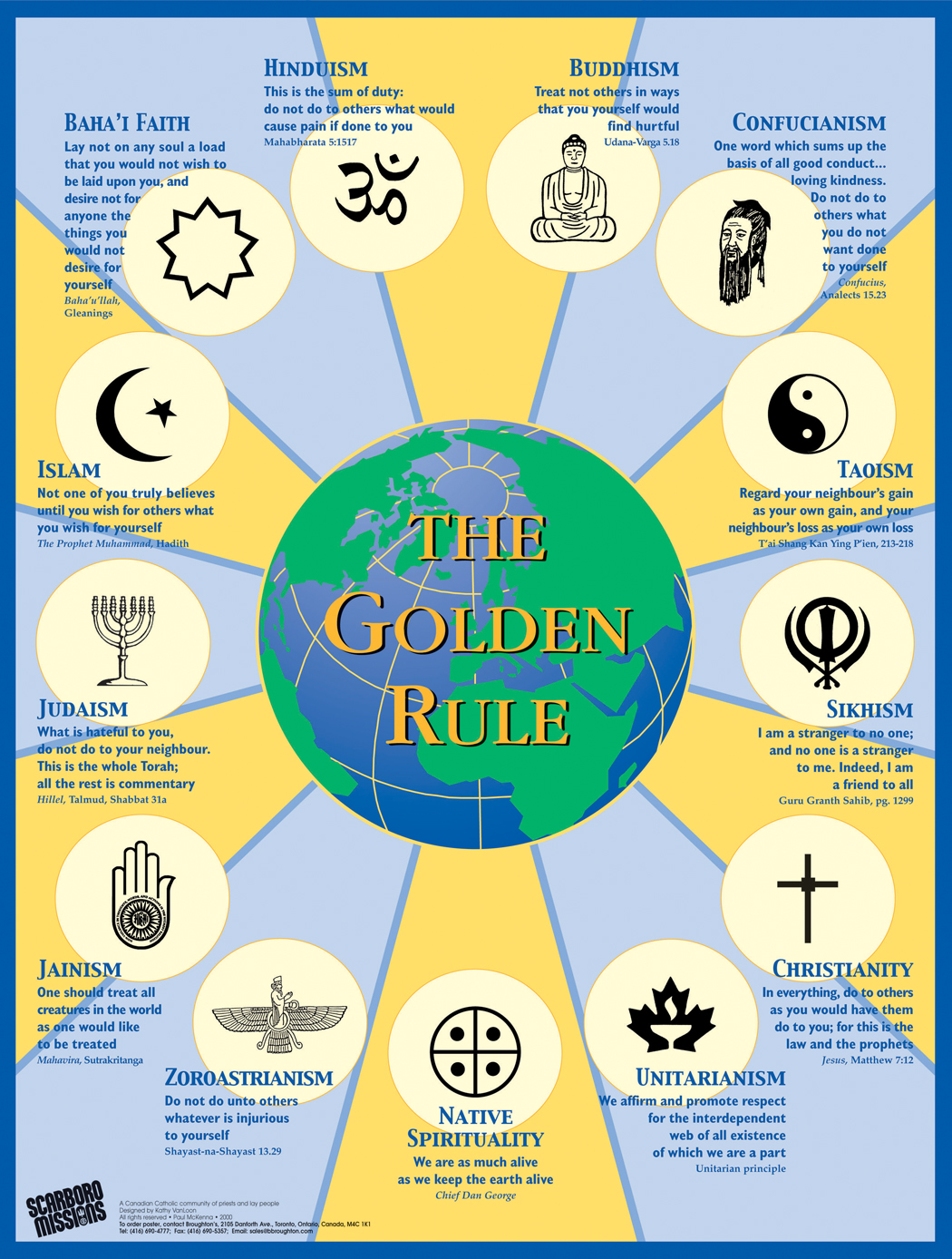
I have found endless versions of this rule, sometimes referred to as the Platinum rule or Universal Rule. You can find slightly grainy pictures like this one (because they want you to actually buy the nice clear one) depicting some of those guiding principles of other cultures.
You could spend hours discussing which one is better or which fits you better. Whatever you do don’t start fighting about it or you have completely missed the point.
To avoid that kind of fight about Popper’s quote, I need to go back to it because it contains a few key words that were adequate to what he was saying at the time, but now that we have rebuilt Europe, taken down the Berlin Wall, found our way to a world beyond two super powers bent on destroying each other and entered a world where empires can fall without the inevitable grab for power involving death and destruction on a massive scale, we need to develop a new language that acknowledges how all of our cultures share common bonds.
One of those words is “spiritual”. This word gets bandied about quite often in phrases like “spiritual but not religious”. I let people use whatever terms they want to define themselves, then, if I’m interested, I ask them to describe what they mean. So I don’t need to come to a consensus on what this word means. For my purposes here, and I think adequately for Karl Popper, spiritual things are not material things. They are the hard to measure things like feelings, the value of health over wealth, and knowledge as an end itself instead of a means to something else.
In the quote, Popper is putting the “tribe”, the ones who defend a bordered territory, a set of traditions and ties of birth and history up against an idea of listening to as many voices as possible and synthesizing and harmonizing them for the good of all. Democracy in this quote is not just majority rule or an ideology tied to an economic policy and a particular constitution, it is the ideal of maximum inclusivity and plurality. At least that’s how I see it. That he says “rise of democracy” indicates to me that he still saw much work to be done.
I’ve already addressed that the idea of individual over tribe is not solely a Western idea, but Popper also makes the claim that it is the central doctrine of Christianity. This is a Western-centric statement. It even ignores the very Eastern roots of Christianity. It’s something we have to deal with when evaluating any wisdom coming out of thinkers in the mid 20th century and even more so from those before that. Popper knew his ancient philosophers. I don’t know how well he knew religions. Regardless, I’m not going to devalue him or his sentiment because he choose this particular symbol of neighborly love to express it.
The Old Testament and the New as well as commentaries surrounding them have versions of their greatest prophets being asked how to summarize their teachings. They all say something like loving God and loving your neighbor. Trouble is we also have a wide variety of scholars who spend their days trying to understand words that have been translated through a few languages and through many cultures. Even today, the word neighbor can mean the person next door, or an adjoining country. In Biblical times, it may have meant only Jews or only certain Jews. By the time the gospel of Luke was written, it appears it was starting to mean more than just that. Later letters though, like 1 John, appear to be returning to more tribal thoughts.
The rise of democracy and broadening sense of morality include the idea that we care about a wider and wider circle of people and places. If we agree on that, then it doesn’t matter so much that Christianity has it as a core tenant. It’s great, don’t get me wrong, it means they are on board with the arc of human history, but it doesn’t say anything special about that particular part of history. I suspect if I was alive in Popper’s time, I could have easily been happy knowing I was a Christian and that my traditions included loving those around me in the way I would hope to be loved. I’m glad I’m alive now in a time when I know that sentiment has a much wider reach and is derived from a wider base. I know it’s something even my enemies have some sense of.
* Strong atheism involves the denial of all, or at least one god in particular. Usually it’s saying they know gods do not or cannot exist. “Hard” or “Explicit” atheism also state gods don’t exist with some degree of certainty.
These entries are almost all non-religious. When you leave a believe system, you have to rebuild a foundation for how you figure what is true. The same problems keep coming up, like we can't be 100% certain and that there are many experts that need to be sorted out but we don't have the expertise to challenge all of them.
I've argued with Libertarians as a way to try to understand them, with gun advocates to try to find a peaceful solution and with my liberal friends who often use the same flawed logic that they accuse conservatives of using.
I put what I think are the best in bold. They are in reverse chronological order, but only a few mention something topical.
There are few ways to go with this. CA’s original statements
stands well on its. Also, in any current form of religions I know, there is no
preferable universalism that I know of. My problem with Randal is, he doesn’t
go far enough with interpreting hell out of Christianity. I think that can be
done, although it strips Christianity down to its Jewish roots, even into some
type of Reformed Judaism, so it probably is not a popular route. My problem
with the Counter Apologist is the use of assuming beliefs by the gospel writers
when it’s convenient while claiming we don’t know what they meant most of the
time. I think this hinders the very reforms we want to see in religion.
Starting with the reforms; I don’t think it’s a stretch to
say the arc of the Biblical narrative is that history has a goal, that there is
some inherent reason for our existence, and it’s something good, and we need to
discover our part in making it happen. This is the MLK thesis on justice and
even if you take the atheist view of meaning created by the individual, it is
compatible with a goal oriented form of utilitarianism as a theory for morality.
To have this discussion across cultures, we need to be reasonable and accept
that neither modern philosophers nor the Bible have a clear sense of what “justice”
and “good” are. Modern philosophy accepts that, practically as a premise. The Bible
has its moments, like Job arguing with God, but for the most part modern day practitioners
of Abrahamic religion believe a supernatural force is the source of “good” and
don’t care if they can’t prove it with scripture.
The above point is somewhat proven in the way Randal
backtracks on his own religion when confronted with a rather straightforward
problem like eternal or long lasting punishment. So let’s look at how CA supports
the argument.
If atheists want to make the point that the Christian
version of hell is wrong, I don’t think they need to stray deep into what the
Bible says hell is. The Bible is not clear on that, that’s clear. Atheists don’t
need to quote Jesus to prove Jesus was saying something. This degrades their
own arguments since they begin with the understanding that the gospels are a
poor reflection of any actual Jesus. This is the consensus of scholars,
including religious scholars, but it seems to get forgotten when atheists start
looking for proof texts. We are always quoting unknown authors and worse we might
be quoting many authors in the course of just one passage.
For example, “torments” and “flame” in Luke 16 might be an
allegory of justice for the rich man who neglected to care for the poor man at
his gate. The thrust of the parable up to that point is about upending the
power structure, and rewarding goodness for goodness sake instead of rewarding the
powerful just because they do their rituals. This passage looks like a Greek
version of hell getting tacked on to an earlier tale. Whether that was for
better marketing of the book or because that belief was creeping into Jewish
culture is debatable and barely relevant to a debate on the reality of hell.
What I think is important here is to recognize the opening
Randal gives us. Christian scholars are quick to say things like Hellenism had
crept into and corrupted Judaism at the time the gospels were being written,
but they are slow to say exactly how. Christian scholars probably won’t lead
those discussions because they suspect or fear they will result in less
believers. This is exactly why atheists should be pushing in that direction. Two passages from Revelation were included in
CA’s list. Maybe Randal is open to eliminating Revelations from the canon. It
has been debated since it was first proposed and is not in some Bibles. If it
is an inaccurate depiction of hell that is incompatible with 1st
century teaching, then let’s settle that and then move on to the next misinterpretation,
redaction or mistranslation.
This might sound daunting, but I don’t think every line of
scripture will need to be addressed before Christian culture begins to change.
This approach to the Bible has been happening for a long time and has altered
many denominations and led to reforms like women and gays being accepted.
Atheists would do well to understand it.
Quitting religion for me was somewhat like quitting smoking, I did it several times. I probably could have gone on having positive moments with that community and just accumulating the good memories, but I kept thinking something about it wasn’t good for me. I could have focused on observing people going to church around me and then acting in the world in positive ways. In a slightly different world, that could have been enough to allay the doubts and just dismiss them as the normal human condition of not knowing the answers to the ultimate questions.
Church is very good at handling these doubts. They love to bring the lost sheep back into the fold. They have a wide of variety of books and techniques to deal with loss and pain. Not quite as well advertised, they are also willing to cut you loose if you don’t respond the way you are supposed to. I’ve heard more than a few stories of kids getting kicked out of Sunday School for asking too many questions. Adults need to figure it out for themselves and for some it can be quite painful. Some people leave behind their whole system of community support when they leave a church.
I was lucky. I was able to observe all of this safely and find an alternate community just by asking around. It took effort and time, but it was something I could afford to do. Some people are isolated and only have one version of religion presented to them. You can be isolated even in a densely populated urban environment, especially when you are young and still need the support of the people who raised you.
If you find yourself in that situation, the only advice I have is that of Charles Eastman’s father. Eastman, also known as Ohiyesa, was a Lakota, born in 1858 when the US government was forcing his tribe to relinquish their ancestral knowledge. His father, who had almost been killed as part of the largest mass hanging in US history, told him to not fight it, to learn as much as he could about the ways of the people who had conquered them. Eastman became a doctor and wrote about Sioux ethnohistory and even got invited to the White House as a sort of ambassador to the tribes.
Anyway, that wasn’t my experience, but in 2009, a book came out, 50 Voices of Disbelief. It told stories of people who had experienced that isolation and indoctrination. Many of them had gut wrenching experiences making the transition from their isolated worlds to the real one. Those stories really hit me and were difficult to not think about. I’ve since talked to many people who were raised in what we might consider a normal Middle American fashion that included religion and didn’t find the transition quite so hard. They were given resources like a college education and understood they had choices, even if those choices caused a little disappointment with their parents.
I think we dismiss these stories a little too easy. There is a spectrum. There are certainly abusive churches out there and I don’t have a problem focusing on them, but I have heard the same fundamentalist half-truths and apologetics in the most liberal of churches. In one of my Bible study classes, back when I was still Christian, someone came to class having just read an article about the Leviticus 21 passage about slavery. She was concerned that the Bible clearly supported slavery. The pastor smoothed it over by talking about how slavery then was more like indentured servitude from a few centuries ago. We didn’t open the Bible and examine the verses in question or address the problem at all. She didn’t even get a chance to talk about them, so at the time I didn’t know the verse I just linked. I just filed the concern in the back of my head as a minor problem. Years later I had to have Matt Dillahunty, an atheist podcaster, shove those verses in my face before I understood my mis-education.
I’m sure that pastor was just repeating what he’d been told. He probably avoided looking at those passages and that is exactly what he wanted us to. Any similar or more direct questions I have asked of religious people of all calibers since have been met with similar dismissal or, my favorite, “that’s not our church”. The story of the pastor above is someone I care about very much. I have other stories of churches that I have and still consider wonderful communities that are doing great things. That’s how I tell these stories. The entire point of the stories is that they are doing great things, and, and, they can’t reconcile that with the fundamental founding documents of their organization. But it doesn’t matter how well I paint those communities, when I tell the part about the slavery apologetics, or the kid who had to be excused from Sunday School, the response is, “that’s not our church”.
They might even have some evidence. They might say they learned from the pulpit that the book of Timothy was not really written by Paul and the anti-feminist stuff in there does not apply. They might just consider it obvious that slavery is bad and not understand why they even need to address it. If I point out that good Christians of the not too distant past supported slavery and patriarchy they still say it’s not them, that it’s in the past. When I point to Christians today not accepting homosexuality, they are at a bit of a loss for words.
What’s missing in these aborted attempts at a conversation is that these changes in morality were not guided by or sourced from any religious authority. It may have been Christians who led the abolitionist movement but they had to draw on secular philosophy and modern data to make their case. If people claim “their church” is modern and open to new data, it is data that is coming from outside the teachings of 1st century Judaism. For that matter, the gospels include the teachings from people outside of 1st century Judaism. This is the one of the paradoxes of modern religion. To be modern you acknowledge that change has happened throughout the history of the church, but when I try to get one religious person to address a particular needed change today, suddenly they don’t act so modern.
People who try to tell me that their church is different and wouldn’t act the way I describe people in my experience are, most likely, not asking the questions I asked or reading the books I’ve read or accumulating the doubts like I did. To remain in a church, or possibly any organization, you have to allow for some parts of it that you don’t like. It’s a matter of degree of how much is tolerable and explainable. For example, I have on occasion considered leaving my country due to some of its policies and actions, but overall, I like it here and prefer to follow the advice of Carl Schurz, an immigrant who fought in the civil war. In 1872 he said, “My country, right or wrong; if right, to be kept right; and if wrong, to be set right.”
There is no particular wrong that caused me to leave church. It was the inability of it to address what was wrong. Religion is uniquely designed to avoid change. It holds up the ideal at the highest levels of decision making that if you sit quietly in a darkened room with your eyes closed and just ask for answers, they will come to you. Change comes through claims of revelation and requires that you connect your revelation to an earlier figure in the tradition, an earlier figure that might not have even existed. This is the opposite of using reason and evidence and observation and worse, the opposite of listening to the voices of those around you.
Being frustrated with an organization you are member of, or your country or your family or anything in between is not that unusual. We all settle on family having done the best they could, well, most of us, I realize some families are really messed up. We accept that we get something for the taxes we pay and we hope that next time we’ll have better candidates to vote for. No matter what, we look for underlying principles of fairness and some sort of logical progression from biological needs of love and support up to the day to day fulfillment of those desires. The Bible fails at that. Sure, Jesus said to “love thy neighbor as thyself”, but a lot of traditions said that before. And that was his second commandment, the first was to “love the Lord thy God with all thy heart, and with all they soul and with all they mind.” That part is not very well explained and has some serious problems.
Some people have specific events that made them quit religion, but I’m not one of those. If anything, there were a few things I can remember that kept me hoping that I could get continued value from that community. One of those was meeting Rabbi Michael Lerner. He had written some books on applying his Jewish traditions to liberal politics and for a few years had been an advisor to the Clintons who were Methodists, just like me. Ideas like the Jubilee year where debts are forgiven or the Sabbath where you unplug all your electronic devices for a weekend. This was before smart phones. A lot a people talk about this as a good idea now.
https://www.tikkun.org/nextgen/images/header_lernerpage.png
A community formed around these and other ideas and that work continues. It’s good stuff, but the Biblical connections were not that direct. His work is a good response to fundamentalism. It shows you can go to church or synagogue or mosque and be inspired to work for justice and peace and equality. But if you’re looking to make a case that the Biblical narrative leans more to the left, I didn’t find that there.
For more detailed Bible study that does look for modern messages in the text, there was the Jesus Seminar. This group of authors was active the 1990’s. Dominic Crossan is still writing and speaking. Marcus Borg died recently. Robert Price has since become atheist, but he still studies the Bible. In the first book I read from that group, they put the gospels side by side and showed how they are irreconcilable. I have since come to see these things like this more cynically. They are things you can learn, but really not apply. It’s an anti-fundamentalist statement, but doesn’t tell you much about what the gospel authors were trying to say.
They are a way a church can show it is progressive and opening up to new scholarship, but they don’t integrate the study into the full mission. I read that book as part of an adult study class. That’s where this kind of study usually ends up, relegated to the basement with a small group. They are a spoon full of progressivism for those who are asking for it, but they are still feeding the same old buckets of liturgy every Sunday.
So, that’s my cynical view, but I have to admit that some of this education included the political messages of the narratives. These are stories of an oppressed people under the rule of a conquering empire that had co-opted their religious leaders by sharing some of their riches with them in exchange for keeping the populous in line. That’s a universal story that repeats itself throughout history up to this day. What the Bible offers are stories about how they dealt with it.
For example, when Jesus says, “render unto Caesar that which is Caesar’s”. He doesn’t mean, pay your taxes and shut up. Before he says that, he gets a Pharisee to pull a Roman coin out of his pocket. That coin has Caesar’s face on it, and he is considered a god. This is idle worship, and without saying it directly, Jesus just pointed out how the leaders of his religion are corrupted. We do this today by calling out Joel Osteen for not helping people during Hurricane Harvey.
So going down to the basement was one way to find deeper discussion about interpreting scripture, the other direction is up the leadership chain. There are a variety of seminars available to help potential leaders grow, and although you are again meeting in smaller groups, at least there is a sense this is the direction of the national organization, not just some pastor who found a book he liked. One of those classes I attended talked about something called the “Rule of Christ”. If you Google that you will get a ton of hits about Christ being the ruler of the kingdom. That’s not the one I mean.
The one I’m talking about is found in Matthew 18:15-20. It’s about how you handle a member of your group who is not on board with the mission. You speak to him privately then bring in more people if more understanding of the situation is needed. Then if needed go to whatever decision making body you have. If the situation still can’t be worked out, it may be the person has to go. Now, there’s some danger of this being used to enforce “group think”, so 5 verses isn’t enough to cover that, but it’s a good start. It’s better than letting rumors fly or of letting one disruptive person poison every meeting.
That kind of study was going well for a few years then I thought it would be a great idea to become a lay speaker. A lay speaker can fill in for a pastor on Sunday and usually has some other leadership duties. I went to an all day event where we talked about what it was about and what the United Methodist Church was up to. One of their programs was called “Open Hearts, Open Minds, Open Doors”. Sounds pretty self descriptive, and from the diverse group of people attending the class, it seemed like openness was the direction we were all headed. The church that was hosting the event had an entire set displaying the idea with doors and banners.
Then one of the speakers gets up and a few minutes into his talk, picks up one of the brochures for that “open” program and says, “we don’t need to worry about open doors, we need to get back to the miracles in the Old Testament.” A little later at lunch, he floated this idea again, asking rhetorically, “what would happen if we all got up in front of our churches and started saying that miracles were real.” No one said a word, probably a pretty common response to someone saying something like that. He tried answering it himself, saying it would cause miracles to happen or something.
I wrote the district Bishop about it and received no response. I talked to a couple pastors and got sympathy, but not much else. One of the other leaders at the event said she wasn’t happy about it either, but there wasn’t much she could do. What I saw was, the church leaders believe they need to keep as much of the old ways as possible even as they try to move forward. This is obviously about keeping butts in pews but it is also simply a lack of vision.
There are people like me who want to be part of an organization that is serving those who want to work for a better world. We can, if we want, find groups that address specific topics and volunteer our time doing something we consider worthwhile. It’s harder to find a place that addresses our need for community, our need for places where we celebrate our accomplishments and counsel each other on our failures, where we discuss the foundations of our values. You can see the numbers by looking at the declining church going population. There are polls showing many of those people left because the church is not open to new ideas. But churches are not good at addressing that population. They are experts at welcoming the fallen back into the fold, but when someone is going through serious doubts, they are almost silent.
When I tell stories like this, I often hear the response, “that’s not my church. We’re not like that.” I’ll address that next time.
When I ask people what we should do when we disagree, most
people say we should go find people who do agree with us and work with them. At
best they might make some sort nod to inclusivity. This worked fine for most of
human history, but then we found out that what we do affects people on the
other side of the planet. What we wear and what we eat can cause suffering for
children on other continents. What we don’t do can result in death and disease
just down the road from us. Even if we want to be selfish, ignoring that
suffering will eventually result in problems for us and our loved ones.
There are answers to the question. We have rules of order
for running meetings. We have neighborhood groups and community organizations.
We have Constitutions and International Law. We have the Rule of Christ if you
prefer, Matthew 18:15-20. But very few people know how these systems work and
even fewer actually use them or use them wisely. All of them are designed to
regulate common decency; take turns speaking, respond to what was said before
starting a new topic, when consensus doesn’t exist take a vote, seek facts,
agree on how to determine truth then stick to that agreement. Drawing a
boundary and keeping some people outside of it is the last resort.
I left the 3rd largest denomination of Christians
because they couldn’t agree on how to deal with the issue of homosexuality. The
United States moved on and I realized my church was no longer a leader on one
of the most important issues of our time. But I didn’t blame all Christians. I
blamed half of the people in my church and I blamed the poor system of decision
making they all inherited. But I still acknowledge and support those who are
fighting that fight from the inside of what I consider a flawed organization.
That’s around 6 million people I consider allies, not
enemies. I’m sure I have many differences with many of them. But they have a
voice that gets heard in tiny villages all across Africa where they still have
the death penalty for loving someone in the wrong way. They have ways and means
of building community that I don’t. My facebook post congratulating my friend
and his husband doesn’t have that kind of impact.
I just picked this one issue. If you think this post is
about advocating for LGBTQ or whatever initials I forgot, you missed the point.
Pick your issue; GMOs, Afghanistan, vaccines, big government, big organic,
sending food to Kenya, choice, life, free speech, then think about who you can’t
talk to because you disagree on those issues. Then pick an issue like
breathable air or drinkable water or creating communities where children can grow
and discover their place in the world. How many partners do you need to make
that happen?
First off, I won't write a book about my approach to the Bible, so my prophecy in the title of this blog post will be fulfilled due to my own inaction. The reason I won't write it is I see what kinds of books people buy about the Bible. Most of them confirm what has been being said for hundreds of years. A few of them say they have something new to say, then they say how amazing it is and how you will discover God and Jesus by looking at it this way. I don't want you to discover anything that isn't true. Most people find reality pretty boring. Too bad, they don't know what they are missing.
In Rob Bell's latest book, he manages to both give this message to the church and tell you that he knows what God thinks and knows how you can know that too. He has the advantage of once having preached at a mega-church and he's studied the ancient languages and been seminary school. But I don't think you need to do all that to understand what he gets right and what he gets wrong.
Most organizations that say they are teaching something about reality that you can only find by following their ideas, their practices, will tell you anything except that you can find it on your own. John Prine may be one of the few people who could tell you that and still sell albums. Churches and fortune tellers and gurus and snake oil salesmen and politicians have a goal of self preservation.
The Bible does not teach you to hang on to one way of thinking. It teaches you to give things up. It teaches you that your tradition is corrupt. It teaches you that your leaders have an agenda that does not further the needs of the community. Sometimes, while doing that, it recommends fixing it by returning to the tradition, but in some more pious or more devout or more self-sacrificing way. This is one of the more commonly ridiculed flaws, but focusing on those just becomes a mask for the major theme, found throughout, that to make progress, you have to leave where you are.
Being a slave may be comfortable, but it's not who you are. Your family is great, but it needs to spread itself out over the land and maybe not get together as much. And later, you may find visiting that long last relative and reconciling old wounds may be just the ticket. Whatever it might be, getting together every Sunday with the same people and singing from the same hymnal is probably not it. Celebrating the glory of what someone said thousands of years of ago is not progress.
Rob's sub-title is about transformation, mine would be something like, "An ancient library that has some useless and wrong history and some stories that changed things in important ways a long time ago and just a few stories that can still inspire some people today." Probably not a blurb that is going to sell anything.
I was at a Christian camp the other day, not as a Christian, it was a cross-country skiing group. I like to poke around their libraries. This one was just a bookshelf will old Bibles, old Sunday School guides, except one book from 1982 by Francis Schaeffer, The Christian Manifesto. I didn’t have time to read the whole thing, so I’m not sure just what the “manifesto” was, but I’m pretty sure he was promoting violent overthrow of the US government. That might sound like something from a 60’s radical rather than a leader of evangelical conservative Christians, but it was definitely in there. His justification was that the government was allowing, and in fact supporting the killing of innocent children, via abortion.
I’m not going to dwell on the violence part too much, and he doesn’t lay out any kind of plan. What was interesting was how he made parallels to those 60’s radicals and lots of other radicals through history. He kinda of made violently overthrowing your government sound completely rational and logical. I’ve seen this sort of thing in my travels with counter cultures. When I took a paid position as a canvasser against the transportation of nuclear waste for example; it would have been right about the same time Francis was writing this book. One night, an anarchist joined us and took a few minutes to explain that she thought the only way to ultimately end the nation’s support of nuclear weapons was to violently overthrow the government, take control of said weapons, and of course, she and her minions would do the right thing and dismantle them. She didn’t say too much about killing untold numbers of people in gaining that power, but it seemed to be her plan. No one joined her army that night and I have no idea what became of her.
Schaeffer takes a longer view of history. In this book for instance, he builds his case by listing many of the wars that took place between Protestants and Catholics. When the Protestants won, he tells the story about an evil Catholic King who was deposed and the people of that kingdom were saved further oppression, because they now had a Protestant ruler and were free to be, well, Protestants. When the Protestants lost, he said they were martyred. Just as modern news of war talks of the brave soldiers defending freedom and is less generous about those who die daily from our constant shelling, these stories soften you up for the call to action.
He then further builds his case using a “just war” theory from Lex, Rex, or The Law and the Prince; a Dispute for the Just Prerogative of King and People, published in 1644. Apparently this is a quite famous work. As shown in the bottom paragraph here, Shaeffer, using Rutherford’s logic, believed it was the duty of the people to execute God’s will when the government body does not. On the next page, he compares this to Bob Dylan. He says the differences in language changes nothing, although I would say Rutherford is a little stronger in his suggestion of an actual uprising, and Schaeffer later minces no words at all.
There certainly were those who listened to Dylan and were inspired to shot at cops or bomb government buildings, but Dylan was not telling them to do that anymore than the Beatles were sending secret messages to Charles Manson. I couldn’t copy the whole book, but on page 110 Schaeffer says it is time to use appropriate forms of protest, and in other places, he is definitely leaning toward what Rutherford called “lawful resistance”. He was suggesting doing more than marching around with cardboard signs. On this page he is talking about how the ACLU has taken God out of the schools. In later pages he speaks to the problem of the government supporting abortions.
To be very clear, I advocate none of this. I don’t want people to have abortions, but there are better ways to reduce the need for them than by picketing abortion clinics. Until it becomes a regular part of our government to throw people out of their homes, or force people to worship one way or the other, or to lock people up for their thoughts, I’m not ready to take up arms against them. I know those things happen, and more often than I’d like, but we still have legal means to undo them and to punish our police when they need to be policed. There was a time in my life when I broke the law on a daily basis, but I never thought that the system of law itself was unjust. It has unjust aspects, but that’s part of living in a democracy, you aren’t supposed to like everything about it. Nor are you required to. If you don’t, you can work to change it.
So, back to this book. I could be wrong about what Francis Schaeffer actually meant. A central point of it though, and I think he does a good job of making this point, is that the idea of there being a higher law, one that transcends temporary governments and power structures, has been around for a long time, perhaps for as long as there have been power structures. There has always been a resistance of some sort. Most of them we don’t hear about, because they don’t have the power and never get it.
It doesn’t matter if that resistance is fighting for “free love” or for “moral power”, the rhetoric will sound very similar in either case. They will call the law makers law breakers, or worse they will call them rapists and murderers. What Schaeffer is a little less quick to mention, is they, or someone who hears them, will then justify bending the rules just a little in the name of their higher authority. When you can convince someone that you have tapped into the transcendent reality, and that they are now privy to that special knowledge, you can get them to do just about anything.
I’m trying to present all of this without judgment. When you are unfamiliar with the background information of a culture, something like a doctor being shot in cold blood for performing abortions or a protest erupting into violence can be a shocking story with no rhyme or reason. But rarely do such things come out of nowhere. Manifestos by people living in shacks in the woods are rare, and typically less coherent. Anarchists like the one I met, show up, break a few windows and fade into the background. But organizations like the ACLU and the Evangelical Church will probably be around for a while. We’re going to need to find ways to get those two camps together.
If you click around the link to the L’Abri Institute above, it’s more than just an introduction to who Francis Schaeffer was. It tells of his work that included trying to understand just what the 60’s counter culture wanted, something I'd like to see more of from that side. If you follow the link to the ACLU, you’ll see they fight for everyone’s rights, not just against religion or for liberal causes. And as we found out last November, there is something they are not listening to either. If you are unfamiliar with one or the other of these histories, I can see how it would seem like there is some evil force in the world that needs to be countered. If you are unfamiliar with both, the world would seem chaotic indeed.