Showing posts with label compassion. Show all posts

Saturday, December 20, 2025

Listening Across the Divide

 I have changed my tune. I used to say "Facts don't change people." It's one of those poorly developed slogans, like, "defund the police." The change I want to see takes at least a paragraph to start to develop the idea. Facts are of course important. I could simply add, "alone", as the second word. It takes a little more skill and practice to get to the "how" of presenting facts. When I try to have these conversations, I get plenty of counter examples, sometimes data (anecdotal or otherwise), and my favorite, "they will never change." That last one is conversation ending, but it doesn't have to be "the end."

This post will be updated as I find examples of people using their listening skills to build relationships and finding that the person they disagree with has something valuable to say. The stands on the issues might not change, although sometimes they do. The perceptions that the people have of each other change in most of these. They also find that even though their ideas remain more or less intact, they can work together toward a common goal. 

In 2017, a journalist from the very liberal Seattle Oregon loaded up a bus of people like herself and went to a small town that had voted the opposite of her own. It went better than expected. 

MeltingMountains

One I haven't examined in too much detail yet

Americans Reconnect: Talking Across the Political Divide | MPR News

Jonathan Rausch is gay and Jewish and has presented his work to groups like "Faith in Family". They listened

Cross Purposes and https://www.abebooks.com/9780805076332/Gay-Marriage-Why-Good-Gays-0805076336/plp

Stand Together Stories


Wednesday, April 30, 2025

Morality, where do we see it?

Francis Schaeffer is sometimes considered the progenitor of the Evangelical movement in the second half of the 20th century. In his seminal work “How Then Shall We Live”, he begins by looking at failed civilizations and philosophies over thousands of years. Without very much background or logical connection, something Click and Clack the Tappet Brothers might call “unencumbered by the thought process”, he concludes therefore, that there must be an ultimate truth, a source of wisdom beyond human ability and that must be the God of the Christian Bible.

This offer of an answer to the questions of how to live, to me, is not different than the offerings of a populist leader who does not acknowledge the input of the people they are leading. They are the opposite of the leader who says, “it was a team effort”, when asked how they succeeded. Examples of that form of cooperative leadership at high levels are hard to find. Democracy is an attempt to formalize it at a national level but we’re still experimenting. Mythology passed down to Indigenous cultures might contain lessons.

One of those is the Seventh Generation Principle. It comes to the modern Western world from the Iroquois Confederacy of tribes around what is now Lake Ontario in pre-Columbian North America. Some of their ideas inspired the United States Constitution but the idea of considering the impact of decisions on future generations was dumped, overridden by the culture of Capitalism and short-term gains.

Early diaries of European explorers of North American speak of settled areas that had been abandoned. Germ theory had not yet been discovered, so we can forgive them for not understanding where everyone went. Later however, this was forgotten or more likely changed to the story of how those Europeans “tamed” the wilderness. The practices of forest management and hunting that preserved species didn’t result in walled cities and wide roads, so for centuries European methods have been considered superior. The impending failure of those methods is finally drawing that consideration into question.

Spiritual practices are difficult to understand from the outside, so I hesitate to comment on them. I will stick to less controversial statements. Connection to the land and a reverence for nature is easily recognized in writing and stories. Some tribes use the term “two-spirit” or something similar to describe a person with masculine and feminine gender identities. This is something that is rarely honored in other cultures the way N.A. culture has. Also, in my recent interactions with American Natives alive today, I have heard expressions of belief that are unlike other beliefs that have a hierarchical system, with the most powerful gods leading and demanding worship. There seems to be more of a recognition that the stories are symbolic, but this could be just my interpretation.

Overall, my estimation is these ideas and practices were lost and subjugated when Empires with more effective weapons and battle techniques took control of large areas of the map. That changed not only who was in control but how values of how best to survive were passed on. Reflecting on how much better off we are than the previous generation or our younger selves was replaced by what general could best the previous ones or what innovator could create technology to make last year’s model obsolete.

These ideas are not exclusive to Native American but I am most familiar with them. I’m sure similar ideas could be found in other parts of the world and in more philosophies. Now that we have connected the globe and have a better vision of history, including pre-written history, it is time we incorporate all that knowledge and experience into a global sense of morality. Religions that have been at war with each other for as long as they have existed now gesture and speak in platitudes of how we are all praying to the same God or that their God points to the same beliefs as the others. There is even recognition lately of moral systems that have nothing to do with Gods at all. Is it possible to bring all this together and at least talk about the common ground?

This is a bit a tangent from the main theme of how to create a moral system, but I sometimes feel Carrier spends too much time critiquing the people who call themselves moral leaders and not so much on where we could be looking for real leadership.


Friday, January 1, 2021

A most excellent New Year

There was a new Bill and Ted excellent Adventure movie this year, gotta give a nod to that. It was about the fulfillment of their original mission, to bring the whole world together with their music, which keeps seeming to happen and then not happen in each of the movies. I've followed a similar pattern through the years. You could review last year's New Year's post for example.

In February, I almost got a local chapter of Braver Angels off the ground, then, that thing that 2020 will be most remembered for happened. Braver Angels has continued online, so that's good, but getting people together in living rooms has not been happening so much. 

I'm sliding toward a "year in review" blog here. That's not I want but I did come across an excellent review of the last 100 years of the Conservative vs. Liberal battle. It's a short summary but covers a lot. If you haven't read any Heather Cox Richardson, this is a good start. 

The article marks this year as the year that we will probably stop referencing the "Reagan legacy" and start using "Trump legacy". Before Reagan, we were very much under the influence of the "Roosevelt legacy", The New Deal. Today, we have people who are confused about all of this, who are afraid of "socialism" but don't want "the government" to take away Medicare or Social Security. The details of this battle between the social safety net and big business are in the article. 

Photo: Race and Reagan


It also describes how racism has been used as a weapon in this battle. That legacy goes back to the Civil War and the years that followed; Reconstruction. It mixes our identity as strong individuals who have high morals and ethics with a focus on vague enemies, like "communism" or "terrorists". It leverages these tools and uses legal maneuvers to selectively apply votes so it appears to be democratic and patriotic. It draws lines, and sets up each side to believe they are the "real" America. I'm using tons of scare quotes because all of these definitions are in flux.       Photo: Deconstructing Reconstruction

Many genies have been released from their bottles lately and they don't like being put back in. They will continue to impress us with their magic tricks. But as everyone knows, you have to be very careful what you wish for because genies can be so literal in their interpretations of your words and the trick is then played on you. 

As the article notes, we are at a point where millions of people are openly asking for votes to not be counted and questioning the entire system and willing to overturn the results of our duly run democratic process. It is not logical, but it is the inevitable result of playing on people's righteous belief in their ideology

The tendency to be blinded by ideology and forget that the person in front of you is a loving human being is not limited to Republicans. Righteousness can bind us and it can blind us. Moral indignation can override our reasoning skills


https://righteousmind.com/
There are scenarios where the same righteousness could have resulted in a Left Wing disaster. But don't confuse the danger of government that is too liberal with the reality of one that was captured by and run by conservative big business. Both can lead to oligarchy; rule by a rich elite. The "liberal" and "conservative" labels lose their meaning when you look at who makes the rules, that is, the ones with the gold.


Tuesday, March 24, 2020

Corona Blog

So, I’m a blogger, so I guess I should do this. It’s about change, about lots of changes through history and what that means to us now. I might seem a bit annoyed. If you want to get a teenager to read this, preferably one who doesn’t want to, they might get the proper tone of voice for it.

Everybody is talking about change. Of course we will change. Hasn’t every President run on that platform for the last 50 years? Make America Whatever or Hopey Changey, I don’t care. Throw the bums out. That’s a desire for change. But there is always tension, against the fear. Too much rapid change to greater rights for more people and a move toward socialism resulted in populism, on the left and the right. I have watched the constant battle between the dawning of the Age of Aquarius and the good old traditions since I was born in 1960. Look at what’s happened in the last 100 years since the 1918 flu pandemic. That’s in your parents’ or grandparents’ lifetime if you are older, so hopefully you talked to them. If you are younger, hopefully you know someone in the next generation up. They might have an old recording or at least some pictures.

They went through:
Nuclear weapons
Invention of vaccines
1918 flu
World War I (1914 to 1918)

Despite the pace of change having increased in the recent centuries, we haven’t developed new ways to cope with it. I don’t have much to suggest for that, but for me, getting some perspective on how much has happened, how far we have come in a short time, and how it has always been the people pushing leaders to change. That has helped me understand it.

My Public Education history spent too much on the days before the Revolution in this country, that’s my opinion. I always wanted to get to the World Wars and why those happened.

It was a major change in how the world worked. Before then, we were a world of royal families. Generals road on horses with colorful uniforms and battles lasted for a few days. With the arms buildup of the late 19th century, a result of the industrial revolution, these in-bred idiots who had no idea how to live in a time of electronic communication and world travel, put a match to the powder keg they built. To defend against heavy artillery, they created trench warfare, to breakthrough that they invented tanks, and on and on.

If you don’t want to have a love for history, don’t click here. Dan Carlin has a great ability to tell the story and provide the facts. His “Blueprint for Armaggedon” series is the story of WWI. 

Going back through the 19th century further you had:
The Industrial Revolution, steam engines, mechanics, oil. Horses were no longer the best source of power, but we still use the term “horsepower”.
Darwin published the Origin of Species in 1859.
Michael Faraday, who died in 1867, advanced our understanding of electromagnetism. That’s kind of important to whatever device you are reading this on.

Pause for a moment on this guy. He discovered the mysterious energy floating around that we could use to move things and to communicate across miles. Click to see David Tong giving a lecture in the same hall where Faraday gave his. Tong is talking about the newly understood forces of quantum physics, that we now understand are the fundamental forces behind all things. He’s giving that lecture in the same hall, with the same desk, that Faraday did. It’s like we just figured out stone tools yesterday, and now we all have scalpels in our medicine cabinets. 

While Faraday was alive, we were finally throwing off the last myths about race and changing laws so we could no longer justify slavery. There are still slaves in the world, I know, but most people know that’s wrong now. What will be commonly thought of as wrong by end of your lifetime?

Change takes a little longer in the centuries before that, but let me connect just a few more things. Once the empires that grew out of ancient history started bumping into each other and “discovering” each other, we started accumulating our knowledge, sharing it actually, but not always in a nice way. You might have heard of Thomas Aquinas, who tried to reconcile the Catholic religion with Greek philosophy. He had a little help from the Muslims by the way. Not too long after that, we had Protestant kingdoms, so there was a lot of fighting with the Catholics.

At the end of all that fighting, after the Thirty Years War, 1648, a treaty was signed called the Peace at Westphalia. It took away powers from the Pope and created a new type of nation. That’s what you live in, a Westphalian nation-state. Sure, your way of life is rooted in a Judeo-Christian/Western Civilization/Constitutional Republic/Democracy/melting pot, sure. But the basic structure of our politics has only been around for 400 years, and it was formed under duress, and it’s not working. A bunch of morons from the Middle Ages made it up to get the Pope out their business and we can get the billionaires out of our pockets if we create the next system.

Something else happened once the European Princes and Bishops quit making us kill each other. It was the British Royal Society, founded in 1660 to promote scientific thought and learning. It was the fertile ground where Isaac Newton flourished. Newton created the mathematics that got us to the moon (along with some of those other folks above). Computers were first put to the test during that work. That pretty much brings us up to where we are now.

To have that sort of creative energy, to allow the brilliant people of the day to discover something, you have to first have some degree of peace. You have to have a little extra left over at the end of the day to give to the general welfare, to build some roads, to have some nurses ready to take care of us instead of working overtime to pay off student loans and a mortgage from that house they bought before the bankers destroyed the economy.

What gets left out of historical discussions like this is none of it happens if we don’t care about people that we will never meet; people on the other side of the world and people who are not born yet. If we aren’t keeping the world clean and free from violence and filled with beauty, if we aren’t nurturing the people who grow our food, or who are sitting in a room somewhere coming up with formulas that who knows what they will do, but we can bet they will do something, then none of this happens. Then we slip back into using those stone tools to harm each other and take whatever we can just because we can. None of this happens if we don’t realize we need each other.


A note on the present: We aren’t purposely crashing the economy by shutting it down, just so we can save a few million lives. The economy would have crashed if we didn’t do anything because the hospitals would have been overrun. People would have chosen to quit interacting with others after it was far too late. Services would be much more disrupted because the closures would be random; we wouldn’t be choosing to keep groceries open as opposed to restaurants, we would be choosing from far fewer options.

It would not be some simple math of 2 or 3% more people dead. We would be surrounded by sick people and no one would want to touch them for fear of getting sick themselves. This would multiply the problems. Any normal illness or regular medical attention needed would be almost impossible. We would have new priorities, like disposing of the bodies.

The stock market selloff was recognition by those who understand how their system works, that it is not working, that it is not designed to respond to a problem like this. It is not designed to take care of the people that actually create the wealth that they accumulated. Ironically, it created the problem by changing the environment, putting workers under stress, and prioritizing profits over health. It put messaging over science. They know this, they saw it coming. They didn’t tell us until they cashed out. But cashing out is a strategy of the dying system. I don’t know what the next system will be, but it won’t be the current leaders who create it.

Saturday, March 23, 2019

Atheism for the Religious and/or Spiritual 6

This is the first time I missed a February for this blog. The Ides of March have already been upon us. No excuses. I even had an idea brewing. I have a few favorite podcasts and I want to relate a couple recent episodes from one of them. It’s Bart Campolo, and he includes something from another favorite, On Being. In fact, I’ll go ahead and start with the poem, rather than try to lead up to it. 

Previous                      First                               Next

Everything Is Waiting for You

David Whyte
After Derek Mahon

Your great mistake is to act the drama
as if you were alone. As if life
were a progressive and cunning crime
with no witness to the tiny hidden
transgressions. To feel abandoned is to deny
the intimacy of your surroundings. Surely,
even you, at times, have felt the grand array;
the swelling presence, and the chorus, crowding
out your solo voice. You must note
the way the soap dish enables you,
or the window latch grants you freedom.
Alertness is the hidden discipline of familiarity.
The stairs are your mentor of things
to come, the doors have always been there
to frighten you and invite you,
and the tiny speaker in the phone
is your dream-ladder to divinity.
Put down the weight of your aloneness and ease into the
conversation. The kettle is singing
even as it pours you a drink, the cooking pots
have left their arrogant aloofness and
seen the good in you at last. All the birds
and creatures of the world are unutterably
themselves. Everything is waiting for you.


The podcast is called Humanize Me. If you follow the link you’ll see a story of a conversation with Conan O’Brien and Albert Brooks. 

The story doesn’t quite complete the answer to the question posed, can insignificance be liberating? Bart spends about a half hour filling in the blanks. It’s not some simple folksy wisdom. We’re all at different places with regards to how well known we are and how others judge our significance, but our approach to the idea of significance can have an effect on our happiness and maybe significantly more than that. He mentions the Tiger Mom who drives her kids to succeed. Whatever you think about that, it will most likely lead them to more success than if she had not done what she did. What her philosophy doesn’t talk about is that at some point in their lives, those kids will be able to make their own decisions, based on that success, and they will no longer need to be driven to succeed strictly for the goal of succeeding. They will be able to enjoy the journey they find themselves on.

With memes and commercials and self-help books and helicopter parents and just everything that is available to us at any moment, we receive a lot of wisdom in small bites, and a lot of it is not for us at this moment in our lives. Like, stopping to smell the roses is a good idea, but if you are on your way to your final exam, better not stop for too long. People will tell you all sorts of reasons for working hard and others will tell you to spend more time with your family. Others will tell you that you can have it all. What I love about Bart’s podcast is that he’s spent some time thinking about what “all” actually is.

In the story that starts this podcast, Conan O’Brien uses the example of President Calvin Coolidge and Bart has referred to Franklin Delano Roosevelt, people who have changed the world in significant ways. We don’t know much about Roosevelt’s private life, and very few people visit Coolidge’s grave. While they were alive perhaps only a hundred people knew them intimately, maybe less. When Albert Brooks tells Conan, “none of it matters”, he’s talking about his movies and his legacy and even the lives he touched because even those will pass and be forgotten. But of course, something matters. It’s true that all of us will be forgotten, so if we despair our individual inevitable end and dwell on the comparison of our accomplishments to those of great Presidents, we have miscalculated where we should be spending our emotional energy, because in the end, we all end up in that same place.

If you are focused on survival then you probably aren’t reading this. If you need to focus on survival, then do that. Hopefully you aren’t creating a sense of panic where there is no need for it. But if needed, you can find help and get to a place of comfort. There are tribes that have room for more and there are ways to find help, so do that first. If you’re already there, reflect on how that happened, what did your tribe do for you, what do you have to be thankful for? Bart tells the story of a chess mentor who teaches a young man not just to play well, but to love the game. Unfortunately, we don’t all get coaches like that, but we can hear about a story of someone who did. It comes around the middle of the podcast. I won’t spoil the story for you.

In February, this theme continued with a call in question from a 15 year old talking about her science class. It was great just to hear something so well thought out and articulated from someone her age. Bart wasn’t quite as happy with this his own answers as he usually is, so he followed up with a redo of it about a month later. I liked both episodes, but you could skip the first one and not miss much. Her question was about how to cope with the dire warnings of the future based on the climate science she is learning about.

In the first one, Bart tried to come up with some analogies, like riding a wave. You don’t control the wave, but you can control the surf board and make it to the end of the ride without getting dunked. He gets a bit dark at times and he apologies for that. He tries to end on a positive note about love. No matter when the end times occur or how, it’s still important to love your kids and appreciate the world we have now. The difficulty of this type of question is a matter of focus. The wave analogy breaks down when you start thinking about where our “waves of life” come from, the things that push us along, some of them are man-made and have levers behind them that we can get control of, and maybe we should try to grab them, instead of just going along for the ride. Or, I’d like to spend time appreciating the world, but there’s a lot of crap going on, and I’d like to fix some of it while I’m here. Bart posits that if the choices we make as individuals lead to a life well lived, then those same values should also apply to what we do as a species, as a whole.

After doing some research and giving it more thought, Bart comes up with some more solid answers to the question in episode 409. One of those is; we just aren’t wired for thinking about the future. Throughout history we’ve survived many disasters, of our own making or not, either by luck or ingenuity and that survival is both due to and feeds back into our optimism bias. I’m not even sure that’s a bad thing. You can check out the optimism bias Wikipedia page and TED talks about it.

Josey, the one called in the question, is a student, so she is just learning about this looming disaster and wondering why everyone is not acting like it’s coming and like it’s the highest priority for all of humanity. Her teacher is not wired to act that way and he has other things to teach. We could get hit by a meteor, our economic system could collapse or we could create nanotechnology that gets out of control and destroys everything. He has to teach all of those things knowing that his students understanding of any one of them could cause a lot of worry. He has also known about them for a long time and has continued to keep his job and feed his family throughout, so he might not see them as worrying. I don’t know what he is thinking, but it’s poor reasoning to equate all doomsday scenarios and conclude they are all wrong because we are still here, but that is part of how our brains work.

This is a problem for anyone trying to get others to adjust their actions to actual threats. Some people will respond to fear but many will get fatigued with constant warnings that don’t appear to be near or present. If you can show that people are trying to solve this problem, even if they are failing, you’ve just shown that someone is working on it, and we can hope they succeed. There are other problems, many more immediate, that also need attention. A constant drum beat becomes background noise. Bart didn’t defend this way of thinking, he just pointed out that we do it.

This isn’t just some psychology problem to deal with when you are talking to your friends either. It is built in to our political structure. To solve the problem of despotic kings a few centuries back, we created a democratic system where leaders can be voted out every couple years. This works great for slowing the accumulation of power but it is not designed for a change in climate that is occurring over many decades. We didn’t plan for this because it is only recently that we can predict such events. It’s only the last couple hundred years that we knew the earth was more than a few million years old. It’s even more recently since we have been able to predict the weather, let alone long term climate trends. We survived a long time without thinking on these scales.

It may be that the action we need is not the technological solution, although we’ll need that too, but we won't get to that if we don’t adjust our thinking first. We need to figure out how to accept and understand the science, understand our place in a vast universe and deep time, see our part as cooperative social creatures including future generations, and learn to discuss all of this with a diverse set of people and cultures knowing our survival depends on all of us getting along in ways we have never seen in human history. That’s a pretty tall order.

At the end of this episode, Bart says the answer to the question is to listen to all his other episodes. That might sound like a cop out or a marketing ploy, but I have listened to a lot of them, so I know it’s not. Bart’s theme of building community attempts to address all of these concerns at different times and in different ways. It takes hours of discussion to even begin to chip away at this and Humanize Me is one effort to do that. They answer it from the perspective of providing comfort to each other in difficult times, even up to and including the end of the world and how to be in a world of difficult choices so we can get together and solve all the world’s problems. The bottom line answer to all those is to care and nourish those close to you and do it in a way that helps to expand that caring and nourishing out into whatever surrounds you.

The summer of Year B covers some problematic behavior of Kings in the book of Samuel
Ecclesiastes really speaks for itself
Solomon upgrades the relationship to God in Kings
There are many ways to interpret Job. One could fit with this story.

Saturday, December 15, 2018

Atheism for the Religious and/or Spiritual 4

It might seem like this would be a good time to summarize the previous entries and start to converge toward a philosophy that I believe in or that is expressed in some sort of non-believer terms. That’s not where I’m headed. Atheism is not a philosophy. There is no atheist creed. At its simplest, it means a lack of belief. People love to complicate it and add qualifiers like “strong” or “hard”*. Some like to say that agnosticism is the only correct choice. Those are all points worth considering, but also not where I’m headed.

Previous                    First                       Next

Where I’m headed is better expressed by someone like Karl Popper. If you don’t know who that it is, you will be surprised to find out how much of how you see the world today was shaped by him or at least expressed by him. He wrote “The Open Society and Its Enemies” as the world was embroiled in its Second World War, a time when it was uncertain if decent democratic societies would survive. He wanted to preserve as much of the accumulated wisdom of our cultures as he could. He got it so right that his ideas are pretty much taken for granted so it just doesn’t seem necessary to quote him.

One thing you might hear Popper’s named attached to is the scientific concept of “falsifiability”. For something to be considered scientifically true, you must be able to state it in a way that you could create an experiment and prove it false. If repeated experiments provide data demonstrating evidence in support of the facts, then it’s a pretty good chance it is true. There are plenty of philosophical discussions about this, and it is being questioned more and more lately, but it has been a guiding principle of science since 1963.

Popper also wrote on government, ethics, and much more, including this statement about the Golden Rule,

“The emancipation of the individual was indeed the great spiritual revolution which had led to the breakdown of tribalism and to the rise of democracy.” 

He says this in a discussion about Plato and how he attacked individualism. Plato was an advocate for a caste system. But I don’t think we need a complete history of Western thought to get the point about loving our neighbors. As Popper says,

“This individualism, united with the altruism, has become the basis of our western civilization. It is the central doctrine of Christianity (‘love your neighbor’, say the Scriptures, not ‘love your tribe’); and it is the core of all ethical doctrines which have grown from our civilization and stimulated it.”

He goes on to say how even Kant, who believed morality is derived from reason, not the divine, said, ‘always recognize that human individuals are ends, and do not use them as mere means to your ends’.  Nor is this limited to Western culture. I would go so far as to say there are no cultures that survived or have left behind any kind of legacy that did not have some version of this idea in their core guiding principles.

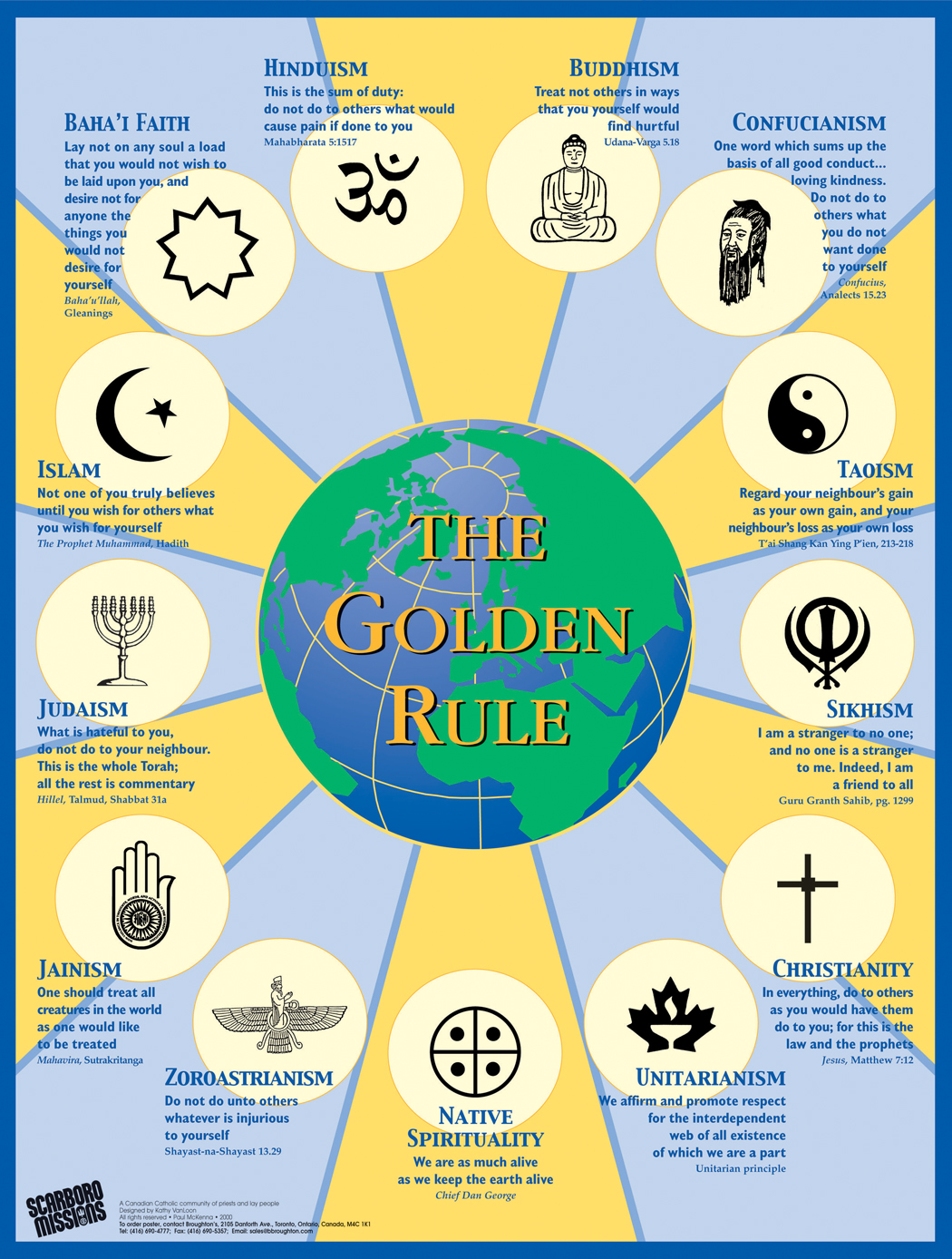
I have found endless versions of this rule, sometimes referred to as the Platinum rule or Universal Rule. You can find slightly grainy pictures like this one (because they want you to actually buy the nice clear one) depicting some of those guiding principles of other cultures.

Image result for golden rule poster

You could spend hours discussing which one is better or which fits you better. Whatever you do don’t start fighting about it or you have completely missed the point.

To avoid that kind of fight about Popper’s quote, I need to go back to it because it contains a few key words that were adequate to what he was saying at the time, but now that we have rebuilt Europe, taken down the Berlin Wall, found our way to a world beyond two super powers bent on destroying each other and entered a world where empires can fall without the inevitable grab for power involving death and destruction on a massive scale, we need to develop a new language that acknowledges how all of our cultures share common bonds.

One of those words is “spiritual”. This word gets bandied about quite often in phrases like “spiritual but not religious”. I let people use whatever terms they want to define themselves, then, if I’m interested, I ask them to describe what they mean. So I don’t need to come to a consensus on what this word means. For my purposes here, and I think adequately for Karl Popper, spiritual things are not material things. They are the hard to measure things like feelings, the value of health over wealth, and knowledge as an end itself instead of a means to something else.

In the quote, Popper is putting the “tribe”, the ones who defend a bordered territory, a set of traditions and ties of birth and history up against an idea of listening to as many voices as possible and synthesizing and harmonizing them for the good of all. Democracy in this quote is not just majority rule or an ideology tied to an economic policy and a particular constitution, it is the ideal of maximum inclusivity and plurality. At least that’s how I see it. That he says “rise of democracy” indicates to me that he still saw much work to be done.

I’ve already addressed that the idea of individual over tribe is not solely a Western idea, but Popper also makes the claim that it is the central doctrine of Christianity. This is a Western-centric statement. It even ignores the very Eastern roots of Christianity. It’s something we have to deal with when evaluating any wisdom coming out of thinkers in the mid 20th century and even more so from those before that. Popper knew his ancient philosophers. I don’t know how well he knew religions. Regardless, I’m not going to devalue him or his sentiment because he choose this particular symbol of neighborly love to express it.

The Old Testament and the New as well as commentaries surrounding them have versions of their greatest prophets being asked how to summarize their teachings. They all say something like loving God and loving your neighbor. Trouble is we also have a wide variety of scholars who spend their days trying to understand words that have been translated through a few languages and through many cultures. Even today, the word neighbor can mean the person next door, or an adjoining country. In Biblical times, it may have meant only Jews or only certain Jews. By the time the gospel of Luke was written, it appears it was starting to mean more than just that. Later letters though, like 1 John, appear to be returning to more tribal thoughts.

The rise of democracy and broadening sense of morality include the idea that we care about a wider and wider circle of people and places. If we agree on that, then it doesn’t matter so much that Christianity has it as a core tenant. It’s great, don’t get me wrong, it means they are on board with the arc of human history, but it doesn’t say anything special about that particular part of history. I suspect if I was alive in Popper’s time, I could have easily been happy knowing I was a Christian and that my traditions included loving those around me in the way I would hope to be loved. I’m glad I’m alive now in a time when I know that sentiment has a much wider reach and is derived from a wider base. I know it’s something even my enemies have some sense of.


Mark on the Golden Rule and its link to Old Testament
Luke and the Golden Rule and it’s alternatives
Leviticus early version of the Golden Rule, Matthew too, what is a neighbor
1 John


* Strong atheism involves the denial of all, or at least one god in particular. Usually it’s saying they know gods do not or cannot exist. “Hard” or “Explicit” atheism also state gods don’t exist with some degree of certainty.

Saturday, January 6, 2018

New Year 2018

I know some of you might find this surprising coming from me, but looking back over this last year, the world is actually pretty awesome. I know about the bad things, you know I do. I argue for change all the time. I want things to be better. That’s why I speak up. I considered moving to a cabin in the woods a long time ago, but I decided it’s better to stay engaged with the world.

I fight because I can. I have accumulated advantages from previous generations and I paid my dues to show that I return value for what I have. Life isn’t fair so that formula doesn’t work for everyone. As we found out this year, a lot of women didn’t have that choice. If they had spoken up, their careers would have been over and we would have never heard of them. Some of them lived long enough to see justice. They are preceded by many who did not.

I know the word “divided” has come up a lot this year. As if generations were always on the same page before, or North/South and East/West are some never before known demographics that have been discovered. But we don’t fight the same kind of wars over these like we use to. We respect boundaries and cultures. We don’t pillage. We vote. We don’t conquer. Not everywhere in the world of course, but a least in the US that means no matter where you are, you’re going to bump into someone who didn’t vote the way you did. You can argue with them if you want, or you could celebrate that our children are healthy and are getting an education despite those differences. Maybe we should make sure that happens first, then get back to arguing about a policy that only affects people who have more than 10 million dollars in the bank.

This idea that people with slightly different values than us are tearing apart the fabric of society is very old. It used to be that you were sacrificing the wrong things on the wrong altar. More recently it’s about how wealth is distributed and how ownership is claimed. It has become less of an academic exercise and more of a spectacle. As it becomes more of a farce, the easier it is for the looters to walk off with whatever they want. It’s not a secret conspiracy, they do it right out in the open.

Meanwhile, we keep making progress. We see farther into space which means seeing back in time. We understand our bodies and minds better. We can read things from thousands of years ago that very few people, even those from the time they were written, have ever read. We see connections between keeping our hair in place and ripping a hole in the protective layer on the edge of space. We take corrective actions before we kill ourselves. Hopefully.

In case you didn’t get the reference:https://news.nationalgeographic.com/2016/06/antarctic-ozone-hole-healing-fingerprints/

Sunday, December 10, 2017

Behold, I bring you tidings of great joy

We all know the verse that Linus recites at the climax of Peanuts Christmas. Charlie Brown is questioning what Christmas is all about. Linus ends his reading with “Peace on earth and goodwill toward men.” That’s great, and by 1965 when that was made, most Christians throughout the world agreed this is the meaning of Christmas. Trouble is, this was written before there was the modern version of Christmas and it originally said, "Peace on earth for those whom God likes." You need to understand a bunch of Greek and Latin to understand that, but simply, you drop one Greek letter and you have to also change the whole subject/object stuff of the sentence and that’s what you get.

I heard this a few times, and it just sort of passed by me. It’s an interesting artifact of history from a time when there were no copy machines. A simple mistake. No real harm done. Except, when you start digging through the various copies throughout history, it was not a mistake at all, it was quite deliberate. This didn’t just happen in the third century and now, with better tools of historiography, we are discovering it. This has been known throughout the history of Christianity by the few people who had control of these books. Just like now, where we have neighbors who are happy to break bread at their ecumenical gatherings and multi-denominational dinners and also fundamentalists who want holy war, there were people who said they wanted peace in the world and others who knew their scripture said only some of them should see that peace. Sometimes it was the same people, saying one thing while knowing the other.
http://ntvmr.uni-muenster.de/manuscript-workspace?docID=20022

The difference between now and then is the balance of power. For the most part, those who truly believe in tolerance and peace are in power. But every day we see signs that it is still a struggle. Mainstream religion may appear to hold these values, but the facts of these discrepancies in our manuscripts raises some questions. If you accept the expert opinion on this, if you accept that people who spend their days pouring over these fragments of paper and studying the ancient languages actually got it right, then why don’t we change the Bibles? That is, correct them to what they originally were. Even if we don’t change the Bibles, why don’t preachers tell us this is only what modern people believe, not the people who first wrote the words. Those were the people who were closest to the events that inspired the words. If we are saying that we should listen to what they say, that their ancient wisdom has value, why shouldn’t we be listening to what they really said?

There are a few ways to go from here. We could believe that peace should be for only a select group. We can believe that something from outside of the physical universe somehow guided these hands and created these words on paper once, then had another hand erase it or misspell it and somehow that series of changes was slowly revealing this truth to us. We can believe that the original authors had some special vision, maybe divinely inspired or maybe just some special set of circumstances that they observed that helped them tap into this wisdom. Or, we can believe we are creatures with the ability to reflect on the past and future, trying to figure out what to make of our existence on this lonely planet. There may be millions of other planets like ours, but the universe is rather large, and we can calculate the odds of contacting one of those other planets, and they aren’t good. We might want to figure out how to get along with just each other for the time being.

To put it simply, we need to say that whoever wrote the gospel according Luke, was wrong. And when I say “we”, I mean it needs to come from the people who make a living interpreting this book. Those authors were wrong on this account, and they were wrong about some of the other things they said. We have fought wars based on religion. That includes Christians fighting over the meaning of words like these. We have had Kings anointed by gods and we have died for them. We have believed that the world could unite under one set of laws, inspired by some spirit, and experience a thousand years of joy. We were wrong.

We have found that allowing for borders and respecting the sovereignty of others is a way to deal with our differences. We found we have universal values despite theological differences and tried to create international laws, and sometimes we even got it right. Sometimes, nations put aside their differences to keep one nation from getting out of control and imposing its will on weaker people. It’s rarely pretty, but we muddle towards a world where we talk more than fight.

Instead of looking to something that was said hundreds or thousands of years ago, we look to what can be demonstrated by our senses. We extend our senses with tools created by an understanding of basic principles that have been tested over and over again. We know the sun has come up every day regardless of what sacrifices were made, so we don’t make ritual sacrifices anymore. We know the earth compressed the organic material from millions of years ago to give us fuel to light our universities so people can work late into the night curing what was once called a curse. To make that happen, we also know that we need to have some degree of peace with the people who are sitting on a lot of that organic material. The same goes for copper and materials needed to create more sustainable energy infrastructure. What is important is, so far, we just have this one planet.

You can accept what I’m saying or not. You also have the tools to research this yourself. The manuscripts with these words on them have been cataloged, numbered, digitized and are available to you free right now. The 1% of today only have power over us because we don’t do this work. The 1% in the time of Luke had a much easier time of it because they were the only ones who could read at all. The fact that I learned these things is the result of the accumulated knowledge I mentioned above and the cooperation of people across borders. The internet began as a way for scholars to share their work. It has become a way to avoid the lines during the Christmas rush. How it will be used tomorrow is our choice.


Saturday, October 28, 2017

People Suck

I came across this meme the other day while looking for something else. It's from a local Lutheran church. It's a nice church. I have friends there. They do good things. I don't know who put this up or how many of them would just agree to it without thinking. Hopefully not too many.

I couldn't confirm the exact quote, but it does paraphrase a work by Augustine, The Confessions. Augustine was born after Christianity was made legal by Constantine and contributed greatly to the work of trying to figure out what St. Paul meant and what the gospels were trying to say. Things like the Trinity were still being hotly debated at the time. Unfortunately, the people who won the debates were from some of the worst, most extreme forms of Christianity. The ones we would today call The Fundamentalists.

They wouldn't have called themselves fundamentalists, because they had not yet decided on what the fundamentals were. Today we define fundamentalists by those who call the Bible the literal word of God and consider Jesus to have been a real person, the son of God, who actually died and bodily resurrected . Back then, they were still debating which writings belonged in the Bible and if Jesus was a man, fully human and fully God, a spirit, a man who was born then possessed by the holy spirit, or what. The difference then was, people on all sides of those debates had some degree of power and influence. Today, suggesting that Jesus was not a physical human, walking around and talking to people, will get you laughed at in most circles, even outside of church.

So, why am I bringing this up? Sure, it's from 16 centuries ago. But here it is on a modern "wall". It's posted by a church that was founded by a guy who protested against a church that was corrupt. The Catholic Church claims to have it's roots in communities founded by all those writers from the first few centuries that Augustine was debating about. Those communities were protesting the corruption in the Roman Jewish community in their time. Churches today will often claim that they are challenging the world order, that they are uncovering the corruption of power, that they are symbolically turning over the tables of the money lenders in the Temple. And sometimes they do. But they also will tell you that you are not good.

Whatever other traditions churches might have, the legacy of them telling you that you are not good enough for God has endured throughout all of them. When you do that, when you convince people that there is something they don't know, and they need to keep coming back to you to figure out what it is, you can get them to do anything. In the case of the late 4th century Christians, they got people to burn the scripture they didn't like, tear down the churches that didn't teach the right brand of Jesus, and to do the same to people who sat in the wrong place and read the wrong books or said the wrong things.

This is not some alternate history. It is well known. It is the beginning of what came to be known as "The Dark Ages". I'm not blaming the Christians for this. The Romans started their own downfall when they kicked out Aristotle and gave power back to corrupt rulers instead of promoting democracy. Something would have replaced that, and we could have done worse, but we could have done a lot better.

After about a thousand years, we did start doing better. Instead of reading interpretations to people, we taught them to read. We didn't treat people like slaves, we encouraged each other to work for each other. We found out genius and inspiration was everywhere if you just gave it room to grow. Seems pretty obvious now, but it was a struggle to get where we are. People like Susan B Anthohy, Rosa Parks, Ghandi, and Ayaan Hirsi Ali continue that struggle today.

All of them fought using reason. They read, understood and developed philosophy that valued human dignity and human feelings. They didn't try to figure out some logic that explained why a God who claimed to be ultimately good could allow for evil in the world. They acknowledged that there is good and evil and they tried to find ways to deal with it. They didn't provide simple answers. They asked for the right to ask the question. They claimed the right to participate. If someone claimed authority by referring to someone from the 4th century who said they weren't good enough, that they could never measure up to some ultimate authority, they questioned that authority. It's the basis for the world of freedom we have today.

Keep what's good from religion if you can find it, but get rid of stuff like this.


Thursday, September 28, 2017

How many partners do you need?

When I ask people what we should do when we disagree, most people say we should go find people who do agree with us and work with them. At best they might make some sort nod to inclusivity. This worked fine for most of human history, but then we found out that what we do affects people on the other side of the planet. What we wear and what we eat can cause suffering for children on other continents. What we don’t do can result in death and disease just down the road from us. Even if we want to be selfish, ignoring that suffering will eventually result in problems for us and our loved ones.

There are answers to the question. We have rules of order for running meetings. We have neighborhood groups and community organizations. We have Constitutions and International Law. We have the Rule of Christ if you prefer, Matthew 18:15-20. But very few people know how these systems work and even fewer actually use them or use them wisely. All of them are designed to regulate common decency; take turns speaking, respond to what was said before starting a new topic, when consensus doesn’t exist take a vote, seek facts, agree on how to determine truth then stick to that agreement. Drawing a boundary and keeping some people outside of it is the last resort.

I left the 3rd largest denomination of Christians because they couldn’t agree on how to deal with the issue of homosexuality. The United States moved on and I realized my church was no longer a leader on one of the most important issues of our time. But I didn’t blame all Christians. I blamed half of the people in my church and I blamed the poor system of decision making they all inherited. But I still acknowledge and support those who are fighting that fight from the inside of what I consider a flawed organization.

That’s around 6 million people I consider allies, not enemies. I’m sure I have many differences with many of them. But they have a voice that gets heard in tiny villages all across Africa where they still have the death penalty for loving someone in the wrong way. They have ways and means of building community that I don’t. My facebook post congratulating my friend and his husband doesn’t have that kind of impact.

I just picked this one issue. If you think this post is about advocating for LGBTQ or whatever initials I forgot, you missed the point. Pick your issue; GMOs, Afghanistan, vaccines, big government, big organic, sending food to Kenya, choice, life, free speech, then think about who you can’t talk to because you disagree on those issues. Then pick an issue like breathable air or drinkable water or creating communities where children can grow and discover their place in the world. How many partners do you need to make that happen?


Sunday, April 30, 2017

Doubt

From the book, Doubt by Jennifer Michael Hecht, her closing statement:

Cicero ended his study, “The Nature of the Gods”, by picking a winner among the doubters and the tradition is worth keeping up. The contest I want to judge however is not between various doubters but between the great doubting tradition and all the other traditions of religious thought. Theistic religions all have in them an amazing human ability; belief. Belief is one of the best human muscles. It can be very good. The religions are all beautiful and horrible, filled with feasts, sacrifices, miracles, wars, songs, lamentations, stained glass, onion matzahs and intense communal joy. Everyone kneeling, everyone rocking, everyone silent, everyone nose to the floor.

The religions have also been the energy behind much generosity, compassion and bravery. The story of doubt however has all this too, it also has a relationship to truth that is rigorous, sober and when necessary, resigned. And it prizes this rigorous approach to truth above the delights of belief. Doubt has its own version of comforts and challenges. From doubt’s beginnings it has advised that if you create your own desires and model them after what you actually experience, you can be happy. Accept that we are animals, but ones with special problems. And that the world is natural, but “natural” is just an idea that we animals have in our heads. Devote yourself to wisdom, self-knowledge, friends, family, and give some attention to community, money, politics and pleasure.

Know that none of it brings happiness all that consistently. It’s best to stay agile, to keep an open mind. Anyway, if you live long enough you’d likely find yourself believing something that you’d never believe today, or disbelieving. In a funny way, the one thing you can really count on is doubt. Expect change, accept death, enjoy life. As Marcus Aurelius explained, “the brains that got you through the trouble’s you have had so far, will get you through any troubles yet to come”.

Throughout history many great thinkers have argued that the study of these questions could give life meaning, grace and happiness. Many heartily suggest, indeed insist that doubters should do some practices, some therapy, some art to tune themselves to a manageable relationship with a universe that very possibly has no humanness at all. Doubters in the modern world have all sorts of philosophies and communal experiences in which to engage and participate. And it is not uncommon for doubters to compose a sacred but secular for themselves out of reading philosophy of some sort, taking part in psychotherapy, art and poetry, meditation, dance, secular solemnities and festivals.

The only things such doubters really need that believers have is a sense that people like themselves have always been around, that they are part of a grand history. I hope it is clear now that doubt has such a history of its own and to be a doubter is a great old allegiance deserving quiet respect and open pride for its longevity, its productivity, its pluck, its warmth, its service to friend and foe and its sometimes ruthless commitment to demonstrative truth. I give the palm to the story of doubt.

Monday, March 6, 2017

Back to the Shack

There are no what I would call “spoilers” in this review. The trailer tells you that the little girl is killed in this movie. That is the central story. It is not a murder mystery, and I won’t talk about those parts anyway. It’s an unusual movie with a lot of quiet conversations, sitting around a table or a campfire. There’s plenty of story too, and no gratuitous violence. But, if you want to form your own opinions, see the movie first.

So, I went to see the movie “The Shack” this weekend. I liked it much better than the book; partly because it only lasted an hour and a half. But seriously folks, go see this movie. The book has sold over 20 million copies, so someone you know has likely read it, although they might not be talking about it.  That might be because the best parts of this story are the ones that aren’t on the surface. I see three layers.

The first one is the obvious one; man has a difficult childhood with his church-going but abusive father and never quite buys into Christianity, then comes into the fold in the end. The next layer is a little deeper, revealing a softer, modern theology, but one that still holds on to Jesus is real, prayers are answered sometimes, and there is a heaven and our lack of faith is the reason for hell. This is the layer that the author of the book talks about in interviews. It’s the theology that he wanted to describe through story, for his children, when he wrote the book. The third layer comes from his life experiences and is not expressed directly in much of the dialog. It appears in the book, sometimes seemingly by accident then disappears as he goes back to hammering you with the speeches by “Papa” the God figure, His Son, and a few words from the Spirit.

In the movie, you are spared those lengthy dialog. You still get the big questions, like “why does God let bad things happen”, and you get the same inadequate answer, that He doesn’t “purpose” them. But then, there is no adequate answer to the problem of how to be perfectly loving and perfectly merciful and all powerful. You can’t allow people to be who they are, and forgive them when they harm others, and also love everyone but not use your power to protect them. Those who try to make this system work, have to give up something or add some ad-hoc reasoning. Paul Young does it by reducing God’s powers. Also, like many theologians, amateur or otherwise, he puts some of the burden on people. When Augustine does this, you end up with “original sin”, making people responsible for their own suffering. When Young does it, it almost comes out like humanism. We can’t save the world, so we have to forgive each other when we fail.

One scene from the book I had forgotten is when Mac, the hero of the story, meets Wisdom. She sits on the throne of judgment, where Mac has been sitting all his life without realizing it. You might know someone like this. But Mac’s judgment was not tempered by wisdom. She offers, and then insists that he take that seat. She shows him many images of people deserving of retributive justice, and Mac gladly condemns them to hell. Then he is shown his own father. Then he sees that man as a boy, being abused himself. Knowing who to judge suddenly gets more complicated.

This does not cure him of being judgmental; there is no way to stop that. If we don’t judge, we don’t know good from bad. But it widens his perspective on the whole of humanity. Not long after that moment, he sees how his anger at the man who killed his child has blinded him and separated him from the love of his family. Now he has judgment tempered by wisdom, the ability to forgive, including forgiving himself.

Unfortunately, the movie, or what I remember from the book, doesn’t give you much more on this. If we all had the power of God to forgive and also the power to love people so much that they would do less of the things that needed forgiveness, the world would be a more peaceful place. But we don’t. Bad things happen. Evil exists. Forgiveness is necessary. But forgiveness is what comes after. We still need to judge good from evil, and be aware of intentions, and take actions to prevent evil when we can.

That’s the humanist message I was talking about; we can’t change what has happened, but we can look at what led to it happening, we can understand that people usually do the best they can given the circumstances they are handed. We can learn from the mistakes and work together for something better. We can hope that people eventually see the error of their ways, or that some good comes from bad. But that is not guaranteed. It may take a generation or longer to see something grow out of whatever ashes someone left behind. We may be left with nothing but a bad example to remember and to try to avoid. In the end, all we have is each other.


Sunday, December 18, 2016

The Birth Lottery

I heard a "Millennial" the other day say she had lost in the "birth lottery", that she was born into high college costs and dwindling job prospects and a service economy. That's all true, but who ever won this lottery? It seems to me it's not the time you are born, but to whom, and that is usually about a 1% chance that you will win.

I was born in the previous generation and there were lakes on fire from garbage, Presidents being shot, murder rates on the rise and corruption so bad they impeached an administration. The generation before me had free love, but they also got drafted into Vietnam. You have to go back another generation to get to 80% of young people doing better than their parents, but how did they do it? America did well because the economies of Europe were destroyed by World War II.

Before that, you were the "Greatest Generation", which means you saved the world from Fascism, which means a lot of you died. It gets worse. The Great Depression, the First World War, the Civil War and there were Depressions back then too. And if you were born somewhere else in the world, it was probably under a King who choose your religion for you and your job choice was most likely to do the same thing your parents had done. For women, that would be raising children.

If you were doing well, you were most likely white and your affluence was directly related to the exploitation of people from non-European countries, or the fact that your country was stripping resources from one of the other continents. If that's the lottery you want to win, maybe you need to rethink your values.

I'm not picking on this Millennial young woman. This happens to most people in their 20's, they start to look beyond the limits of what their education handed them and find out things don't work the way they thought they did, the way they were told. It's not just the education systems fault, it's also that each of us has to do some of that figuring out on our own.

That's a long conversation, but I think it's instructive to look at that period of growth and prosperity right after the 2nd world war. At that time, we all were working on spreading the wealth by working on making the world wealthier. We invested in Europe and Japan because the people who lived there, the people being born there, weren't the same people that tried to kill us. They didn't cause the problem, just like a child born in Mexico or Afghanistan is not causing us any problems now.

The birth lottery ticket most of us get is to work on some little part of the world and try to make it better than you found it.

Tuesday, August 30, 2016

Naturalization of teleological language. Say what?


I’ve been tracking Bart Campolo lately and finding him well worth a listen. In a section of this podcast, about 10 minutes long, so many things are tossed around, it could take hours to develop. It’s a rapid exchange. Bart was passionate about his desire to incorporate the many voices he hears on campus while Tripp was trying to explain the value of the language of the traditions he holds so dear. Both were pointing in the same direction, but many differences need to be worked out before they can really work together toward that same goal. Or maybe there’s a third way.

Listen to the whole thing, or jump to around 20 minutes in and try to catch up. I took their words for the next 15 minutes and made these “study” questions. Some of them get expanded on later, but mostly they are left unanswered. I hope the two of them get together for more.

Questions that depend on belief

Did the human technologies of eating together, singing together and performing rituals develop naturally, through evolution, and then get incorporated into religion, or were they developed by inspired religious leaders?

Did all of that get associated with a supernatural explanation at a time when the only explanations we had were supernatural, or do they actually have a supernatural origin? Is there another explanation?

Questions that could be separated from the belief question

Did science emerge from monotheistic assumptions then move through secularization, removing the supernatural aspects?

Since we are now developing more natural explanations, is theological language being “naturalized” to apply to our teleological relationship to creation?

How are these two sets of questions related?

How does our language hold our beliefs in place?

How do we develop the language to serve the need of bringing people together to lead happier and more productive lives?


Sunday, May 1, 2016

God's Not Dead 2

This movie finally came around to my little town. Not much left to be said about that hasn't been said, but I'll try.

Two key scenes destroy the premise of the movie. One, the victim, the school teacher (who said something about Jesus in answer to a question while they were studying King and Ghandi, IN HISTORY CLASS) and her lawyer, classic public defender guy, realizes that the defense they need is that Jesus is a historical figure. Two, is the big dramatic close the lawyer does where he pretends to turn on his client, the school teacher, and says, “let's convict her”, but points out that would take anyone's right to talk about religion in any way. He's right of course, which is why the scenario in the movie would never happen. Those precedents are already set.

But this movie wants there to be victims. If this were a documentary, it would get to the point where the school disciplined the teacher. A group like the ACLU or FFRF would find out about it. They would write a letter to that school board telling them she was perfectly within her rights. If the school board was smart, as has actually happened in the real world, they would realize their mistake, and the teacher would be back to work. 

But this movie wants to see hate. It shows a group of angry protestors, yelling at a bunch of young Christians with signs saying “God's Not Dead”. The signs of the yellers are obscured, and their words are not heard at all, just their angry faces, shouting something. The kids hold hands against this mob. How about a movie where all of those people calm the fuck down and just talk and hold hands with each other.

One other scene I'll mention, a less central one. The cool pastor from the first movie meets up with the kid from Japan who is looking into Christianity, but has a lot of questions. He asks about the Sermon on the Mount. He explains how it seems impossible to reconcile it and to apply those principles in his life and live them every day. The pastor takes a deep breath, says, “okay”, and sits down with him. The scene ends. After catching up with other characters, we return to the cool pastor who is now at the end of his day, tired, and his cool pastor friend comes by to ask him how he is. He explains how he spent the day explaining the Bible to this kid.

This is how Christianity works. We hear a story about someone having questions, then someone talked to them, then they become Christian. But we never get to hear the part where Christianity is explained. You have to do that work on your own. And it didn't work for me. It doesn't work for a lot of people. It doesn't work for about 80% of the world. Any time I've asked questions that are too hard, I have been referred to some other answerer. You eventually get to the top, Augustine, Aquinas, Van Til, Bolf, Bultmann. I can find short essays on any one of those that shows where they fail. But Christianity has that part about not questioning it, so most people don't go looking at all. Or, I can go to their own words, and I can hear the same impossible logic that the kid found in the Bible. That's where it always ends. It's time to move on from movies like this.


The movie shows the Japanese kid's father disowning him because of his new belief in Christianity. It uses language about how he would “forsake everything” for this new god he has found. Some Christian love that. And that's what I don't get. If you can't explain it, if you have make up characters that aren't real and say things about American law that aren't real to make your point, is it something worth leaving your family for? When they say “forsake everything”, that includes their own ability to reason, to question, to engage others in dialog. Why trap yourself in that? How about a trap where you commit to always leaving open the possibility that you are wrong? How about trapping yourself into a world where, no matter what, no matter how crazy someone sounds, you'll listen to them? In a world like that, you forsake nothing and keep everything.  

Monday, April 25, 2016

New Jim Crow

This week on On Being, the guest is Professor MichelleAlexander. One of the authors of the book, “The New Jim Crow”. I may have mentioned it. It was recommended to me by a lawyer in the justice department in the County where I worked. Then, this year, I bumped into someone I hadn’t seen in years and she handed it to me. It is an amazing story, that I’ve been witnessing for 30 years, but never really understood.

I’ve been hearing about a “drug problem in the inner city”, “The War on Drugs”, “Racial Profiling”, “Deadbeat Dads”, over policing and over arming the police, and a massive rise in imprisonment.  This breakthrough work puts all of that together into a coherent narrative that touches all of us. The interview starts out pointing out that there is no connection between incarceration rates and crime rates. Putting more people in jail doesn’t reduce crime and we don’t need more prisons because of an increase in crime. Crime has been under control for decades. Who we arrest and who we imprison and who gets their rights reduced is more political than logical.

The On Being website is award winning, I don’t need to add a lot to this conversation. You can hear the produced show, or read it, and you can get the unedited version. They usually add extras too. I’d rather let Michelle’s words stand on their own.

PROF. ALEXANDER: Vincent Harding was such an important figure in my life. He passed too soon. But I think what’s he pointing at there is kind of what I was trying to get at before, which is that this whole idea of every person mattering, this is a radical, revolutionary project that we’re embarking upon.

PROF. ALEXANDER: I think the first step is saying I’m willing to be awake, that I’m not going to tell myself the same old stories. I am willing to wake up to our current racial reality, our current political and economic realities. I’m willing to wake up, and I’m also willing to acknowledge my own complicity in the systems. 

She includes her own story. She didn’t grow up believing people in her community were being treated unfairly and then became a lawyer as some sort of vendetta against that corrupt system. She grew up seeing progress. She was a young lawyer when Obama won the Presidency for the first time. As she walked home from that celebration, she saw a different young black man face down in the gutter with his hands cuffed behind his back. She later talks of how, if Obama had grown up in the same neighborhood as that kid, our now President could be someone who didn’t have the right to vote due to a felony conviction.

She also had a great story about speaking at churches:

PROF. ALEXANDER: I really believe that this notion of us-versus-them, drawing lines and labeling one another all turns on this notion that we can define who the bad guys are, and rest assured that they’re not us. I believe if we’re going to achieve the shift in consciousness that is necessary, we are going to have to be able to say, and mean, we’re all criminals. We have to acknowledge that all of us have done wrong in our lives. That criminals are not them, over there. They’re us. They’re all of us. All of us have done wrong.
 
All of us have broken the law at some point in our lives. I often say, even if you haven’t experimented with drugs, even if you didn’t drink underage, if the worst thing you’ve done in your life is speed ten miles over the speed limit on the freeway, well, you’ve put yourself and others at more risk of harm than someone smoking marijuana in the privacy of their living room. But who do we shame and who do we blame? I’ve spoken in churches and I’ll say to a large congregation, “We’re all sinners.” And everyone will nod their head, oh, yes, we’re all sinners. And then I’ll say, “And we’re all criminals.” And everyone just stares at me kind of bug eyed, like, what? You’re calling me a criminal?
And it was interesting. A young man came up to me after I spoke in one church and he said, “Isn’t it interesting how eager we are all to admit that we violated God’s law, but how reluctant we are to admit that we’ve violated man’s law?” And I think that there is a way in which we kind of give lip service to this idea that we’re all sinners, or we all make mistakes. But we have a difficult time acknowledging, oh, we’re all criminals. Those people that have been shamed and blamed and stigmatized, actually, we are on so many levels not really better than them. We may be luckier than them.
Her ideas are not new. The ways we marginalize are not new. They have just been applied in new ways.

PROF. ALEXANDER: Yeah, it’s funny, because I just recently read a quote by James Baldwin, and I wish I had it memorized perfectly. I don’t. But it had something to do with — along the lines of, “You think that I need to be forgiven, but it’s you who must be forgiven.”
Krista Tippett doesn’t need to work too hard in this interview. Michelle does not need to be drawn out or have her thoughts disentangled. But Krista is a master of what she does, as in these question:

MS. TIPPETT:How do you think this shapes — I want to say this calling of yours, this knowledge, but also this calling — how do you think it shapes your presence in minute ways, in the course of your days? What do you see that you didn’t see before? How do you move through the world differently? I realize that’s a huge question, so maybe just talk about yesterday or today.


PROF. ALEXANDER: Yeah. I don’t know. I talk a little a bit at the beginning of the book that once my own eyes were opened, there was no way I could unsee. There was no way that I could be blind anymore to what I had been in denial about for so long. And I think on many levels there are days when I think, oh, life might have been easier if I’d never woken up. And I think that’s one of the reasons why many of us stay asleep, because we sense that if we really woke up to the full reality and opened ourselves to seeing and witnessing and being present for the unnecessary suffering that exists, and that we’re complicit with, that our life won’t be as easy. More might be required of us, and we’re having a hard enough time making it through the day as it is.
 

But I have to say that waking up and seeing things as they are has also led me to just the most rewarding relationships and work that I could imagine. And I’m grateful to be awake and consciously committed to trying to birth a new America, and no longer lost in this fantasy, this American dream world that if you just get the two-car garage and keep plodding along this path, that somehow we’re going to make it to where we all want to go. So I have to say that I’m grateful. The relationships that I now have, and the work that I’m now involved in is much more rich and meaningful than the path that I had been on before.

MS. TIPPETT: And how do you think all of this has shaped, evolved your sense of what it means to be human?
 

PROF. ALEXANDER: I’ve been thinking a lot lately about this notion of “revolutionary love” and what that means. And it’s something that I spoke with Vincent Harding quite a bit about. And I think for me what it means to be fully human is to open ourselves to fully loving one another in an unsentimental way. I’m not talking about the romantic love, or the idealized version of love, but that the simple act of caring for one another, and being aware of our connectedness as human beings, and also the reality of our suffering, and the reality that we make a lot of mistakes, and we struggle and we fail.

Monday, March 14, 2016

21st Century speaking


I have two months "in the can", from June 12 to August 21. I'm not stopping to put them all up just yet, just offering these teasers for now. I do take requests. 


Luke 13:10-17

The symbols in the Luke verses have a little more meaning than many of the verses in recent readings. Jesus calls this woman to him. But he's teaching in a synagogue, that's male territory. The inclusion of women in the early movement may be a significant factor in why Christianity has survived. When men began fighting the Romans in the uprising of 70 AD, an exclusively male movement would have suffered. No doubt the women also contributed to the more compassionate nature of the movement. (See Richard Carrier's chapter in John Loftus' collection, "The Christian Delusion")

He also challenges the law. The details of exactly which laws were the right ones (the ones Jesus came to fulfill Matt 5:17) and which were wrong is not laid out in any detail. You only get clues like this, that healing someone is more important than watering your donkey. It doesn't seem that difficult of a choice. This story carries more weight if we understand how these additional laws, supported by the elites played a role in maintaining their status (as we saw in Luke 11 back in week 12).

You also might want to compare this to the similar story in Mark 2 and 3. Mark is the earliest written gospel that we have, and this similar story comes earlier in that gospel. It sets the tone in Mark. It's important to Luke, but Luke is addressing the growth of the movement into the upper classes.

Today, we are dealing with questions of moral law like family values. Some Christians say things like; staying in a marriage is the only right thing to do. This is sometimes followed so strictly that a single mother is shunned and her children are not given the support they need. This is done regardless of the circumstances of how she came to be a single mother. Hopefully, a thousand years from now, everyone will have difficulty understanding why someone would say that, just like we have trouble understanding why the Pharisees acted as they did.

Jeremiah 1:4-10

The book of Jeremiah may have actually been written by Jeremiah, a prophet in the time of King Josiah. As we get further along in the Bible we know more about the people discussed. Jeremiah probably also wrote Deuteronomy. This "second law" of Deuteronomy was intended to fix the problems of Israel being exiled by the Babylonians. Here he's proclaiming his authority by saying God literally put words in his mouth. And he gets to destroy and overthrow. This is why we have secular governments and democracy now.

As an aside, I live where there are lot of billboards about abortion. One of them uses this “Before I formed you in the womb I knew you” partial verse. I'm pretty sure this is Jeremiah making this claim about himself and what God said to him, not every egg that has ever been fertilized or in this case, every soul that existed before it was even conceived. If I were to say that God speaks to me because he spoke to Saul, I'm pretty sure the people who made that billboard would have a problem with that. It's convenient to say that God can know us individually in that way, but inconvenient when someone says they have a relationship to God that doesn't fit their narrative.

Isaiah 58:9b-14

Often, an easy way to increase your understanding of the lectionary passage is to simply read the whole chapter that contains it. Verse 6 tells says the yoke is the yoke of the oppressed. In the included verse 9, it is also about not arguing with one another about what to do next. The other verses expand on the ideas of sharing bread with the hungry and bringing homeless into your home. Acts like performing a fast are said to be meaningless if these actions are not also taken.

However there is also mention of honoring the Sabbath, so ritual acts are not to be eliminated. This author, as many in the Bible do, sees the two things, ritual and working for the community as integrated, almost one and the same. As we've been seeing lately in Luke and some of the Old Testament passages, this theme of doing more than merely appearing to be godly is repeated throughout the Bible. The reminders to actually do some kind of work usually are often mixed with reminders to pray or to remember God. Here, the Sabbath is not just the day to stop working, it's the day to refrain from pursuing your own interests. It is not some arbitrary rule designed to oppress you, or to focus on something imaginary, it's a reminder of how to build a community, through peace, with justice.

I think the 21st century speaker can repeat these themes of community building without the language of worship or “delighting in the Lord” or stopping to explain who the ancestor Jacob is. Our rituals can involve more direct symbolism of where our attentions should turn. Whether those attentions turn on a certain day at a certain time, is not always that important. And there doesn't need to be lot of promises about springs of water or our needs being satisfied. It doesn't hurt to talk about how investing in your community has a tangible return, but the work itself should be its own reward. You may not see a direct payoff to serving up a free meal, but someone in that line will undoubtedly go on to contribute in a way that benefits others. That's how it's supposed to work.